
Australia will formally recognise a Palestinian state at the United Nations General Assembly next month, with the condition that Hamas plays no role in its governance. ABC reports that Prime Minister Anthony Albanese announced the decision on Sunday, saying it followed commitments from the Palestinian Authority to recognise Israel’s right to exist, pursue demilitarisation, and hold democratic elections. "Australia will recognise the state of Palestine,” Mr Albanese said. “A two-state solution is humanity’s best hope to break the cycle of violence in the Middle East and to bring an end to the
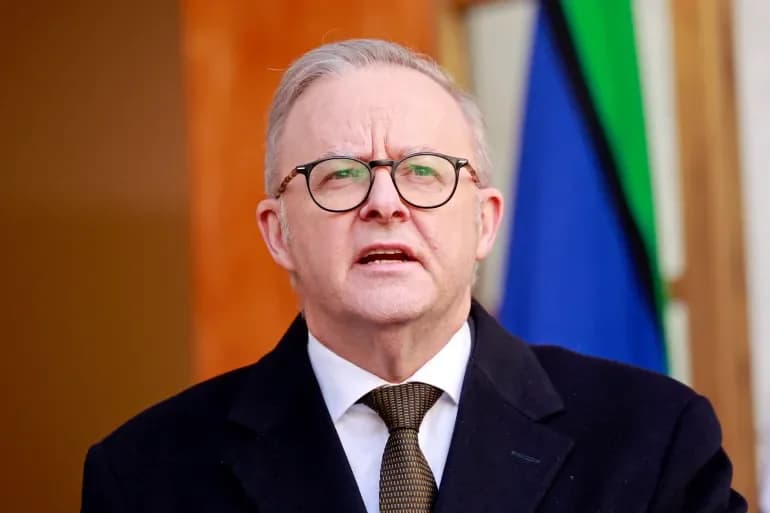
Australia will formally recognise a Palestinian state at the United Nations General Assembly next month, with the condition that Hamas plays no role in its governance. ABC reports that Prime Minister Anthony Albanese announced the decision on Sunday, saying it followed commitments from the Palestinian Authority to recognise Israel’s right to exist, pursue demilitarisation, and hold democratic elections. "Australia will recognise the state of Palestine,” Mr Albanese said. “A two-state solution is humanity’s best hope to break the cycle of violence in the Middle East and to bring an end to the conflict, suffering and starvation in Gaza." The prime minister argued that waiting for a guaranteed peace deal before recognition had become untenable. “The risk of trying is nothing compared to the danger of letting this moment pass us by,” he said. According to the government, the Palestinian Authority has assured Australia that Hamas will have no part in a future Palestinian administration under a peace agreement. Mr Albanese said these assurances were critical to Canberra’s decision. Foreign Minister Penny Wong noted it had been more than 77 years since the world first pledged to establish a Palestinian state. “We can’t keep waiting for the end of a peace process that has ground to a halt,” she said. Israeli Prime Minister Benjamin Netanyahu dismissed Australia’s move as “delusional,” claiming it would not bring peace and accusing Canberra of “falling into a rabbit hole.” Israel’s ambassador to Australia, Amir Maimon, argued the move would “not change the reality on the ground.” “Peace is not achieved through declarations; it is achieved when those who have chosen terror abandon it and when violence and incitement end,” Mr Maimon said. “By recognising a Palestinian state now, Australia elevates the position of Hamas, a group it acknowledges as a terrorist organisation,” he added. Opposition Leader Sussan Ley said the recognition was premature and at odds with the United States, Australia’s “most important ally” in the Middle East. “Until today it has been a bipartisan position that the question of recognising Palestinian statehood should come at the end of the peace negotiation process, not at the start or during it,” she said. “Anthony Albanese has committed Australia to recognising Palestine while hostages remain in tunnels under Gaza and with Hamas still in control of the population of Gaza. Australians all want the war in Gaza to end. Ending this war is the only way to save lives and safeguard a two-state solution. The clear advice of our most important ally is this decision will not expedite that outcome.” “Until today it has been a bipartisan position that Palestinian recognition should come at the end of peace negotiations, not before or during them,” Ms Ley said. Jewish community leaders also condemned the announcement, calling it a “betrayal” of Israeli hostages still held in Gaza. Australia’s shift comes as the UK, France, and Canada also prepare to recognise Palestine at the September UN meeting. France and the UK have set the same condition barring Hamas from governance. The United States remains opposed, with President Donald Trump warning it would be “rewarding Hamas.” As a permanent UN Security Council member, the US can veto Palestine’s admission as a full UN member state. Currently, 147 of 193 UN member states recognise Palestine. But major obstacles remain: Israel opposes Palestinian statehood, Hamas refuses to disarm, and decades of negotiations have failed to produce a two-state solution.



Comments
No comments yet. Be the first to share a thought.