
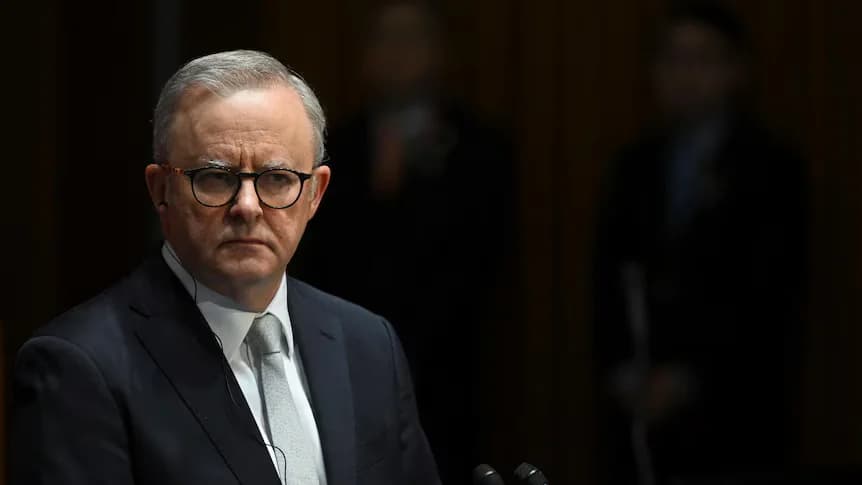
Australian Prime Minister Anthony Albanese has described the ongoing conflict in Gaza as a "humanitarian catastrophe" and reaffirmed Australia’s commitment to a two-state solution, as France prepares to formally recognise a Palestinian state. France's planned recognition, expected later this year, would make it the most influential European nation to do so, and the first among the G7 group of leading economies, according to ABC News. In one of his strongest statements on the war to date, Albanese said the situation in Gaza had "gone beyond the world's worst fears". “Gaza is in the grip of a
Australian Prime Minister Anthony Albanese has described the ongoing conflict in Gaza as a "humanitarian catastrophe" and reaffirmed Australia’s commitment to a two-state solution, as France prepares to formally recognise a Palestinian state. France's planned recognition, expected later this year, would make it the most influential European nation to do so, and the first among the G7 group of leading economies, according to ABC News. In one of his strongest statements on the war to date, Albanese said the situation in Gaza had "gone beyond the world's worst fears". “Gaza is in the grip of a humanitarian catastrophe. Israel's denial of aid and the killing of civilians, including children, seeking access to water and food, cannot be defended or ignored,” he said. “We call on Israel to comply immediately with its obligations under international law.” His comments came after Australia joined 27 other countries in a joint statement earlier this week calling for an immediate end to the conflict; the statement that Israel dismissed as “disconnected from reality,” urging the international community to focus instead on the actions of Hamas. Also Read: Australia Joins 28-Nations Call for Gaza Ceasefire, Condemns Israeli Aid Restrictions Australia does not formally recognise a Palestinian state, but refers to the West Bank and Gaza as the "Occupied Palestinian Territories". Nevertheless, it maintains diplomatic ties with the Palestinian Authority. While Albanese did not directly address France’s move, he reaffirmed Australia’s long-standing position on Palestinian statehood. “Recognising the legitimate aspirations of the Palestinian people for a state of their own has long been a bipartisan position in Australia,” he said. “The reason a two-state solution remains the goal of the international community is because a just and lasting peace depends upon it. “Australia is committed to a future where both the Israeli and Palestinian peoples can live in peace and safety, within secure and internationally recognised borders.” Former Labor minister Ed Husic called on the Australian government to follow France’s example and recognise Palestine. Speaking on ABC’s Afternoon Briefing, Husic said the time had come for Australia to act. “We should move to recognise Palestine now, standing alongside France because there will be a number of countries that will do so,” he said. “The time is now for us to stand and step forward and say we will recognise the State of Palestine now.” In response, Israel’s ambassador to Australia, Amir Maimon, said criticism of Israel was misplaced. “To condemn Israel for defending itself is wrong,” he wrote on X. “It deflects attention from the real perpetrators of this horror: Hamas. Pressure must be placed where it belongs, on Hamas.” Last year also, Australian Foreign Minister Penny Wong suggested that Australia was open to recognising a Palestinian state as part of a broader peace process, rather than at its conclusion. The Australian Coalition criticised Albanese’s comments, accusing him of failing to hold Hamas accountable. “It is disappointing that Prime Minister Albanese’s statement about Gaza once again fails to place any blame on Hamas, a listed terrorist organisation, for the delays in aid reaching the people of Gaza,” said Shadow Foreign Minister Michaelia Cash. “Any moral outrage about the situation in Gaza should be directed at Hamas. Hamas and its allies have tried to disrupt the flow of aid into Gaza and have stolen humanitarian aid for their own purposes.” Hamas has denied those allegations. However, Senator Cash acknowledged that Israel also bears responsibility in facilitating aid. “The Coalition acknowledges that the delay in aid entering Gaza is unacceptable and that the Israeli government needs to urgently work with international bodies to allow aid to flow freely to those that need it,” she said. “However, the right system must be in place so that it can be distributed without Hamas intervening in the process.” Over 140 countries recognize Palestine, but key Western allies including the U.S., U.K., Canada, and Australia, have withheld recognition pending a negotiated peace. France’s decision, however, signals a potential shift among advanced economies.



Comments
No comments yet. Be the first to share a thought.