
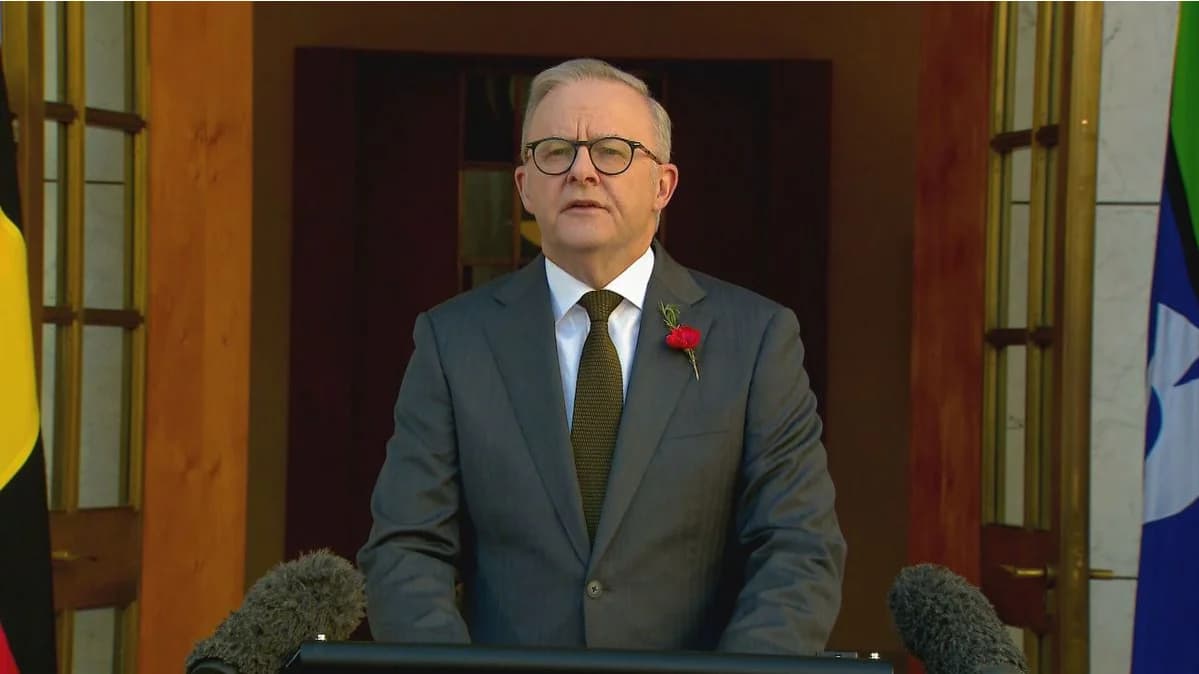
Anthony Albanese has been declared the decisive winner of the fourth and final leaders' debate after a night marked by intense and often personal exchanges on topics like cost of living, housing, and the welcome to country practice, among other key issues. Just six days before the election, Peter Dutton stirred controversy by describing the welcome to country ceremonies as "overdone," while Albanese rebuked the opposition for what he said was a pattern of "chopping and changing" their policies during the campaign. The debate produced some memorable moments, including Dutton referring to Elon
Anthony Albanese has been declared the decisive winner of the fourth and final leaders' debate after a night marked by intense and often personal exchanges on topics like cost of living, housing, and the welcome to country practice, among other key issues. Just six days before the election, Peter Dutton stirred controversy by describing the welcome to country ceremonies as "overdone," while Albanese rebuked the opposition for what he said was a pattern of "chopping and changing" their policies during the campaign. The debate produced some memorable moments, including Dutton referring to Elon Musk as an "evil genius" and Albanese jokingly suggesting that former U.S. President Donald Trump might not even possess a mobile phone. Following the heated exchanges, a panel of 60 undecided voters participating in Channel 7's Final Showdown overwhelmingly awarded the win to Albanese, with 50 percent backing him, compared to 25 percent for Dutton, and the remainder remaining undecided. Although Albanese holds a lead in the polls and is aiming for a majority Labor government, the debate presented Dutton with an opportunity to narrow the gap during the campaign’s final stretch. Yet, with a significant number of early votes already cast, the actual influence of tonight’s event on the election outcome remains uncertain. Hosted by Channel 7, the debate quickly turned personal. Dutton accused Albanese of dishonesty and said he should be "ashamed" of the issues that had developed during his time in office over the past three years. Albanese pushed back, saying that while Dutton could direct personal attacks at him, he would not allow him to "attack the wages of working people." Throughout the evening, major discussions revolved around cost of living pressures, tax, and housing challenges. Breaking down the results topic-by-topic, Albanese led Dutton with a commanding 60 percent to 16 percent margin on the cost of living issue, 49 percent to 21 percent on tax, and a closer 35 percent to 30 percent edge on housing. However, Dutton found stronger support on Indigenous issues, leading Albanese 46 percent to 27 percent in that area. In his opening remarks, Dutton focused sharply on economic management. "This election is all about who can best manage the Australian economy," he said. "If we can manage the economy well, it means we can bring inflation down. It means we can help families with the cost-of-living crisis that this government’s created." He acknowledged that although Australia remains one of the best countries to live in, many families are struggling. "As we've moved around the country, we've spoken to families literally in tears," he added. Albanese, in contrast, emphasized cost of living while highlighting the consistency of Labor’s proposals compared to the Coalition’s shifts. "Australians have a real choice this Saturday to continue building Australia's future or go back to the past," he said. "We know that we live in very uncertain times, and that's why we need certainty. During this campaign, we have put forward clear, decisive policies — the opposition have chopped and changed. Australians deserve certainty. What we will deliver is just that. We will trust in our people. We will value our Australian values, and we'll build Australia's future." Addressing cost of living pressures, Albanese promoted Labor’s plans to reduce costs under the Pharmaceutical Benefits Scheme and childcare services. He pointed out that inflation had fallen from 6 percent to 2.4 percent during his tenure, and noted that interest rates — which had been reduced for the first time in years this March — were beginning to ease. Meanwhile, Dutton leaned on the Coalition’s proposal to cut the fuel excise, although Albanese criticized this move as a short-term fix. Dutton defended the policy, comparing it to temporary relief measures provided during the COVID-19 pandemic, saying it would "give us time to clean up Labor's mess." Both sides have announced major initiatives to tackle the housing crisis, though experts have questioned how effective these plans will ultimately be. Dutton largely blamed escalating housing costs on migration, accusing Labor of mismanaging "every aspect of the migration program." "It looks like a nightmare," Dutton said when discussing the challenge of achieving the Australian dream. "And it's a nightmare because rents have gone up by almost 20 percent, and this Prime Minister has brought in a million people over the course of the last two years through the migration program." Albanese responded that his government was actively addressing the issue rather than just identifying it. "That's why our measures, whether it be increased private rentals through our incentive for build-to-rent programs, or the first home buyers scheme, or whether it be the increased support for social housing — we are concentrating on supply, not just demand, because we know that's the key going forward," he said. Tax While the debate around taxes didn't reveal significant new policies, it sparked the night’s most heated moments. Voters are being presented with a clear choice: a $5 per week tax cut for average earners next year and again the following year, versus an immediate 25 cents per litre reduction in fuel excise. Both leaders defended their positions, but tensions flared when Albanese accused the Coalition of planning to scrap the government's same-job, same-pay measures — a claim Dutton strongly rejected. "That is just not true, Prime Minister. Honestly, this whole campaign, it's hard to believe anything you say," Dutton said, before adding that Albanese "should be ashamed" of the problems during his leadership. Albanese retorted, "Peter can attack me. I tell you what I won't let him do. I won't let him attack the wages of working people." He continued, "I won't let him attack the changes we've put in place for cheaper child care. I won't let him abandon free TAFE so that people can get an opportunity in life. I won't let him get away with this nonsense about economic management. We inherited a deficit of $78 billion. We turned that into a $22 billion surplus." Welcome to Country In the aftermath of the booing incident that disrupted an Anzac Day ceremony in Melbourne, both leaders faced questions about the welcome to country and broader Indigenous issues. Dutton argued the ceremonies had become "overdone," suggesting they should be reserved for significant occasions rather than being performed routinely. "For the opening of parliament, fair enough, it's respectful to do. But for the start of every meeting at work or the start of a football game, I think a lot of Australians think it's overdone and it cheapens the significance of what it was meant to do," he said. "I think a lot of Australians think it's overdone and it cheapens the significance of what it was meant to do. It divides the country." Albanese emphasized that welcome to country ceremonies are about showing respect to Indigenous Australians. "It is up to them and people will have different views and people are entitled to their views, but we have a great privilege from my perspective, of sharing this continent with the oldest continuous culture on earth, and when I welcome international visitors to Parliament House, they want to see that culture," he said. Although Albanese acknowledged the Voice referendum result, he stressed the importance of continuing to consult Indigenous communities on matters affecting them. Both leaders also condemned the neo-Nazi groups that disrupted the Anzac Day ceremony and confirmed they had no plans to change the date of Australia Day. As the conversation shifted toward foreign policy and growing tensions involving China and the U.S., an unusual moment arose when Albanese joked that U.S. President Joe Biden might not have a mobile phone. "I'm not sure that he has a mobile phone, the US president, or Joe Biden," Albanese said when asked whether he texted Trump. "That's not the way it works … with any global leader." Pressed on which country posed the greatest threat to Australia, Dutton directly identified the Chinese Communist Party, whereas Albanese took a more diplomatic stance. Albanese stated that China was "seeking to increase its influence" across the region and characterized Australia's relationship with Beijing as "complex." "I am the prime minister of a country and how you deal as prime minister is diplomatically and that is what we continue to do," he said. Energy policy stood out as one of the most stark differences between the parties, with Labor emphasizing renewable energy investments while the Coalition advocated a pivot toward nuclear energy. It also led to one of Dutton’s strongest attacks on Albanese. "You will wreck the economy and you are doing it now and that is why families are suffering and why 30,000 small businesses have closed under your watch," Dutton charged. Albanese countered that Australia currently has more small businesses operating than ever before. He defended Labor’s energy transition plans, combining renewables, gas, and battery technologies, and criticized Dutton for not visiting the proposed sites for nuclear plants. "Under the former government, 24 out of 28 coal-fired power stations announced their closure so we were way behind," Albanese said. "Nothing was happening in terms of the investment that was needed. Now with renewables, there's been already enough projects approved to power 10 million homes." Dutton maintained that nuclear power is a safe, widely-used technology across most G20 nations. Quick Questions Segment During a rapid-fire question segment late in the debate, both leaders were quizzed on everyday topics. On the price of a half-dozen free-range eggs, Dutton guessed $4.20, falling short as the real price was over $8. Albanese offered a closer estimate, suggesting about $7 "if you can find them." When asked to describe Elon Musk, Dutton labeled him an "evil genius," while Albanese replied simply, "Tesla, and a very rich man."



Comments
No comments yet. Be the first to share a thought.