
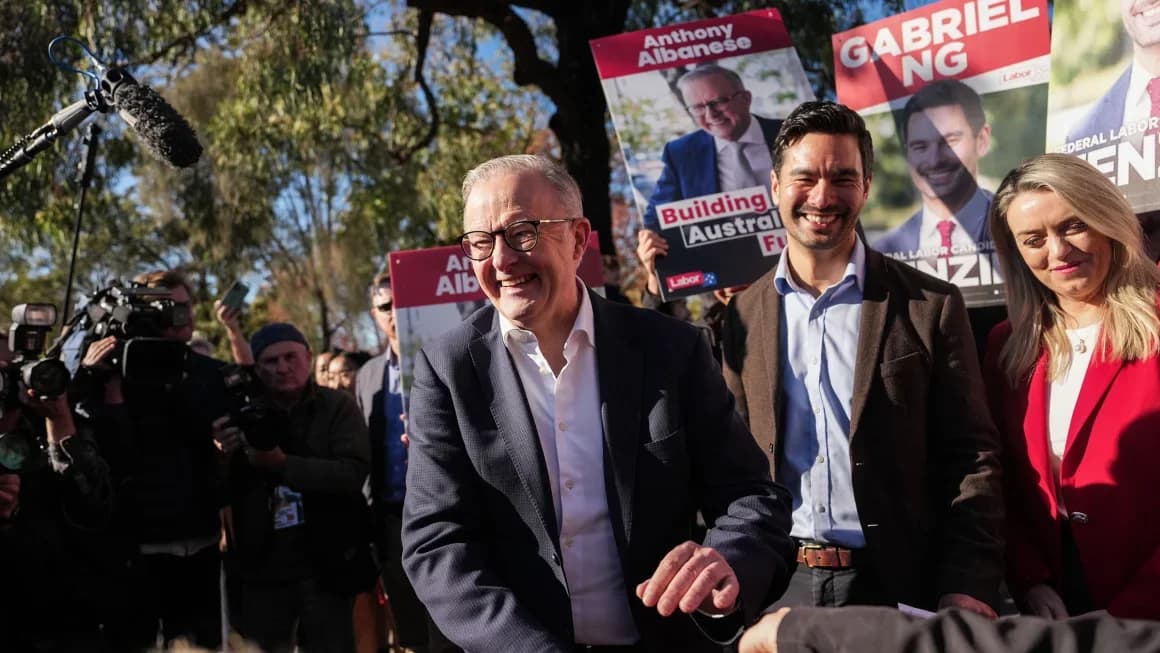
Australian Prime Minister Anthony Albanese has won a second term in office following a decisive electoral defeat for the opposition Liberal Party, as voters opted for stability amidst global uncertainty stirred by the return of former U.S. President Donald Trump. Albanese’s center-left Labor Party appeared poised to secure a parliamentary majority, with early vote counts showing a significant swing in its favor, according to projections from national broadcaster ABC News. Though vote counting was ongoing, the early indicators signaled a commanding performance by Labor. In a stunning upset, L
Australian Prime Minister Anthony Albanese has won a second term in office following a decisive electoral defeat for the opposition Liberal Party, as voters opted for stability amidst global uncertainty stirred by the return of former U.S. President Donald Trump. Albanese’s center-left Labor Party appeared poised to secure a parliamentary majority, with early vote counts showing a significant swing in its favor, according to projections from national broadcaster ABC News. Though vote counting was ongoing, the early indicators signaled a commanding performance by Labor. In a stunning upset, Liberal Party leader Peter Dutton lost his Brisbane-based outer-suburban seat—a constituency he had represented for more than two decades. His loss capped off a punishing night for the conservative veteran who previously held key portfolios in the Coalition government. Dutton had entered the five-week campaign with momentum but failed to maintain it through to election night. Albanese’s re-election marks the first time in twenty years that an Australian Prime Minister has successfully won a second consecutive term, a feat last achieved by John Howard in 2004. The Australian outcome also mirrors Canada’s recent leftward political shift, which saw Mark Carney’s Liberal Party make significant gains. Although Australia has not faced direct threats to its sovereignty in the same way as Canada, recent surveys suggest that Trump’s unpredictable foreign policies and tariffs have eroded Australians’ trust in the U.S. as a reliable ally. Dutton’s campaign, initially strong, faltered due to missteps in policy execution, abrupt reversals, and the broader global impact of Trump’s return to power. Analysts argue that Trump’s destabilizing approach to international relations cast a shadow over Dutton’s prospects. In contrast, Albanese’s Labor Party projected a consistent and composed response to international challenges. The Prime Minister responded firmly to Trump’s surprise announcement on April 2 of a 10% tariff on Australian goods—tariffs which were later suspended. Flanked by his foreign affairs and trade ministers, Albanese held a press conference where he stated, “This is not the act of a friend,” signaling a strong rebuke of the U.S. policy shift. Meanwhile, Dutton struggled to deflect attacks from political opponents who drew parallels between his leadership style and that of Trump. On the domestic front, Albanese’s government has pledged to tackle cost-of-living issues after prolonged high inflation. His policy commitments include delivering tax cuts, providing temporary relief from soaring energy bills, and constructing 1.2 million new homes to address the country’s deepening housing crisis.


Comments
No comments yet. Be the first to share a thought.