
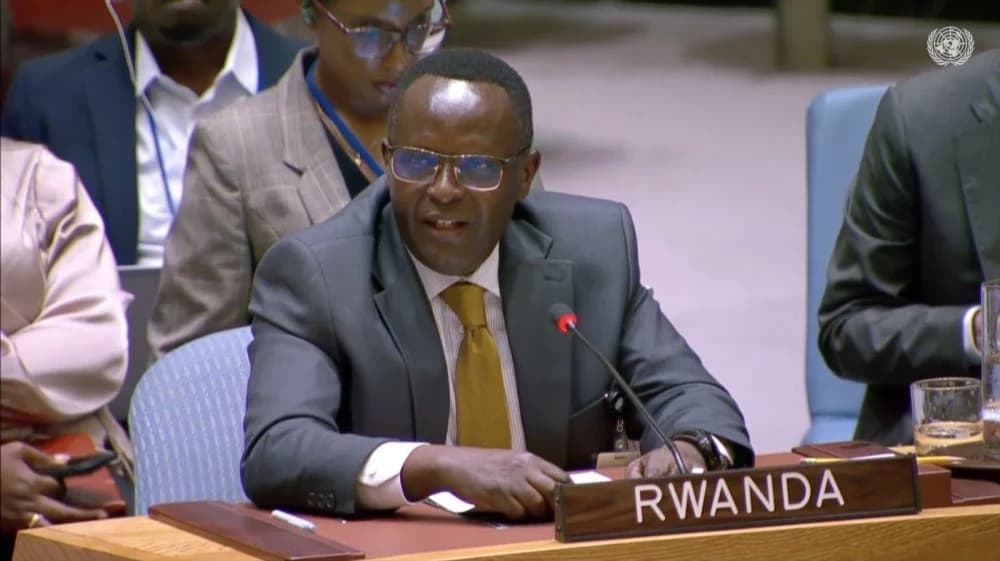
Rwanda’s Permanent Representative to the United Nations, Ambassador Martin Ngoga, has called for a comprehensive review of the UN’s crisis management system, especially in Africa’s Great Lakes Region. He said the UN’s current approach has failed to address the root causes of insecurity and has allowed geopolitical interests to overshadow the organisation’s founding principles of impartiality, justice, and collective security. Speaking during a live discussion on X Space (formerly Twitter) hosted by Intango y’Umurage in collaboration with Hobe Australia , Ambassador Ngoga analysed the topic:
Rwanda’s Permanent Representative to the United Nations, Ambassador Martin Ngoga, has called for a comprehensive review of the UN’s crisis management system, especially in Africa’s Great Lakes Region. He said the UN’s current approach has failed to address the root causes of insecurity and has allowed geopolitical interests to overshadow the organisation’s founding principles of impartiality, justice, and collective security. Speaking during a live discussion on X Space (formerly Twitter) hosted by Intango y’Umurage in collaboration with Hobe Australia , Ambassador Ngoga analysed the topic: “Where Does the United Nations Stand on the Security Crisis in the Great Lakes Region?” Historical Reflection: The UN’s Mandate and Africa’s Place in It Ambassador Ngoga began by recalling the historical context of the United Nations, founded after World War II to prevent future global conflicts. At that time, Africa was still under colonial rule and had little or no role in shaping the UN Charter, which continues to guide the organisation today. Eighty years later, he noted, the UN has grown in membership but not in inclusivity. “The Charter remains largely unchanged,” Ngoga said. “Africa’s absence from permanent decision-making bodies like the Security Council has created an imbalance in global governance where some nations’ voices are heard more than others.” He stressed that lasting peace and stability cannot exist in a system that excludes those most affected by conflict. Rethinking Crisis Intervention in the Great Lakes Region Turning to the Great Lakes Region, Ambassador Ngoga criticised the UN’s crisis intervention model as outdated and reactive rather than preventive and transformative. He cited the United Nations Organization Stabilization Mission in the Democratic Republic of the Congo (MONUSCO) as an example of this stagnation. For nearly three decades, MONUSCO has been mandated to protect civilians and neutralise armed groups, yet insecurity continues to rise. “The mission’s long presence without real progress shows that the model is no longer fit for purpose,” Ngoga said. “A peacekeeping mission should not become permanent it should evolve or leave once it stops achieving results.” He noted that more than 200 armed groups now operate in eastern Congo an alarming sign of local governance failure and international fatigue. The Politics of Selective Engagement Ambassador Ngoga warned that the UN’s credibility is being damaged by selective engagement from powerful member states. In the Great Lakes Region, he said, some countries pursue their own political and economic interests especially in mineral-rich areas while hiding behind humanitarian rhetoric. “When politics and profit outweigh human security, peace becomes an illusion,” he remarked. “The UN must rise above political bargaining and return to its core mission serving humanity, not power.” He added that multilateralism only works when neutrality is upheld and nations resist using global institutions for self-interest. Protection of Civilians and the FDLR Question Addressing the humanitarian crisis in eastern Congo, Ambassador Ngoga expressed deep concern over ongoing attacks on Kinyarwanda-speaking Tutsi communities, mainly by the FDLR a militia made up of remnants of those responsible for the 1994 Genocide against the Tutsi in Rwanda. He warned that ignoring groups like the FDLR endangers lives and fuels genocide ideology and regional instability. “Turning a blind eye to such threats undermines the very principles on which the United Nations was founded,” he said. Ngoga reaffirmed Rwanda’s commitment to peace and cooperation but stressed that lasting stability in the DRC requires addressing root causes, not just symptoms. The Need for Evidence-Based Reporting Ambassador Ngoga also criticised the poor research quality of some UN expert reports, saying many rely on unverified or politically biased information instead of solid field evidence. “Professional investigations should be based on rigorous methods, neutrality, and verifiable data,” he said. “When reports are shaped by incomplete or biased information, they mislead global opinion and weaken genuine peace efforts.” He emphasised that institutional credibility must rest on evidence, not influence. A Call for Institutional Renewal and Shared Responsibility In conclusion, Ambassador Ngoga called for institutional renewal within the UN, including reforms to improve transparency, fairness, and efficiency. He urged the global community to move from rhetoric to action, grounded in equality among nations. Citing the Washington Agreements, he noted that all nations share interconnected economic and security interests. “The Great Lakes Region does not need more statements, it needs consistent, coordinated action,” he said. “A credible United Nations listens, reforms, and responds to the realities of all its members, not just a few.” An Educational Takeaway Ambassador Ngoga’s reflections challenge the international community to face an uncomfortable truth: the structures created in 1945 no longer meet the challenges of 2025. To restore global confidence, the UN must reform transforming from a reactive institution into a proactive, inclusive platform for collective problem-solving. Only through fair representation, shared accountability, and evidence-based engagement can the United Nations remain relevant in promoting peace, security, and dignity for all especially for those whose voices have long gone unheard. By Renatus Murindangabo



Comments
No comments yet. Be the first to share a thought.