

Studies show falling performance in reading, focus and problem-solving across the US and Europe, raising concerns over screen exposure and modern learning environments. For decades, each new generation was expected to outperform the one before it in intelligence and cognitive skills. But a growing body of international research now suggests that this long-standing trend may be slowing and in some cases reversing particularly among Generation Z. Across parts of the United States and Europe, young people have begun scoring lower than previous cohorts on measures of reading comprehension, att
Studies show falling performance in reading, focus and problem-solving across the US and Europe, raising concerns over screen exposure and modern learning environments. For decades, each new generation was expected to outperform the one before it in intelligence and cognitive skills. But a growing body of international research now suggests that this long-standing trend may be slowing and in some cases reversing particularly among Generation Z. Across parts of the United States and Europe, young people have begun scoring lower than previous cohorts on measures of reading comprehension, attention, reasoning, and academic performance, prompting renewed debate among neuroscientists and education experts.

Gen z having fun through taking group selfie together in summer camps
A Reversal of the Flynn Effect
Throughout most of the 20th century, IQ scores steadily increased from one generation to the next, a phenomenon known as the Flynn Effect, attributed to better education, nutrition, and living standards. However, researchers have observed that these gains have plateaued or declined in several developed countries. A major review published in Intelligence confirmed that while IQ rose for much of the last century, the trend has slowed significantly in recent decades, with evidence of reversals in multiple nations. Countries including Norway, Denmark, Finland, France and the UK have reported similar patterns, raising concerns that cognitive development may be shifting in unexpected ways.
Falling Academic Skills in Young People
Beyond IQ testing, international assessments show declines in core academic abilities. The OECD’s PISA evaluations which measure reading, mathematics and science performance among 15-year-olds have documented major drops in learning outcomes in the US and across Europe, especially after 2018. Experts describe the declines as historically significant, with many students struggling more with sustained reading and problem-solving than previous cohorts.
The Screen Time Question
One of the most widely discussed explanations is the rapid expansion of digital technology in everyday life, particularly among young people who have grown up with smartphones, social media and constant online stimulation.

Gen z scrolling through social medias
Neuroscientists warn that excessive screen exposure may affect brain systems involved in: •sustained attention •memory formation •deep reading •critical thinking Research published in Scientific Reports found associations between higher digital media use and reduced cognitive performance in adolescents, although the relationship is complex and influenced by socioeconomic and environmental factors.
Digital Learning in Schools Under Scrutiny
The rise of tablets, laptops and online learning platforms in classrooms has also drawn criticism. Some experts argue that technology, when overused, may replace deeper learning practices such as long-form reading, structured reasoning and face-to-face engagement. Neuroscientist Dr. Jared Cooney Horvath has publicly suggested that modern learning environments may be weakening fundamental cognitive skills, particularly when digital tools are introduced without clear educational structure.
Not a Simple Decline in Intelligence
Despite alarming headlines, researchers caution that this does not necessarily mean Gen Z are “less intelligent” overall.
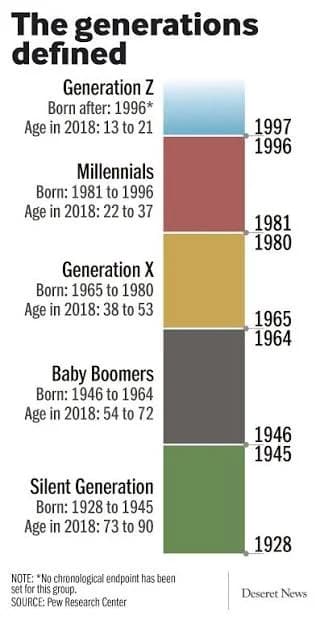
A graph explaining difference between generation and the year each generation started on
Many scientists emphasize that intelligence is multidimensional, and younger generations may be developing strengths in areas not captured by traditional IQ testing, such as: •rapid information processing •digital navigation •adaptive multitasking •visual learning At the same time, critics argue that constant digital stimulation may come at the cost of deep focus and sustained analytical thinking.
Educators and policymakers are now grappling with how to respond.
Some European countries have begun limiting smartphone use in schools, while researchers call for balanced approaches that encourage: •reduced recreational screen exposure •stronger reading habits •more offline learning time
improved attention training in classrooms
The question is no longer whether technology is changing cognition but how societies can ensure that digital life supports, rather than undermines, foundational learning. While the claim that Gen Z is the “first generation less intelligent than Millennials” is not universally proven, reliable evidence shows measurable declines in reading, academic performance and some cognitive outcomes across Western countries. Researchers agree that the trend deserves serious attention particularly as digital environments reshape how young people learn, focus and think. The challenge ahead may not be about blaming a generation, but about rebuilding the conditions that allow cognitive skills to thrive in a screen-dominated world.



Comments
No comments yet. Be the first to share a thought.