
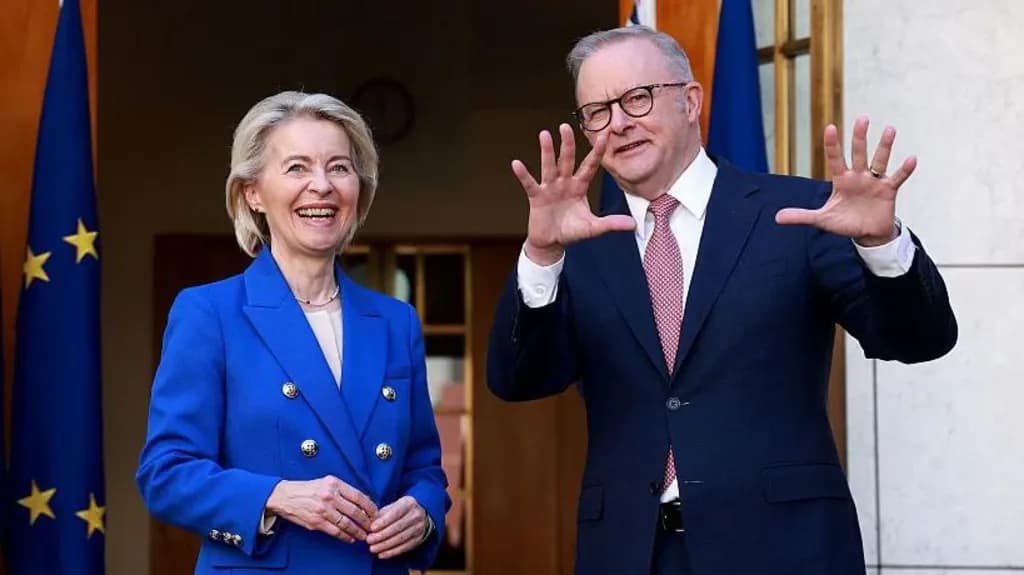
Australia and the European Union have officially sealed a sweeping free trade agreement after eight years of negotiations, marking a significant milestone in global economic cooperation. The deal, valued at around A$10 billion, was signed by Anthony Albanese and Ursula von der Leyen, who both described it as a mutually beneficial breakthrough. At its core, the agreement eliminates nearly all tariffs between Australia and the EU, opening new doors for trade across agriculture, manufacturing, and services. Australian exports such as wine, seafood, dairy, and grains will gain easier access to Eu
Australia and the European Union have officially sealed a sweeping free trade agreement after eight years of negotiations, marking a significant milestone in global economic cooperation. The deal, valued at around A$10 billion, was signed by Anthony Albanese and Ursula von der Leyen, who both described it as a mutually beneficial breakthrough. At its core, the agreement eliminates nearly all tariffs between Australia and the EU, opening new doors for trade across agriculture, manufacturing, and services. Australian exports such as wine, seafood, dairy, and grains will gain easier access to European markets, while consumers in Australia can expect lower prices on European goods like pasta, chocolate, and spirits. One of the most sensitive aspects—food naming rights—was carefully negotiated. Australian producers will still be allowed to use terms like “parmesan,” while the use of “prosecco” for exports will gradually be phased out over the next decade. This reflects the deep cultural and historical ties between Europe and Australia, shaped by generations of migration. Beyond trade, the agreement expands into strategic sectors. Both sides committed to stronger collaboration in defence, counterterrorism, maritime security, and space. There is also a clear focus on critical minerals such as lithium and tungsten—resources increasingly central to global supply chains and clean energy transitions. Von der Leyen emphasized that the deal is about more than economics. In a world marked by geopolitical tensions and shifting alliances, she highlighted the importance of “collective resilience” and trust between partners. Her remarks subtly referenced the growing use of tariffs and supply chain control as geopolitical tools by major powers. However, not all reactions have been positive. Some Australian industry leaders, particularly in the meat sector, expressed disappointment over export quotas, arguing the agreement falls short of expectations and represents a missed opportunity. Overall, the Australia–EU trade deal stands as a forward-looking partnership—balancing economic opportunity with strategic alignment in an increasingly uncertain global landscape.



Comments
No comments yet. Be the first to share a thought.