
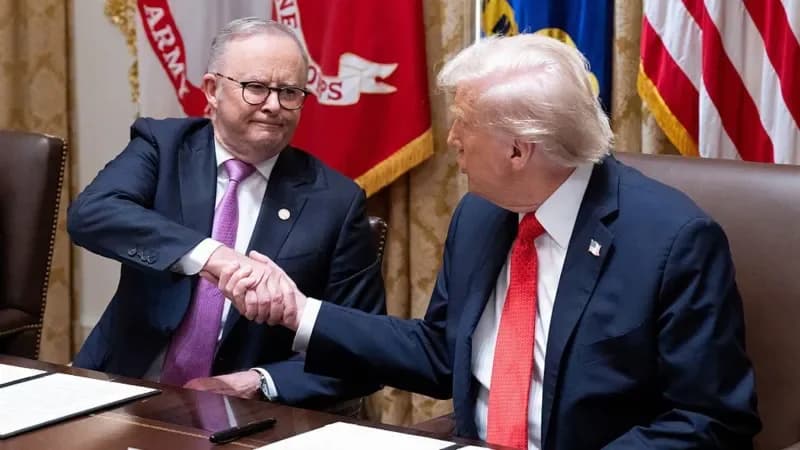
Australia and the United States have signed a new agreement to boost the supply of rare earths and other critical minerals, as Washington seeks to reduce China’s dominance in the global market. The deal was signed on Monday, November 21, during Australian Prime Minister Anthony Albanese’s official visit to Washington. Albanese said the agreement would support a pipeline of $8.5 billion (A$13 billion; £6.3 billion) in “ready-to-go” projects aimed at expanding Australia’s mining and processing capabilities. According to the framework, $1 billion will be invested by both countries in joint pro
Australia and the United States have signed a new agreement to boost the supply of rare earths and other critical minerals, as Washington seeks to reduce China’s dominance in the global market. The deal was signed on Monday, November 21, during Australian Prime Minister Anthony Albanese’s official visit to Washington. Albanese said the agreement would support a pipeline of $8.5 billion (A$13 billion; £6.3 billion) in “ready-to-go” projects aimed at expanding Australia’s mining and processing capabilities. According to the framework, $1 billion will be invested by both countries in joint projects in the U.S. and Australia over the next six months. The two nations have been collaborating on critical minerals since Donald Trump’s first term. Albanese said the latest deal would take their partnership to the “next level.” On Monday, U.S. President Donald Trump also commented on Australia’s multi-billion-dollar submarine pact with the U.S. and U.K.—known as AUKUS, saying it was “full steam ahead.” Earlier this year, the submarine deal came under scrutiny after the Trump administration announced a review to ensure it aligned with its “America First” agenda. This raised concerns that Australia might not be able to purchase U.S.-made submarines to replace its ageing fleet. When asked if Australia would still receive the submarines, Trump replied, “Oh no, they’re getting them.” China currently controls about 70% of rare earth mining and 90% of the processing industry. These materials are essential for products ranging from defense equipment to computer chips and electric vehicles. U.S. companies rely heavily on these resources, leaving them vulnerable as China has recently restricted exports in response to new U.S. tariffs and rising trade tensions. Following the announcement, shares of Australian rare earth companies surged. Arafura Rare Earths, based in Perth, rose by around 7.7%, while Iluka Resources gained more than 3%. Albanese said the new agreement aims to accelerate investment in three key areas, including U.S. investments in Australian processing facilities. The two countries also agreed to cooperate on issues such as pricing, permitting, and government review rules for company and project sales in the sector. The U.S. separately announced plans to invest in building a 100-tonne-per-year advanced gallium refinery in Western Australia and is preparing to offer about $2.2 billion in financing for critical minerals projects through its Export-Import Bank. Ahead of the meeting, shares in Australian firms such as Lynas Rare Earths rose on expectations of greater U.S. backing. Lynas, which previously received a U.S. Defense Department contract, is currently developing a project in Texas. The framework released by the White House contained few details, reflecting the sensitive nature of the discussions. Australia remains a major supplier of critical minerals but, like the U.S., still depends heavily on China—its largest trading partner—for processing the raw materials into usable forms.



Comments
No comments yet. Be the first to share a thought.