
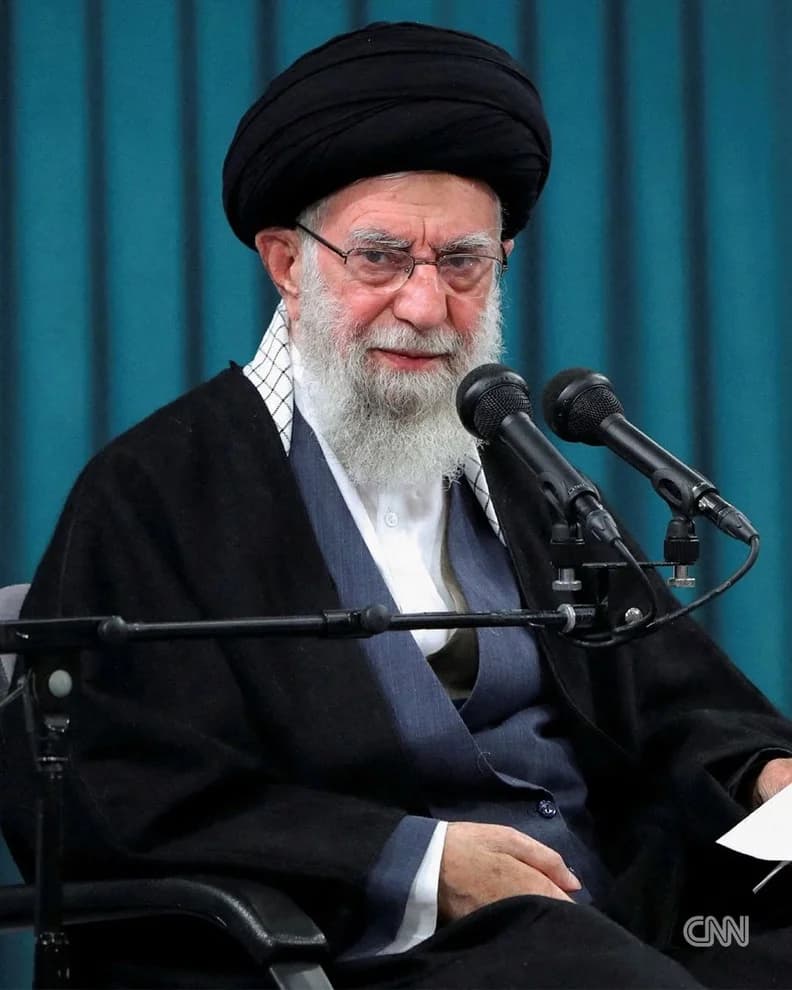
The man who shaped Iran’s political and ideological trajectory for more than three decades is dead. Iranian state media confirmed Sunday that Supreme Leader Ali Khamenei was killed during a wave of coordinated U.S.–Israeli military strikes that began on February 28. He was 86. State television announced that Khamenei had “ reached martyrdom ,” declaring 40 days of national mourning, suspending public institutions and calling for nationwide religious observances. The broadcaster directly blamed the United States and Israel for his death, describing it as an act of aggression against the Islamic
The man who shaped Iran’s political and ideological trajectory for more than three decades is dead. Iranian state media confirmed Sunday that Supreme Leader Ali Khamenei was killed during a wave of coordinated U.S.–Israeli military strikes that began on February 28. He was 86.
State television announced that Khamenei had “reached martyrdom,” declaring 40 days of national mourning, suspending public institutions and calling for nationwide religious observances. The broadcaster directly blamed the United States and Israel for his death, describing it as an act of aggression against the Islamic Republic.
Khamenei, who had ruled Iran since 1989, was not merely a head of state. As Supreme Leader, he wielded ultimate authority over Iran’s armed forces, judiciary, intelligence services and foreign policy. His death in a foreign military operation marks a historic escalation, the killing of a sitting leader whose decisions shaped Middle Eastern geopolitics for a generation.
The strikes, launched jointly by Washington and Jerusalem, targeted military infrastructure and senior leadership sites in Tehran and other cities. U.S. President Donald Trump and Israeli officials said the operation, code-named Operation Epic Fury, aimed to degrade Iran’s missile capabilities and nuclear ambitions. In a social media post hours after the announcement of Khamenei’s death, Trump described the moment as “a great chance for the Iranian people to take back their country,” framing the operation as a blow against authoritarian rule.
Tehran responded within hours, launching missile and drone attacks toward Israel and at U.S. bases across the Gulf. Regional air defense systems were activated as projectiles were intercepted over parts of Qatar, Kuwait and the United Arab Emirates. Casualty figures remain fluid, but the exchange has pushed the region to the edge of sustained conflict.
Inside Iran, the reaction has been complex and deeply polarized.
State-organized crowds gathered in Tehran and Qom, chanting in support of the Islamic Republic and vowing revenge. Yet videos circulating online, difficult to independently verify, appeared to show small groups celebrating quietly in private settings. Many ordinary Iranians, exhausted by economic hardship and sanctions, expressed uncertainty rather than jubilation or rage. (AFP)
That uncertainty is constitutional as well as political.
Under Iran’s constitution, a temporary leadership council composed of the president, the judiciary chief and a senior cleric is expected to assume interim authority. The powerful Assembly of Experts, an 88-member clerical body, must select a new Supreme Leader. Potential successors frequently mentioned by analysts include President Ebrahim Raisi and Khamenei’s son Mojtaba Khamenei, though internal factional rivalries could complicate the process.
The stakes extend beyond symbolism. The Supreme Leader directs Iran’s nuclear strategy, oversees the Islamic Revolutionary Guard Corps, and influences relationships with allied armed groups in Lebanon, Iraq, Yemen and Syria. A leadership transition during open military confrontation could reshape Iran’s regional posture, either hardening it or creating space for recalibration.
International reaction has been swift and sharply divided.
Russia condemned the killing as an “unacceptable act of armed aggression” and warned of destabilizing consequences. The European Union called for immediate de-escalation and urged all sides to prevent further civilian harm. Gulf states expressed alarm over missile exchanges over their airspace, while China called for restraint and a return to diplomatic negotiations.
At the United Nations, diplomats began urgent consultations over whether the killing of a sitting head of state constitutes a violation of international law or an act of war.
For historians, parallels are rare. Assassinations of national leaders by foreign powers have altered the course of regions before, but seldom under the glare of modern global media and nuclear-era tensions. Khamenei’s tenure saw the expansion of Iran’s regional influence, support for proxy networks and prolonged confrontation with Western governments. His death removes a central pillar of that strategy.
Whether it also removes an obstacle to diplomacy, or ignites a wider war, remains unclear.
For now, Iran stands at a crossroads: a theocratic system confronting its most significant leadership rupture since the 1979 revolution, amid active military escalation.
The coming days will determine whether this moment becomes the beginning of internal transformation, regional war, or a volatile mixture of both.
Iran has survived revolution, war and sanctions. It has never before faced all three pressures simultaneously, while burying its Supreme Leader.



Comments
No comments yet. Be the first to share a thought.