
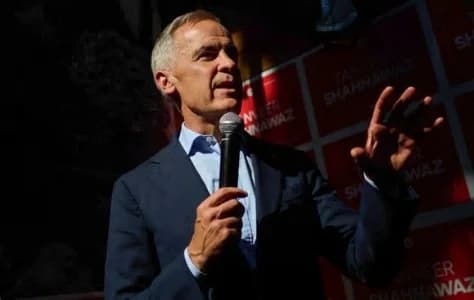
Canada’s Prime Minister Mark Carney has described the latest US tariffs on Canadian goods as a “miscalculation,” accusing Washington of demanding too much while offering too little as trade negotiations between the two countries collapsed. The breakdown has pushed relations between the two long-standing economic partners into a new phase of uncertainty, with Carney warning Canadians that the country is now facing a trade “war” with the United States. Speaking to Canadians on Saturday, Carney said the US had presented unacceptable conditions during negotiations and accused Washington of maki
Canada’s Prime Minister Mark Carney has described the latest US tariffs on Canadian goods as a “miscalculation,” accusing Washington of demanding too much while offering too little as trade negotiations between the two countries collapsed.
The breakdown has pushed relations between the two long-standing economic partners into a new phase of uncertainty, with Carney warning Canadians that the country is now facing a trade “war” with the United States. Speaking to Canadians on Saturday, Carney said the US had presented unacceptable conditions during negotiations and accused Washington of making last-minute changes that undermined efforts to reach an agreement. “They asked too much and they offered too little,” Carney said. The dispute escalated after the United States imposed new
50% tariffs
on a range of Canadian products. The latest measures affect around
$20 billion worth of Canadian imports
, including wine, dairy products, cement, clothing and hockey equipment. The new tariffs come on top of existing US duties on major Canadian exports such as steel, aluminium, automobiles and lumber.
Canada prepares retaliation
Carney said Canada would respond by imposing matching tariffs on selected American goods, describing the move as a reluctant but necessary step to protect Canadian economic interests. The Canadian government plans to introduce the counter-tariffs from
8 September
, with the measures expected to target sectors including steel, dairy products, appliances and electronics. Carney stressed that Canada did not want an escalation but would not accept terms that he believes threaten the country's economic independence. Canadian political leaders from across the political spectrum have largely backed the government's position, highlighting the seriousness of the dispute. Ontario Premier Doug Ford accused US President Donald Trump of being untrustworthy, while British Columbia Premier David Eby warned that Washington's demands could undermine Canada's ability to negotiate trade agreements with other countries. Conservative opposition leader Pierre Poilievre also described the new US tariffs as unjustified.
Washington and Ottawa blame each other
The collapse of the talks has produced competing accounts of what went wrong. Carney said the US demanded restrictions on Canada's ability to negotiate future trade agreements with other countries, conditions he described as unacceptable. US trade representative Jamieson Greer, however, accused Canada of introducing new demands and backing away from commitments that had already been agreed. Greer also said Washington had been prepared to reduce some tariffs as part of a potential agreement, but indicated that the US currently has no plans to resume negotiations.
Economic consequences
The dispute threatens one of the world's most integrated trading relationships. Canada, the United States and Mexico conduct around
$1.6 trillion in annual trilateral trade
, much of it supported by the United States-Mexico-Canada Agreement (USMCA). Carney acknowledged that the collapse of the latest negotiations was “certainly not good news” for the future of the agreement. Canadian provincial leaders have also warned about the potential impact on businesses and workers. Quebec Premier Christine Fréchette said jobs could be lost as the new tariffs begin to affect Canadian industries. The situation is particularly sensitive because the two countries are already involved in a broader review of the USMCA.
A difficult test for Carney
For Carney, the confrontation represents a major test of his government's economic and diplomatic strategy. While Ottawa continues to leave the door open to negotiations, the decision to retaliate signals that Canada is prepared to defend its interests even at the risk of deeper economic tensions with its largest trading partner. For now, there is no clear path back to an agreement. The collapse of the talks has transformed what was expected to be another round of negotiations into a broader confrontation over tariffs, sovereignty and the future of North American trade.



Comments
No comments yet. Be the first to share a thought.