
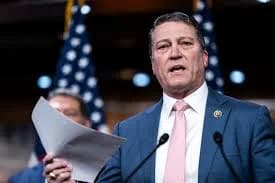
Congressman Ronny Jackson, the special envoy of U.S. President Donald Trump tasked with addressing the security crisis in eastern Congo, has urged the Democratic Republic of the Congo (DRC) government to recognize Congolese citizens in the east as nationals and address the issues that led to the M23 rebel group taking up arms. Dr. Jackson recently visited the Great Lakes region as a special envoy and met with Presidents Paul Kagame of Rwanda, Denis Sassou-N’Guesso of the Republic of Congo, Félix Tshisekedi of the DRC, Evariste Ndayishimiye of Burundi, and Yoweri Museveni of Uganda to discuss
Congressman Ronny Jackson, the special envoy of U.S. President Donald Trump tasked with addressing the security crisis in eastern Congo, has urged the Democratic Republic of the Congo (DRC) government to recognize Congolese citizens in the east as nationals and address the issues that led to the M23 rebel group taking up arms. Dr. Jackson recently visited the Great Lakes region as a special envoy and met with Presidents Paul Kagame of Rwanda, Denis Sassou-N’Guesso of the Republic of Congo, Félix Tshisekedi of the DRC, Evariste Ndayishimiye of Burundi, and Yoweri Museveni of Uganda to discuss ongoing security concerns. Following his visit, which concluded on March 23, Dr. Jackson briefed members of the committee on his observations. In his remarks, he emphasized that eastern DRC requires enhanced security measures and greater international presence. ALSO READ: Three former African Presidents added to DRC peace facilitators’ panel He explained that eastern DRC lacks effective governance, as the national authorities are unable to control the region. As a result, when M23 rebels attempt to seize territory, the national army either flees or joins them. "M23 is the dominant force in this region because they operate without opposition. The Congolese army does not fight; in most cases, its soldiers either flee or join M23," he stated. Dr. Jackson stressed that the Congolese government must address internal issues, particularly the status of Congolese citizens in the east, many of whom, including numerous M23 fighters, are not recognized as nationals. "The Congolese government needs to resolve several serious issues. The primary one is internal, as a large number of Congolese citizens in eastern DRC, including many M23 fighters, are not recognized as Congolese," he said. Dr. Jackson linked this issue to colonial history when Rwanda’s borders were altered, and its land was allocated to the DRC and Uganda, leaving some Rwandans there. "This region was part of Rwanda before the borders changed. When part of it was given to Uganda, those affected quickly received citizenship. This did not happen in the DRC, leaving many people stateless and in distress," he explained. ALSO READ: President Kagame, Tshisekedi meet in Doha to discuss crisis in Eastern DRC To achieve lasting peace in eastern DRC, he suggested integrating M23 fighters into the Congolese army and granting all eastern DRC residents full citizenship with legal rights. "For lasting peace, the Congolese government must integrate M23 fighters into its military and recognize eastern DRC residents as full citizens with legal rights," he stated. Dr. Jackson further emphasized the importance of ensuring that local communities benefit from the region’s natural resources, which are currently being exploited by government officials in collaboration with foreign entities. He also informed his colleagues that Rwanda is concerned about the presence of the FDLR, a DRC-based terrorist group formed by those responsible for the 1994 genocide against the Tutsi in Rwanda. "Rwanda is concerned about the FDLR and the terrorist threat near its border. They have a tourism sector to protect in the northwest. This is a border region with local communities. If mortars and rockets were fired, tourism would be disrupted," he said. Dr. Jackson highlighted the FDLR threat at a time when the group is known to collaborate with the Congolese army and the Wazalendo coalition, a network of armed groups sharing an anti-Tutsi ideology, in their fight against M23 since November 2021. United Nations reports indicate that the Kinshasa government collaborates with the FDLR by providing military equipment, training, and financial support to further its aim of overthrowing the Rwandan government. The genocidal militia’s goal is to forcibly return to Rwanda and continue its extremist agenda.



Comments
No comments yet. Be the first to share a thought.