
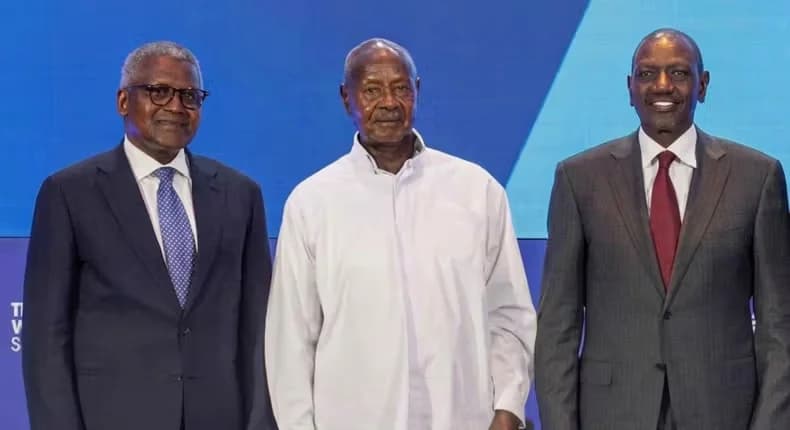
Africa’s richest businessman, Aliko Dangote, has unveiled an ambitious plan to expand his industrial empire into East Africa, proposing the construction of a 650,000 barrels-per-day oil refinery matching the scale of his flagship facility in Nigeria. The announcement was made during the “Africa We Build” summit in Nairobi, where Dangote appeared alongside William Ruto and Yoweri Museveni. The project, he said, would depend heavily on strong policy alignment and long-term commitment from regional governments. “I can give commitment… if they will support the refinery, we’ll build the identical o
Africa’s richest businessman, Aliko Dangote, has unveiled an ambitious plan to expand his industrial empire into East Africa, proposing the construction of a 650,000 barrels-per-day oil refinery matching the scale of his flagship facility in Nigeria. The announcement was made during the “Africa We Build” summit in Nairobi, where Dangote appeared alongside William Ruto and Yoweri Museveni. The project, he said, would depend heavily on strong policy alignment and long-term commitment from regional governments. “I can give commitment… if they will support the refinery, we’ll build the identical one that we have in Nigeria,” Dangote stated, emphasizing that the project could be completed within four to five years if conditions are right. A Regional Energy Game-Changer The proposed refinery would serve a broad regional market including Kenya, Uganda, Tanzania, South Sudan, and the Democratic Republic of Congo. By leveraging shared infrastructure, the project aims to cut costs, boost efficiency, and significantly reduce East Africa’s dependence on imported refined petroleum products. Dangote framed the initiative as part of a broader push to transform Africa’s economic model. “By exporting raw materials and importing finished products, we are impoverishing our population,” he said, calling for a decisive shift toward value addition and industrialisation. His vision builds on the success of the Dangote Refinery, a $20 billion facility that has already begun reshaping energy markets. The refinery is not only meeting domestic demand but also exporting large volumes of refined products, including aviation fuel to Europe positioning Nigeria as an emerging global energy supplier. Strong Political Backing Regional leaders echoed Dangote’s message. President Ruto highlighted Africa’s untapped potential, arguing that the continent has all the ingredients needed for industrial success. “Why would we fail? We have the raw materials, the market, the capital and the industrialists,” Ruto said, revealing that discussions on a shared regional refining model are already underway. President Museveni took an even firmer stance, describing the export of unprocessed resources as “near criminal,” stressing that Africa continues to lose significant economic value by failing to industrialise. Beyond Oil: A Broader Investment Vision The East African refinery proposal is part of Dangote’s wider plan to invest up to $40 billion across multiple sectors by 2030, including petrochemicals, fertiliser, and manufacturing. However, he cautioned that inconsistent government policies remain a major barrier to attracting large-scale investment. “No investor will come without local leadership and domestic commitment,” he warned, urging African governments to take ownership of their development agendas. Dangote also called for improved intra-African mobility, criticizing visa restrictions that hinder trade and business expansion across the continent. “With a European passport, you can move faster in Africa than being an African,” he noted, advocating for visa-free movement to unlock economic potential. Shifting Africa’s Economic Trajectory The proposal comes at a time when Africa’s energy landscape is evolving rapidly. Nigeria’s refining capacity driven largely by Dangote’s operations is already influencing fuel supply dynamics across the continent. In sectors like aviation, the refinery supplies the vast majority of Nigeria’s jet fuel demand, helping stabilise operations despite global disruptions. If realised, the East African refinery would rank among the continent’s most significant cross-border industrial investments. Analysts say it could transform regional trade, strengthen energy security, and accelerate economic integration. More importantly, it signals a growing consensus among African leaders: the future of the continent lies not in exporting raw materials, but in building industries that add value at home.



Comments
No comments yet. Be the first to share a thought.