
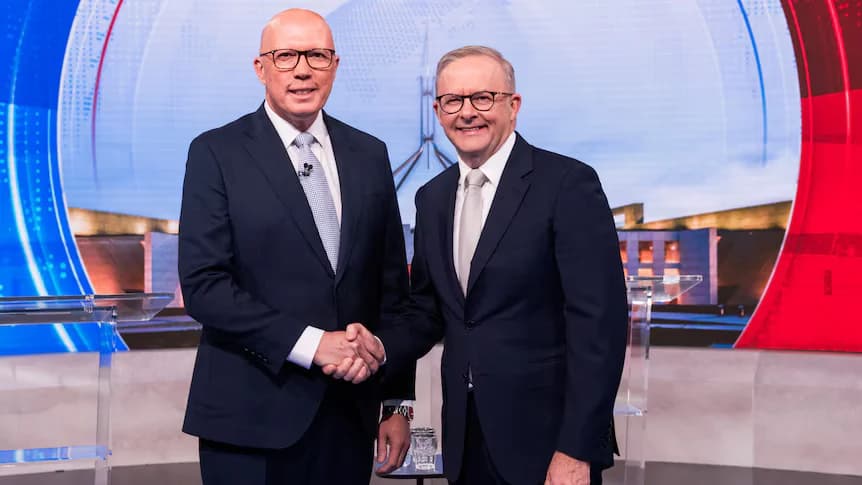
In the third of four federal election debates, Opposition Leader Peter Dutton and Prime Minister Anthony Albanese reiterated unwavering stances on nuclear energy, with both leaders declaring that their positions would remain unchanged regardless of the election outcome. The debate, hosted by the Nine Network, tackled high-stakes issues including energy policy, housing affordability, and foreign affairs, in a discussion often interrupted by moderators for excessive reliance on party “talking points.” The confrontation came at a pivotal moment—the first day of early voting, where hundreds of th
In the third of four federal election debates, Opposition Leader Peter Dutton and Prime Minister Anthony Albanese reiterated unwavering stances on nuclear energy, with both leaders declaring that their positions would remain unchanged regardless of the election outcome. The debate, hosted by the Nine Network, tackled high-stakes issues including energy policy, housing affordability, and foreign affairs, in a discussion often interrupted by moderators for excessive reliance on party “talking points.” The confrontation came at a pivotal moment—the first day of early voting, where hundreds of thousands of Australians headed to the polls. It also marked a return to campaigning after both leaders observed a temporary pause to mourn the death of Pope Francis earlier in the week. "We are committed to nuclear not because it's politically popular," said Mr Dutton. "I haven't committed to nuclear energy for votes. I committed to it because it's in the best interests of our country." He added, as reported by ABC News. Mr Albanese dismissed nuclear energy as economically and practically unviable, stating,
"If nuclear stacked up, there'd be a queue of people saying, 'we think this is a good idea, we're prepared to invest our own dollars'. Instead, taxpayers are going to pay for it… It is a recipe to take us backwards."
The Coalition’s proposal to build government-owned nuclear reactors at an estimated taxpayer cost of $120 billion remained a central point of contention. Mr Dutton claimed his plan would offer more efficient energy generation without overbuilding the grid.
"The only reason people don't invest at the moment is it's against the law… Let's have a mature debate,"
he asserted.
Foreign Policy; Leadership on Trial
In a fiery segment on foreign policy, the debate took a personal turn, with each leader questioning the other's ability to represent Australia on the global stage. Mr Albanese accused Mr Dutton of reckless diplomacy, referencing recent comments made about Indonesia’s president and climate change jokes aimed at Pacific Island nations.
"Every Pacific leader remembers [Mr Dutton] joking about water lapping at their doors. It's not a joke. Climate change is the entry fee to credibility in our region,"
Albanese said. Mr Dutton struck back, labeling Mr Albanese
"a weak leader"
and touting his own international connections.
"I'm very proud of the connections, globally, that I have,"
he said. He further claimed that he could secure a tariff exemption from a potential Trump administration through trade-offs involving critical minerals—an idea Mr Albanese quickly dismissed as "nonsense."
Housing and Economic Strategy
Both leaders pledged no changes to negative gearing or the capital gains tax discount, seeking to quell voter anxiety around property investment and housing affordability. Asked whether he would advise his son to access superannuation to buy a home, Mr Dutton replied:
"If we had this policy in place five years ago, there would have been the option for young Australians to be in home ownership territory."
Mr Albanese signaled openness to working with states to address the impact of short-term rental services like Airbnb, stating he was
"concerned that was part of the impact"
on rental supply. On economic management, Mr Dutton refused to outline full details of his debt reduction plan before the election, stating,
"John Howard didn't outline the budget from opposition… You work through with central agencies in government."
This prompted Mr Albanese to accuse the Coalition of planning secret post-election cuts.
"There will be cuts afterwards, he's just confirmed that, but they won't tell you what they are now. That's just not being fair dinkum,"
he warned.
Early Debates
The first leaders’ debate was held on Sky News Australia, where energy and immigration took center stage. Mr Dutton tried to position himself as a steady hand on national security, while Mr Albanese emphasized a “future-focused” vision rooted in climate responsibility and cost-of-living relief. The second debate, hosted by the ABC, turned combative as the two clashed on Medicare, Indigenous Voice to Parliament, and tax reform. That night, Mr Albanese was widely seen as the steadier performer, while Mr Dutton’s aggression drew both praise and criticism from commentators. With the final debate approaching and the federal election just under two weeks away, both camps are intensifying their push to win over undecided voters. As seen across all three debates, the core battle lines—on energy, leadership, and economic responsibility—remain firmly drawn. In a notable shift from previous debates, the third leaders' debate saw Opposition Leader Peter Dutton declared the winner by Channel Nine’s expert panel, with a 2–1 decision favoring his performance. This outcome suggests a turning point in the campaign dynamics, as Dutton's arguments on energy policy and economic management appeared to resonate more effectively with the panel. The debate's focus on critical issues like the economy, energy policy, and cost-of-living pressures provided a platform for Dutton to challenge Prime Minister Anthony Albanese's record and present his vision for Australia's future.



Comments
No comments yet. Be the first to share a thought.