
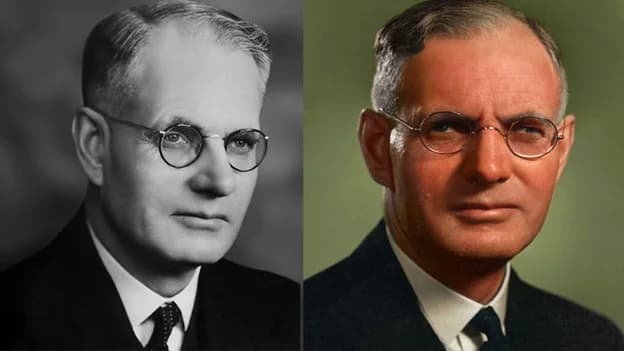
John Curtin's ascent from a working-class youth to Australia's wartime Prime Minister is a testament to resilience, conviction, and leadership. Born on January 8, 1885, in Creswick, Victoria, to Irish immigrant parents, Curtin's early life was marked by hardship. His father, a police constable, retired due to illness when Curtin was five, leading the family through financial instability and frequent relocations. Curtin ended his formal education at 13, taking on various jobs to support his family, including roles as an office boy and estimates clerk. Despite limited schooling, he was an avid r
John Curtin's ascent from a working-class youth to Australia's wartime Prime Minister is a testament to resilience, conviction, and leadership. Born on January 8, 1885, in Creswick, Victoria, to Irish immigrant parents, Curtin's early life was marked by hardship. His father, a police constable, retired due to illness when Curtin was five, leading the family through financial instability and frequent relocations. Curtin ended his formal education at 13, taking on various jobs to support his family, including roles as an office boy and estimates clerk. Despite limited schooling, he was an avid reader and developed a deep interest in politics and social justice. In his youth, Curtin became active in the labor movement, joining the Victorian Socialist Party and the Australian Labor Party. He was known for his anti-imperialist and anti-militarist views, opposing conscription during World War I. In December 1916, Curtin was briefly imprisoned for refusing to attend a compulsory medical examination, a protest against conscription. This act of civil disobedience underscored his commitment to his principles. Curtin's political career progressed as he moved to Perth in 1917 to become the editor of the Westralian Worker, a trade union newspaper. He later served as the state president of the Australian Journalists' Association. His involvement in journalism and union leadership bolstered his reputation as a dedicated advocate for workers' rights. After several unsuccessful attempts, Curtin was elected to the House of Representatives in 1928, representing the Division of Fremantle. Although he lost his seat in 1931, he regained it in 1934. In 1935, Curtin became the leader of the Australian Labor Party, narrowly defeating Frank Forde. His leadership was characterized by a focus on unity and preparation for the challenges ahead. Curtin became Prime Minister on October 7, 1941, during a critical phase of World War II. Just two months into his tenure, Japan entered the war, and Australia faced direct threats. Curtin made the pivotal decision to align Australia's military efforts with the United States, placing Australian forces under the command of General Douglas MacArthur. This strategic alliance was instrumental in defending Australia and contributed to the broader Allied success in the Pacific. Under Curtin's leadership, the Labor Party achieved a significant victory in the 1943 federal election, securing nearly two-thirds of the seats in the House of Representatives: a record for the party. However, the immense pressures of wartime leadership took a toll on his health. Curtin died in office on July 5, 1945, just weeks before the end of World War II. He was succeeded by Frank Forde and is remembered as one of Australia's most esteemed Prime Ministers. John Curtin's journey from a young labor activist to a national leader during one of history's most tumultuous periods exemplifies dedication to public service and unwavering commitment to one's principles. His legacy continues to inspire and is commemorated by institutions such as Curtin University, named in his honor.



Comments
No comments yet. Be the first to share a thought.