
The leaders of the Group of Seven (G7) have issued a joint call for a de-escalation of hostilities in the Middle East, as violence between Israel and Iran enters its sixth consecutive day. In a strongly worded communiqué released late Monday, the G7 nations urged an “immediate ceasefire in Gaza” and expressed “grave concern” over the spiraling conflict. While reaffirming “Israel’s right to defend itself,” the statement also emphasized the group's “unwavering commitment to regional peace and stability.” “Iran is the principal source of regional instability and terror. We have been consistent
The leaders of the Group of Seven (G7) have issued a joint call for a de-escalation of hostilities in the Middle East, as violence between Israel and Iran enters its sixth consecutive day.
In a strongly worded communiqué released late Monday, the G7 nations urged an “immediate ceasefire in Gaza” and expressed “grave concern” over the spiraling conflict. While reaffirming “Israel’s right to defend itself,” the statement also emphasized the group's “unwavering commitment to regional peace and stability.”
“Iran is the principal source of regional instability and terror. We have been consistently clear that Iran must never possess a nuclear weapon,” the statement read.
U.S. President Donald Trump left the summit ahead of schedule, citing the urgent need to return to Washington in light of the crisis. "I have to be back early for obvious reasons," he told reporters. The early departure came as reports confirmed that Israel and Iran had exchanged air and missile strikes for a fifth consecutive day.
President Trump instructed the White House National Security Council to convene immediately upon his return. U.S. Defense Secretary Pete Hegseth later confirmed the deployment of additional American military assets to the region, aimed at reinforcing defensive capabilities.
“This is a precautionary measure to strengthen our posture in the Middle East. We are not seeking escalation,” Hegseth clarified.
While speculation mounted about potential U.S. involvement in Israeli military operations, officials in Washington dismissed claims that America was preparing to join any offensive against Iran.
Since launching a surprise aerial campaign last Thursday, Israel has claimed operational control of large sections of Iranian airspace. The Israeli military said the strikes targeted military and nuclear infrastructure and resulted in the deaths of several senior Iranian commanders and scientists.
However, analysts report that Israel has yet to destroy Iran’s heavily fortified nuclear facilities, such as the underground Fordow enrichment site. Military experts assert that only the U.S. possesses the deep-penetrating bombers required for such a task.
According to the Iranian Health Ministry, at least 224 people have been killed in Iran since the beginning of the Israeli air campaign. In Israel, authorities have reported 24 deaths due to Iranian missile strikes.
President Trump took to his social media platform, Truth Social, to issue a blunt warning to Tehran:
“Simply stated, IRAN CAN NOT HAVE A NUCLEAR WEAPON,” he posted. He also advised residents of the Iranian capital to “immediately evacuate,” without elaborating further.
Earlier reports suggested that President Trump had initially planned to reject the summit’s collective statement on the Iran-Israel conflict. However, after behind-the-scenes negotiations, he ultimately signed off on the final communiqué.
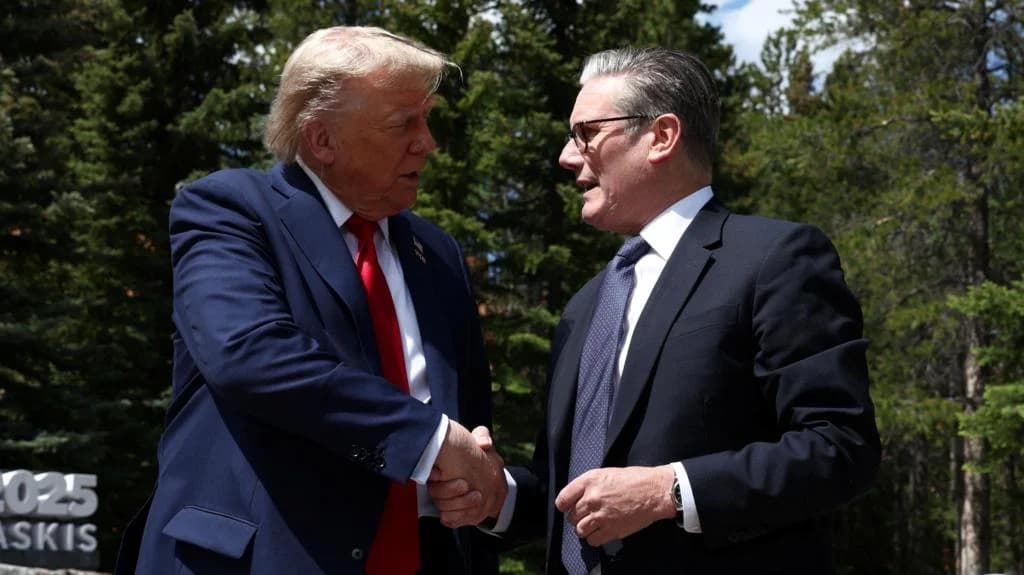
Despite tensions over Middle East policy, the summit produced some diplomatic progress. Trump finalized a new trade agreement with the United Kingdom, easing certain tariffs, and held a bilateral meeting with Canadian Prime Minister Mark Carney, where both sides expressed optimism about resolving ongoing trade disputes within 30 days.
In an unexpected aside, Trump revisited the issue of Russia’s 2014 expulsion from what was formerly the G8. “It was a big mistake,” he said. “Putin speaks to me. He doesn’t speak to anybody else.”
With casualties mounting and diplomatic channels strained, international observers warn that the current trajectory between Israel and Iran could lead to a broader regional war. Though the U.S. has so far emphasized a defensive posture, the situation remains volatile.
The G7 leaders concluded by reaffirming their commitment to diplomacy:
“We call on all actors to exercise maximum restraint and prioritize the safety of civilians across the region.”
source : CNN

Comments
No comments yet. Be the first to share a thought.