
The trial of Christopher Okello Onyum, the man accused of killing four nursery school toddlers in Ggaba on April 2, 2026, has entered a critical phase marked by forensic evidence, contested confessions, and emotional testimony that continues to grip public attention. Okello is accused of murdering four toddlers (Ryan Odeke, Keisha Agenorwoth Otim, Gideon Eteku, and Ignitius Sseruyange) who were aged between one and two-and-a-half years and attending the Ggaba Early Childhood Development Centre in Ggaba, a neighborhood in Makindye Division, Kampala, along the northern shores of Lake Victoria. H
The trial of Christopher Okello Onyum, the man accused of killing four nursery school toddlers in Ggaba on April 2, 2026, has entered a critical phase marked by forensic evidence, contested confessions, and emotional testimony that continues to grip public attention.
Okello is accused of murdering four toddlers (Ryan Odeke, Keisha Agenorwoth Otim, Gideon Eteku, and Ignitius Sseruyange) who were aged between one and two-and-a-half years and attending the Ggaba Early Childhood Development Centre in Ggaba, a neighborhood in Makindye Division, Kampala, along the northern shores of Lake Victoria.
He faces four counts of murder, charges that carry the maximum penalty under Ugandan law.
High Court mobile session in Ggaba
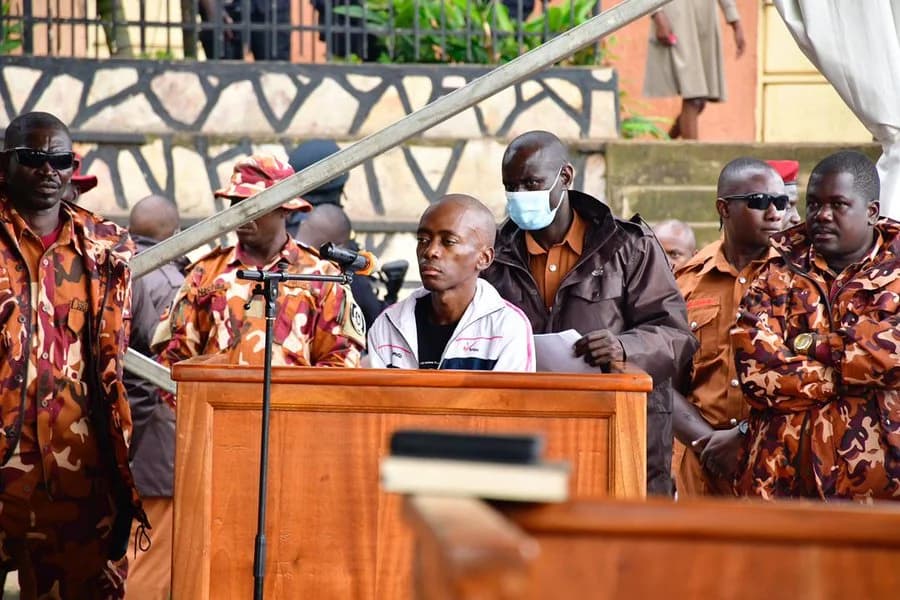
The High Court is hearing the case in a mobile session at Ggaba Community Church, presided over by Justice Alice Komuhangi Khaukha, bringing proceedings closer to the community where the killings occurred.
Okello, who holds Ugandan and American citizenship, is represented by lawyer Richard Kumbuga.
Prosecution closes case after 18 witnesses
The prosecution has closed its case after presenting 18 witnesses, according to court records, building what it says is a strong evidentiary chain linking Okello to the killings.
One of the most significant pieces of evidence is DNA analysis, which reportedly found Okello’s genetic material predominantly on the handle of a black kitchen knife believed to have been used in the attack.
Investigators also told court that Okello had visited the daycare shortly before the incident, allegedly posing as a parent seeking admission for a child.
Alleged motive: ritual beliefs and enrichment claims
A police medical report presented in court indicated that investigators believed Okello may have been driven by a belief in wealth through human sacrifice, with suggestions that he referenced fortune-seeking or enrichment motives.
Prosecutors argue the killings were premeditated, pointing to planning behavior, prior interactions with children in the area, and his presence at the facility on the day of the attack, according to Daily Monitor.
In testimony that deepened the complexity of the case, police surgeon Dr Emmanuel Nuwamanya told the court that during a psychiatric examination conducted on April 7, 2026, Okello disclosed that he had killed his younger brother between 2016 and 2017, claiming at the time that he was "saving him from the troubles of this world."
Okello also reportedly admitted to attempting suicide in 2023 and disclosed a history of mental illness associated with auditory and visual hallucinations between 2016 and 2025." Dr Nuwamanya cautioned, however, that all disclosures were based solely on what the accused told him and could not be independently verified, as Okello presented no medical documents.
Defence: psychological distress and disputed confessions
Okello has denied intentionally killing the children, telling court he was suffering from severe psychological distress in the months leading up to the incident and that he was living in fear and hiding from unknown threats.
His defense team argues that statements allegedly made to police were obtained under pressure and should not be treated as voluntary confessions.
The defense maintains that the prosecution’s case relies heavily on circumstantial evidence and contested statements, and that intent has not been proven beyond reasonable doubt.
Witness testimony and courtroom tension
Prosecution witnesses, including a street child, told court that Okello had previously interacted with children in Ggaba and allegedly asked for help in mobilizing them. The defense has challenged the credibility of such testimony.
Court records show investigators also relied on mobile money transactions and location evidence to reconstruct Okello’s movements before the attack.
The courtroom has been described as tense and emotional, with relatives of the victims attending proceedings as the case unfolds.
From magistrate court to High Court trial
The case was initially handled in Makindye at the magistrate level before being committed to the High Court for full trial.
The mobile court sitting in Ggaba reflects both the gravity of the case and an effort to conduct proceedings closer to the affected community.
The decision to hold the trial in a public community setting was itself controversial. The mobile session followed a directive from President Yoweri Museveni ordering the Judiciary to fast-track proceedings and conduct the trial within the community where the killings occurred.
The Uganda Law Society, in a formal protest note dated April 12, 2026, described the arrangement as a "judicial lynching rally" and alleged that the venue choice followed direct executive pressure rather than a judicial determination, arguing it undermined the accused's constitutional right to a fair trial.
The trial continued despite the protest. Proceedings have been disrupted on multiple occasions, once when Okello told court through his lawyers that he was too unwell to continue, prompting public frustration among attendees, and on another occasion when heavy rain and flooding overtook the makeshift outdoor courtroom, forcing an adjournment.
Public shock and legal stakes
The killings of four toddlers, all aged between one and two-and-a-half years, triggered widespread shock and condemnation across Uganda.
Legal analysts say the central issue before the court is whether the prosecution can prove malice aforethought, a key requirement for a murder conviction.
While DNA evidence and witness testimony form the backbone of the state’s case, the defense continues to dispute intent and the reliability of confessions.
What happens next
With the prosecution case now closed after 18 witnesses, the defense is expected to intensify its challenge to the evidentiary chain as the trial continues.
The court will ultimately determine whether the evidence meets the threshold of guilt beyond reasonable doubt.
The Ggaba daycare killings trial has become a complex legal battle involving forensic evidence, disputed intent, and competing narratives of psychological state and premeditation, with the outcome now dependent on how the court weighs science against contested testimony.



Comments
No comments yet. Be the first to share a thought.