
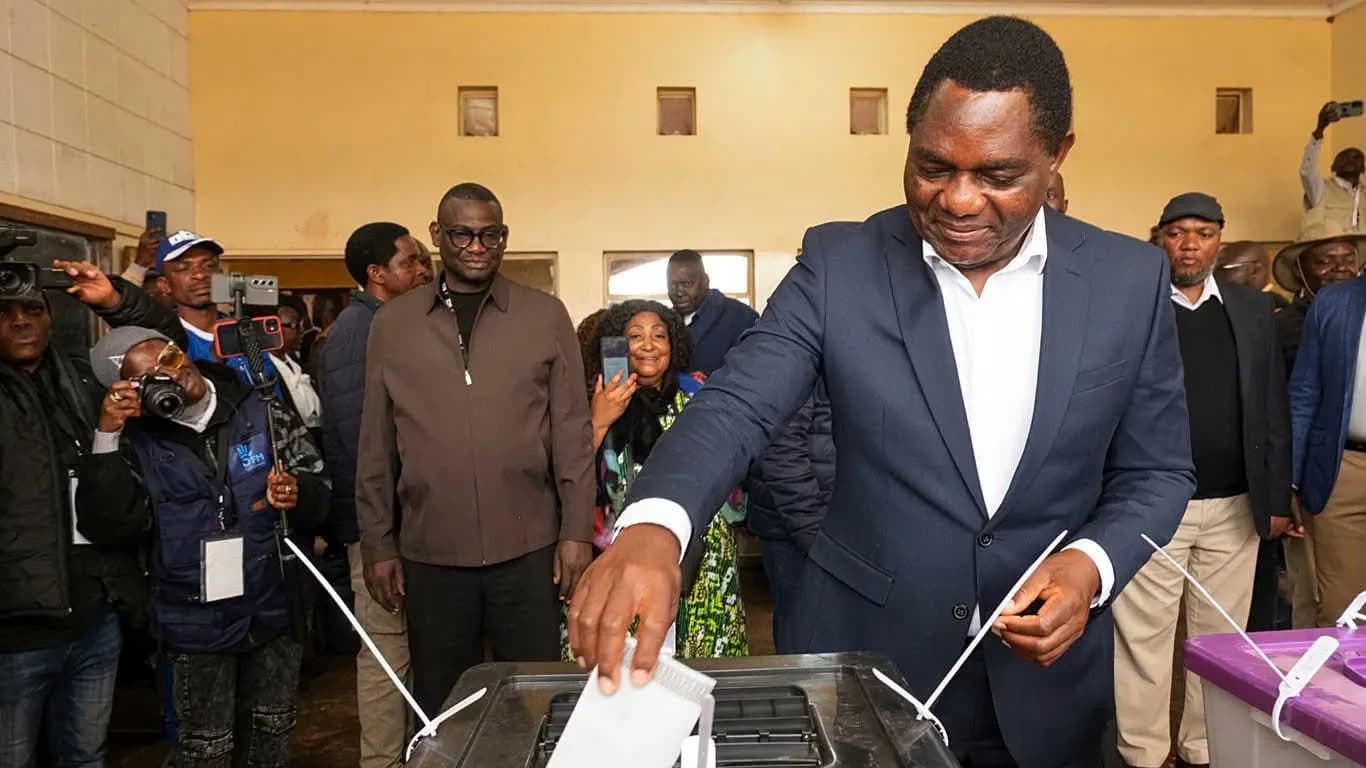
President Hakainde Hichilema has secured a second term in office after winning Zambia’s presidential election with about 60% of the vote, according to the Electoral Commission of Zambia. Hichilema, who first came to power in 2021, defeated 13 other candidates, with his closest challenger, former provincial governor Brian Mundubile, receiving roughly 38% of the vote. The result gives Hichilema another mandate to pursue his economic agenda, but his victory comes against a backdrop of growing debate over the state of political competition and democratic space in Zambia. Opposition parties and
President Hakainde Hichilema has secured a second term in office after winning Zambia’s presidential election with about 60% of the vote, according to the Electoral Commission of Zambia. Hichilema, who first came to power in 2021, defeated 13 other candidates, with his closest challenger, former provincial governor Brian Mundubile, receiving roughly 38% of the vote. The result gives Hichilema another mandate to pursue his economic agenda, but his victory comes against a backdrop of growing debate over the state of political competition and democratic space in Zambia. Opposition parties and civil society groups had raised concerns before the election over restrictions affecting campaigning, arguing that the political environment did not always provide a level playing field for all candidates. Tensions also continued after voting ended. Authorities arrested about 12 people, including senior opposition figures, during a security operation that was followed by reports of gunfire. The government said those detained were suspected of links to armed groups or acts of insurrection connected to the election period. Mundubile’s party rejected the allegations. An economic test for Hichilema’s second term Hichilema’s re-election comes as Zambia continues efforts to recover from years of serious economic difficulties. When he took office in 2021, the country was struggling with debt, economic instability and pressure on public finances. His administration has since made economic recovery and fiscal reforms central to its agenda. The challenge now is to translate those reforms into tangible improvements in the daily lives of ordinary Zambians. Jobs, particularly for young people, the cost of living, investment, public services and the management of Zambia’s debt will remain among the most important issues facing his government. For Hichilema, therefore, winning the election is only the beginning of the next political chapter. The democratic question While the election result provides Hichilema with a fresh mandate, concerns over political competition could remain a major issue during his second term. How his government responds to opposition parties, civil society and criticism will be closely watched, particularly after allegations that political space has narrowed. The credibility of Hichilema’s second term will ultimately depend not only on economic performance, but also on whether Zambia can maintain a political environment in which competing voices can operate freely. Hichilema has won another five-year opportunity to lead Zambia. His biggest challenge now will be turning electoral support into stronger economic results while preserving public confidence in the country’s democratic institutions.



Comments
No comments yet. Be the first to share a thought.