
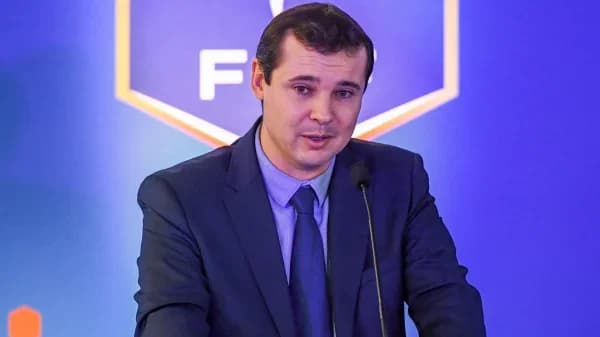
Kevin Lamour’s departure from FIFA may look like another change among the organisation’s senior officials, but the timing has turned it into a much bigger story. Lamour, who served as FIFA’s Managing Director of Daily Operations, left the organisation on August 17, less than three weeks after publicly raising strong concerns about the FIFA Forward Enterprise (FFE) project and the leadership of FIFA President Gianni Infantino. FIFA said the organisation and Lamour had agreed to end their working relationship. It thanked him for his two years of service and wished him well in his future caree
Kevin Lamour’s departure from FIFA may look like another change among the organisation’s senior officials, but the timing has turned it into a much bigger story.
Lamour, who served as FIFA’s Managing Director of Daily Operations, left the organisation on August 17, less than three weeks after publicly raising strong concerns about the FIFA Forward Enterprise (FFE) project and the leadership of FIFA President Gianni Infantino. FIFA said the organisation and Lamour had agreed to end their working relationship. It thanked him for his two years of service and wished him well in his future career. There is no official confirmation that Lamour’s criticism directly caused his departure. But the sequence of events has inevitably drawn attention, particularly because his comments touched some of the most sensitive issues currently facing FIFA.
A senior official challenged the direction of FIFA
Lamour had criticised FFE, a project designed to expand FIFA’s commercial operations, including the management of ticketing and other business activities linked to its competitions. His criticism went beyond questioning the project itself. He described FFE as resembling a “one-man project” and argued that football officials needed to ask whether the organisation was moving in the right direction. Lamour also questioned Infantino’s leadership style, arguing that a president should bring people together and motivate them. Those comments were significant because they came from someone operating within FIFA’s senior management rather than from an external critic. Lamour had joined FIFA in November 2024 after previously serving as Deputy General Secretary of UEFA, giving him considerable experience within European football administration.
The FFE controversy is bigger than one official
Lamour’s departure comes against the backdrop of a wider dispute over FIFA’s commercial ambitions. The FFE project faced resistance from several football confederations after plans emerged for FIFA to sell a 21% stake in the company to private investors. The proposal attracted opposition from organisations including UEFA, CONCACAF and AFC, eventually forcing FIFA to put the plan on hold. That matters because the debate is no longer simply about a commercial project. It raises broader questions about who should control FIFA’s expanding business interests, how major decisions are made and whether commercial expansion is being balanced with FIFA’s traditional responsibility to develop and govern football.
Pressure on Infantino is growing
The timing could hardly be more sensitive for Infantino. FIFA is heading toward its presidential election in March 2027, when Infantino is expected to seek a fourth term. But the political landscape around his leadership has become increasingly complicated. UEFA and CONCACAF have already indicated that they will not support Infantino in the next election, following the controversy surrounding the FFE project. That does not automatically mean Infantino’s position is in danger. FIFA’s presidential elections involve a much wider membership, and political alliances can change considerably before voting takes place. However, the loss of support from major confederations represents an important challenge for a president seeking to extend his leadership. Lamour’s departure therefore arrives at a moment when every dispute inside FIFA is likely to attract greater political attention.
What does Lamour’s exit really tell us?
The most important question is not simply why Lamour has left. It is what his departure tells us about the environment inside FIFA. FIFA maintains that the separation was mutually agreed. Lamour, meanwhile, had already made clear that he was prepared to accept the consequences of speaking about principles he believed in, even if that meant losing his position. That creates an uncomfortable contrast. On one side is an organisation insisting on an agreed departure. On the other is a senior official who had recently challenged both a major commercial initiative and aspects of the president’s leadership. Without stronger evidence, it would be wrong to conclude that one directly caused the other. But the timing makes the episode impossible to separate from the wider debate over Infantino’s leadership.
The bigger battle may be ahead
For Infantino, the immediate challenge is unlikely to be Lamour himself. The bigger challenge will be rebuilding confidence among FIFA’s members and confederations while defending his record ahead of the 2027 election. The FFE controversy has already demonstrated that FIFA’s commercial ambitions can create resistance even among powerful football organisations. Now, the departure of a senior official who publicly questioned the project adds another layer to the debate. For FIFA, the priority will be to show that its decision-making remains institutional, transparent and focused on the interests of football. For Infantino, the coming months will be crucial. The question is no longer simply whether he can secure another term. It is whether he can enter the 2027 election with enough political support and confidence from football’s governing structures to demonstrate that his leadership remains broadly accepted. Lamour’s exit may eventually prove to be an isolated personnel decision. But coming amid the FFE controversy and growing opposition to Infantino, it has become part of a much larger story one about power, commercial influence and the future direction of FIFA.



Comments (2)
Important story. I hope you follow up on what happens next.
A thoughtful read on a complicated topic.