
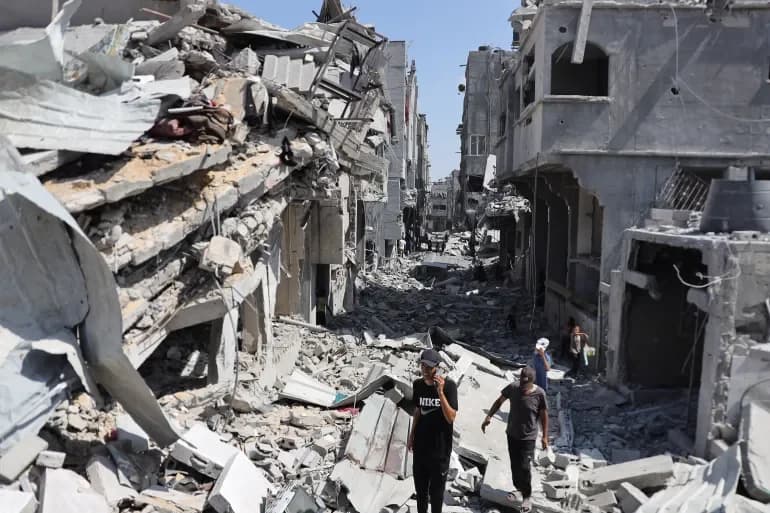
The Israeli military issued fresh evacuation orders and struck high-rise buildings in famine-stricken Gaza City on Saturday, urging Palestinians to flee south as it prepares a new offensive on the city of nearly one million people. According to AP News , aid agencies warned the forced displacement would deepen Gaza’s humanitarian catastrophe. The world’s top hunger watchdog has already classified Gaza City as suffering from famine, a crisis worsened by Israeli restrictions on food shipments. Most families in the territory have already been displaced multiple times during the nearly two-year-
The Israeli military issued fresh evacuation orders and struck high-rise buildings in famine-stricken Gaza City on Saturday, urging Palestinians to flee south as it prepares a new offensive on the city of nearly one million people. According to
AP News
, aid agencies warned the forced displacement would deepen Gaza’s humanitarian catastrophe. The world’s top hunger watchdog has already classified Gaza City as suffering from famine, a crisis worsened by Israeli restrictions on food shipments. Most families in the territory have already been displaced multiple times during the nearly two-year-long Israel-Hamas war. Many say they have nowhere left to go, as previous relocations to so-called humanitarian zones were followed by Israeli bombardments. Others say they are too weak from hunger to move again. Military spokesperson Avichay Adraee said on X that Palestinians should head south to the coastal encampment of Muwasi and parts of Khan Younis, which Israel has declared a “humanitarian zone.” The army circulated a map showing neighborhoods within Khan Younis included in the zone, encompassing Nasser Hospital. That same hospital was hit in an Israeli strike last week that killed 22 people, including five journalists — among them Mariam Dagga, who worked with
The Associated Press.
Adraee said Palestinians could travel from Gaza City to Khan Younis or Muwasi along a designated road without searches. Humanitarian groups, however, warn of dire conditions in Muwasi, including inadequate shelter, food, water and sanitation. Khan Younis, already battered by months of bombardment, lacks basic civilian infrastructure. Israel said it intends to provide field hospitals, food supplies and water pipelines within the new zone.
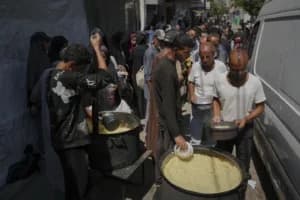
Palestinians line up to receive donated food at a community kitchen in Deir al-Balah, southern Gaza Strip, Saturday, Sept. 6, 2025. (AP Photo/Jehad Alshrafi via AP)
The United Nations announced its staff would remain in Gaza City to continue aid operations, stressing that civilians who evacuate must retain the right to return. “Nowhere is safe across the strip,” said Ayman Abo Saif, a resident of Gaza City. He noted that rents in the south have soared to over $7 a day for just 25 square meters due to the massive influx of displaced families. Israel issued warnings Saturday for two high-rise towers in Gaza City, saying Hamas was operating inside or nearby. Soon after, Adraee confirmed one of the towers had been struck. Defense Minister Israel Katz shared a video of the collapse, writing: “We continue.” The military struck another Gaza City high-rise a day earlier, claiming Hamas used it for surveillance, allegations Hamas denied. The destruction of high-rises is part of Israel’s stepped-up campaign to seize control of Gaza City. The military says it already holds 40% of the northern city. At Shifa Hospital on Saturday, officials counted the dead from Friday’s bombardments: 15 Palestinians, including a family of five killed in the Shati refugee camp. Others died when Israeli gunfire hit civilians seeking aid near the Zikim crossing. According to Gaza’s Health Ministry, more than 2,000 Palestinians have been killed while seeking aid along U.N. routes or at distribution points, many by Israeli fire. The Israeli military did not respond to requests for comment.



Comments
No comments yet. Be the first to share a thought.