
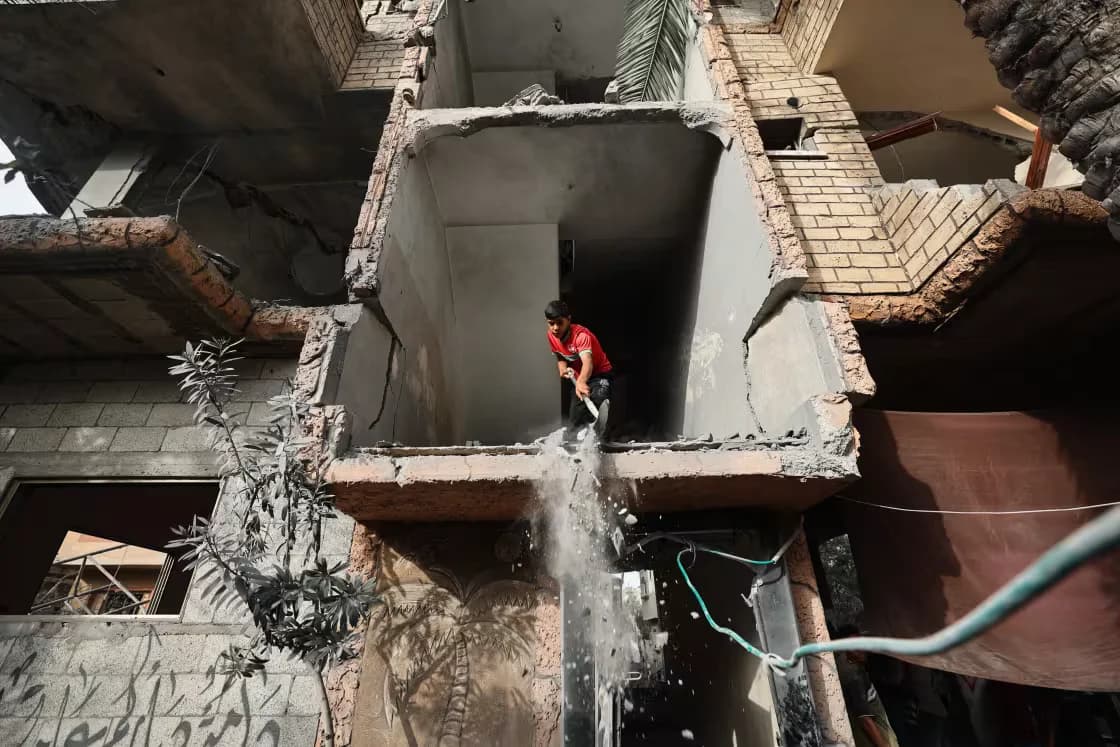
Israeli airstrikes across the Gaza Strip killed at least 103 people from Saturday night into Sunday, according to hospitals and medical sources, as the conflict enters its 20th month with no sign of resolution. In southern Gaza, Nasser Hospital reported over 48 fatalities from strikes in and around Khan Younis, including attacks on homes and tents sheltering displaced civilians. Among the dead were 18 children and 13 women. In the north, airstrikes on homes in Jabaliya refugee camp killed 19 people—mostly women and children—according to Gaza’s health ministry and civil defense forces. The Is
Israeli airstrikes across the Gaza Strip killed at least 103 people from Saturday night into Sunday, according to hospitals and medical sources, as the conflict enters its 20th month with no sign of resolution. In southern Gaza, Nasser Hospital reported over 48 fatalities from strikes in and around Khan Younis, including attacks on homes and tents sheltering displaced civilians. Among the dead were 18 children and 13 women. In the north, airstrikes on homes in Jabaliya refugee camp killed 19 people—mostly women and children—according to Gaza’s health ministry and civil defense forces. The Israeli military has not commented on these latest strikes but maintains that civilian casualties are the result of Hamas operating within populated areas. The attacks come as Israel escalates its military campaign under “Operation Gideon’s Chariots,” which aims to capture more territory, relocate thousands of Palestinians to the south, and exert greater control over aid distribution. Israel says the goal is to pressure Hamas into agreeing to a temporary ceasefire that would secure the release of Israeli hostages without ending the war. Hamas, however, demands a full Israeli withdrawal and a permanent ceasefire. Negotiations mediated in Doha are ongoing, with Prime Minister Benjamin Netanyahu’s office stating that efforts continue to secure the release of the remaining 58 hostages and demilitarize Gaza—terms Hamas has firmly rejected. Israel resumed large-scale military operations after breaking an eight-week ceasefire in mid-March. Since then, it has halted all imports into Gaza, worsening a humanitarian crisis already teetering on the edge of famine. The war began on October 7, 2023, when Hamas-led militants attacked southern Israel, killing 1,200 people and kidnapping 251. Since then, more than 53,000 Palestinians—many of them women and children—have died in Israeli strikes, according to Gaza’s Health Ministry.
ALSO READ:
Israel Claims Killing of Senior Hezbollah Commander in Southern Lebanon Strike
Arab Leaders Urge Ceasefire in Gaza Amid Intensified Israeli Bombardment
In northern Gaza, where infrastructure is largely destroyed, Shifa Hospital reported 43 deaths from multiple strikes, including 15 children and 12 women. The Indonesian Hospital—the region’s last major medical facility—has now shut down due to fighting and an Israeli military siege. It follows the closure of Kamal Adwan and Beit Hanoun hospitals last year after Israeli attacks. Israel says its operations target Hamas infrastructure near medical facilities. However, rights groups and UN experts accuse it of systematically dismantling Gaza’s healthcare system. Central Gaza also saw deadly attacks. In Deir al-Balah, seven people—four women and two children among them—were killed in a strike, while another hit an apartment, killing a family of three. In Nuseirat camp, two civilians were killed in a strike on a home. As the conflict drags on, tensions with Iran-backed Houthi rebels in Yemen have escalated. On Sunday, Israel intercepted a missile fired by the Houthis, who claimed they launched two ballistic missiles, including a hypersonic one, toward Tel Aviv’s main airport. The Israeli military says this is part of ongoing attacks it has responded to by targeting Houthi positions in Yemen. Israel was excluded from a recent U.S.-brokered deal aimed at ending Houthi attacks on American vessels in the Red Sea. In retaliation, it has launched eight strikes on Yemen since the Gaza war began.



Comments
No comments yet. Be the first to share a thought.