
Israel’s security cabinet has approved a plan to take control of Gaza City, Prime Minister Benjamin Netanyahu’s office announced, marking a significant escalation in a 22-month military campaign that has killed tens of thousands of Palestinians, devastated much of the territory, and pushed it to the brink of famine. The Guardian reports that the decision, reached in a late-night meeting that began Thursday and stretched into Friday morning, will still require approval from the full cabinet, which is not expected to meet until Sunday. Netanyahu’s Plan and Military Concerns Ahead of the meet
Israel’s security cabinet has approved a plan to take control of Gaza City, Prime Minister Benjamin Netanyahu’s office announced, marking a significant escalation in a 22-month military campaign that has killed tens of thousands of Palestinians, devastated much of the territory, and pushed it to the brink of famine.
The Guardian
reports that the decision, reached in a late-night meeting that began Thursday and stretched into Friday morning, will still require approval from the full cabinet, which is not expected to meet until Sunday.
Netanyahu’s Plan and Military Concerns
Ahead of the meeting, Netanyahu had declared Israel’s intention to retake control of all of Gaza before transferring governance to “friendly Arab forces” opposed to Hamas. “We intend to, in order to assure our security, remove Hamas there, enable the population to be free of Gaza,” Netanyahu told
Fox News
before the cabinet convened.
“We don’t want to keep it. We want to have a security perimeter… We want to hand it over to Arab forces that will govern it properly without threatening us and giving Gazans a good life.”
The resolution approved by the security cabinet stops short of a full takeover of the entire Gaza Strip, reportedly due to concerns raised by Israel’s top military commander, Lt Gen Eyal Zamir. According to Israeli media, Zamir warned that such an operation could endanger the estimated 20 living hostages still held by Hamas and overextend Israel’s military after nearly two years of fighting across multiple fronts. He also cautioned that occupying Gaza risked drawing Israel into a “black hole” of prolonged insurgency, humanitarian obligations, and heightened threats to hostages.
Scope of the Operation
Israel’s
Channel 12
described the plan as a “limited operation” rather than a full invasion, a framing seen as an attempt to appease wary military leaders. If implemented, the plan would send ground troops into the remaining 25% of Gaza not under Israeli control, displacing an estimated 1 million Palestinians from Gaza City and surrounding areas into evacuation zones in the south. The evacuation deadline is reportedly set for 7 October. Gaza City has endured repeated Israeli bombardments and raids since the war began but remains one of the few areas not converted into a military buffer zone or subjected to permanent evacuation orders. Aid agencies warn that a major ground assault would further cripple humanitarian operations, as most of Gaza’s health infrastructure has been destroyed and the United Nations and other relief organizations face severe restrictions from Israel.
Domestic and International Backlash
The cabinet’s decision has drawn sharp criticism both within Israel and abroad. Former Israeli security officials have denounced the plan as militarily unsound, and opposition leader Yair Lapid warned it would “lead to many other disasters,” including hostage deaths, heavy military casualties, vast economic costs, and “diplomatic bankruptcy.” Families of hostages staged protests outside the security cabinet meeting in Jerusalem on Thursday, fearing the escalation could doom their loved ones. Demonstrations are expected to intensify over the weekend.

Palestinians, who face difficulties in accessing food due to the blockade imposed by Israel, wait to receive hot meals on 7 August. Photograph: Anadolu/Getty Images via The Guardian
International leaders have also voiced concern. British Prime Minister Keir Starmer called the decision “wrong” and urged Israel to reverse course. “This action will do nothing to bring an end to this conflict or to help secure the release of the hostages. It will only bring more bloodshed,” Starmer said in a statement. The UN’s human rights chief, Volker Türk, condemned the plan for a complete military takeover of Gaza, saying it “must be immediately halted.”
Human Cost and Palestinian Reaction
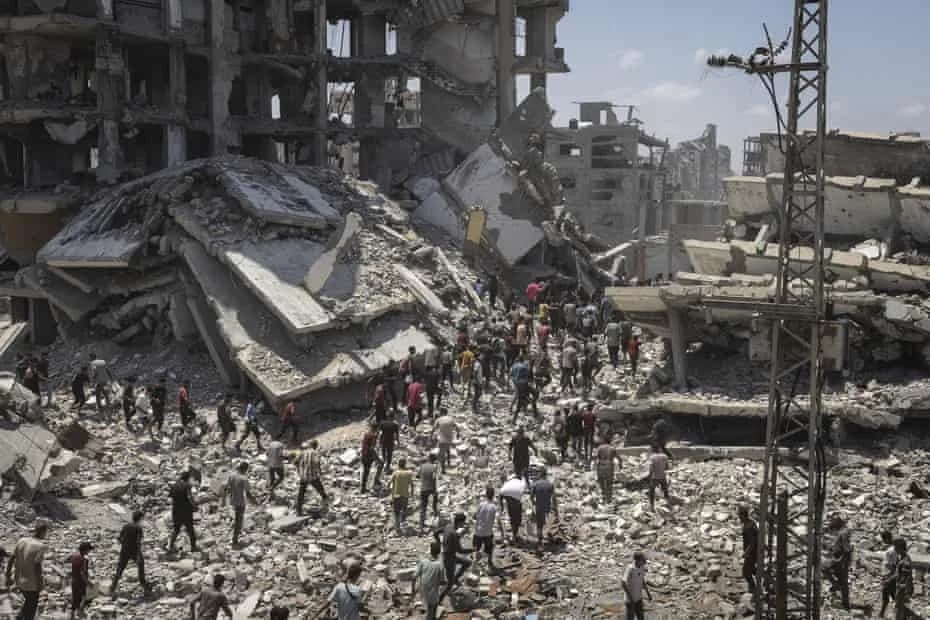
Palestinians, more than 90% of whom have been displaced at least once since the war began, now face the prospect of further upheaval. Nearly one in ten has been injured in Israeli attacks, and the Gaza health ministry says at least 61,000 Palestinians [mostly civilians] have been killed. Thousands more are believed to be buried under rubble, and many have died from war-related deprivation. On Thursday alone, at least 42 Palestinians were killed in Israeli airstrikes and shootings in southern Gaza, according to local hospitals.

Palestinians carry a man who was wounded while rushing to collect humanitarian aid airdropped by parachute into Gaza City on Thursday. Photograph: Jehad Alshrafi/AP via The Guardian
Aya Mohammad, 30, who returned with her family to Gaza City after multiple displacements, voiced her despair:
“Where should we go? We have been displaced and humiliated enough. You know what displacement is? Does the world know? It means your dignity is wiped out, you become a homeless beggar, searching for food, water and medicine.”
For Jaber Abu Odeh, 35, originally from Beit Hanoun but now living in central Gaza, Netanyahu’s proposal signaled more suffering.
“The US is with them, the West is with them, and the world is with them. They have fighter jets from above and an army from below, and from all directions,” he told ABC.
Another resident, Adel Shomali, 40, said the possibility of being uprooted again was crushing.
“It’s enough! The displacement from the beginning of the war until the last ceasefire. We were displaced from Gaza City to the south and then back to Gaza City. There is fear from this situation… God willing, it won’t happen.”



Comments
No comments yet. Be the first to share a thought.