
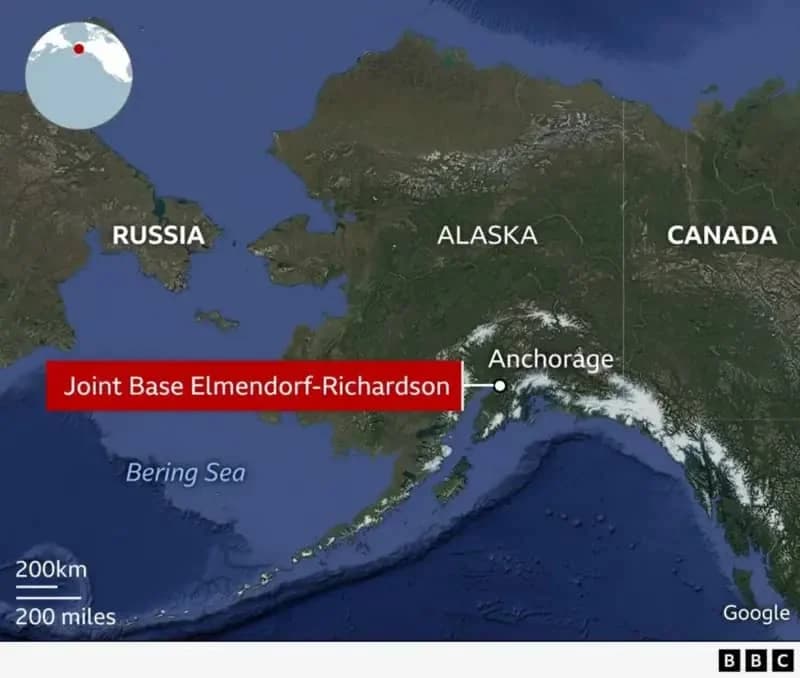
U.S. President Donald Trump and Russian President Vladimir Putin are set to meet for a highly anticipated summit in Alaska on Friday, August 14, at 3:30 p.m. ET, to discuss the war in Ukraine. The location is historically significant: the two leaders will meet on American soil that was once part of Russia. Alaska belonged to Russia until 1867, when it was purchased by the United States. In 1959, it officially became an American state. Russian presidential aide Yuri Ushakov described Alaska as a “logical” place for the summit, given that only the Bering Strait separates the two nations. The m
U.S. President Donald Trump and Russian President Vladimir Putin are set to meet for a highly anticipated summit in Alaska on Friday, August 14, at 3:30 p.m. ET, to discuss the war in Ukraine. The location is historically significant: the two leaders will meet on American soil that was once part of Russia. Alaska belonged to Russia until 1867, when it was purchased by the United States. In 1959, it officially became an American state. Russian presidential aide Yuri Ushakov described Alaska as a “logical” place for the summit, given that only the Bering Strait separates the two nations. The meeting will take place at Joint Base Elmendorf-Richardson, on the outskirts of Anchorage, Alaska’s largest city, located in the southern part of the state. About Alaska Alaska is the largest U.S. state by area—1,723,337 km²—making it bigger than Texas, California, and Montana combined, and ranking as the seventh-largest subnational division in the world. Despite its size, Alaska is the third-least populous and most sparsely populated U.S. state, with an estimated 740,133 residents in 2024 and a population density of just 0.42/km². Most residents live in the south-central region, especially around Anchorage. The state capital is Juneau, accessible only by boat or plane. Geographically, Alaska occupies the far northwest of North America, separated from the rest of the U.S. by Canada. It is bordered by the Arctic Ocean to the north, the Pacific Ocean to the south, and shares a maritime boundary with Russia across the Bering Strait. Before European contact, Alaska was home to many Indigenous peoples, including the Inuit, Aleut, Tlingit, and Athabaskan, who developed rich traditions centered on hunting, fishing, and gathering. Russian explorers arrived in the 18th century, primarily seeking sea otter pelts. The land became known as “Russian America.” By the mid-1800s, however, Russia faced financial difficulties and feared losing Alaska to Britain without compensation. In 1867, the U.S. purchased Alaska from Russia for $7.2 million—about $162 million in today’s value. At the time, critics mocked the deal as “Seward’s Folly,” named after U.S. Secretary of State William H. Seward, who negotiated the purchase. Public opinion shifted after Alaska’s vast resources became apparent. The territory was formally organized on May 11, 1912, and admitted as the 49th U.S. state on January 3, 1959. Alaska’s landscape is strikingly diverse, featuring towering mountains, massive glaciers, deep fjords, and expansive tundra. It is home to Denali, the highest peak in North America at 20,310 feet. Winters can be long and harsh, with parts of the far north experiencing weeks of darkness in winter and continuous daylight in summer. The state is rich in natural resources, including oil, natural gas, gold, copper, zinc, and coal. The gold rush of the late 1800s drew thousands of fortune seekers, and the discovery of oil in Prudhoe Bay in the 20th century led to the construction of the Trans-Alaska Pipeline. Fisheries are also vital to Alaska’s economy, with its waters supplying salmon, crab, halibut, and other seafood to global markets. The state’s forests support a smaller-scale timber industry. Alaska remains deeply connected to its Indigenous heritage, where traditional practices coexist with modern life. It is a haven for outdoor enthusiasts, offering national parks, diverse wildlife such as bears and moose, and spectacular views of the northern lights. Tourism plays a significant role in the economy, attracting visitors for cruises, hiking, fishing, and adventure travel.



Comments
No comments yet. Be the first to share a thought.