
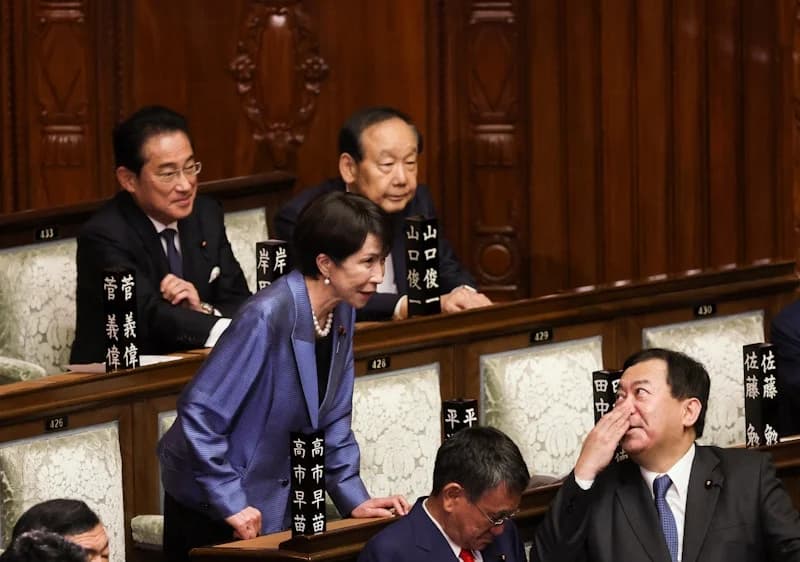
Japan made history on October 21, 2025, when Sanae Takaichi was elected as the country’s first female prime minister, receiving 237 out of 465 votes in parliament. She is expected to meet with the Emperor to formally confirm her appointment. The 64-year-old leader of the Liberal Democratic Party (LDP) won the vote following a new coalition deal between the LDP and the Japan Innovation Party. Her election marks a major milestone in Japan’s political history, as no woman has ever before held the nation’s top office. Born in Nara Prefecture in 1961, Takaichi studied business administration at
Japan made history on October 21, 2025, when Sanae Takaichi was elected as the country’s first female prime minister, receiving 237 out of 465 votes in parliament. She is expected to meet with the Emperor to formally confirm her appointment. The 64-year-old leader of the Liberal Democratic Party (LDP) won the vote following a new coalition deal between the LDP and the Japan Innovation Party. Her election marks a major milestone in Japan’s political history, as no woman has ever before held the nation’s top office. Born in Nara Prefecture in 1961, Takaichi studied business administration at Kobe University before entering politics in the early 1990s. She was first elected to Japan’s House of Representatives in 1993 and has since built a long career in government. Over the years, she has served as Minister of Internal Affairs and Communications, Minister for Science and Technology, and most recently, Minister for Economic Security under former Prime Minister Fumio Kishida. Her steady rise through Japan’s political ranks has made her one of the country’s most experienced and recognizable conservative politicians. Takaichi is often described as a right-leaning, nationalist figure within the LDP. Inspired by former British Prime Minister Margaret Thatcher, she has promoted a strong defense policy and called for revisions to Japan’s pacifist constitution. According to Reuters, she has pledged to strengthen Japan’s Self-Defense Forces and expand security cooperation with allies such as the United States. On domestic issues, she has promised to focus on economic growth, innovation, and national security. Despite her groundbreaking achievement, Takaichi’s political views have drawn both support and criticism. At home, she has faced debate for her conservative stance on family policy, including her opposition to allowing married couples to use separate surnames. Still, many supporters view her as a disciplined and determined leader capable of bringing stability to Japan’s leadership. In her first address to parliament, Takaichi thanked lawmakers for their support and vowed to “serve with responsibility and courage.” She emphasized the need to revive Japan’s economy and defend peace through strength. Her government is expected to face immediate challenges, including managing a slowing economy, rising living costs, and complex regional relations. Takaichi’s election represents both continuity and change for Japan. While the LDP remains firmly in power, her leadership marks a new chapter in a country often criticized for its lack of gender diversity in politics. Sanae Takaichi’s rise to the top of Japanese politics is a moment of historic and symbolic importance. Whether she can meet the high expectations placed upon her will depend on her ability to balance her conservative ideals with practical solutions for Japan’s future.



Comments
No comments yet. Be the first to share a thought.