
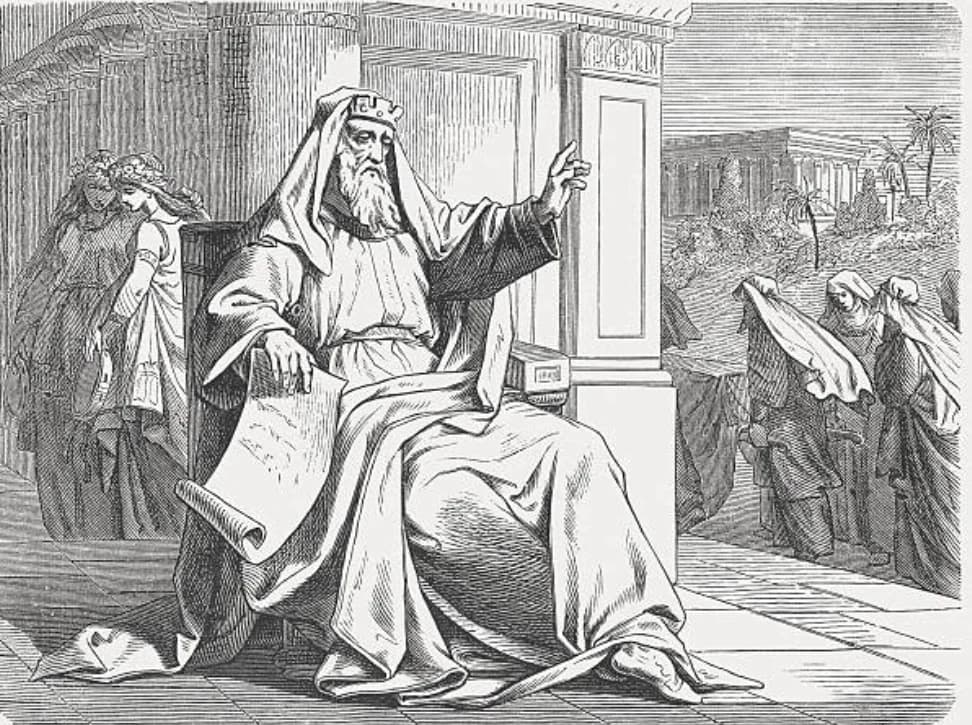
The Reign of King Solomon King Solomon, the son of King David and Bathsheba, is a towering figure in ancient history, renowned for his wisdom, wealth, and the construction of the First Temple in Jerusalem. His reign, which spanned from approximately 970 to 931 BCE, is often considered a golden age for Israel. Solomon's story is chronicled in the Hebrew Bible, where he is depicted as a ruler who brought peace and prosperity to his kingdom. His legendary wisdom is exemplified in the biblical account of the Judgment of Solomon, where he adjudicates a dispute between two women claiming to be the
The Reign of King Solomon
King Solomon, the son of King David and Bathsheba, is a towering figure in ancient history, renowned for his wisdom, wealth, and the construction of the First Temple in Jerusalem. His reign, which spanned from approximately 970 to 931 BCE, is often considered a golden age for Israel. Solomon's story is chronicled in the Hebrew Bible, where he is depicted as a ruler who brought peace and prosperity to his kingdom. His legendary wisdom is exemplified in the biblical account of the Judgment of Solomon, where he adjudicates a dispute between two women claiming to be the mother of the same child. Solomon's contributions extend beyond governance; he is credited with authoring several books of the Bible, including Proverbs, Ecclesiastes, and the Song of Solomon. His interactions with other cultures, especially through his marriage alliances, fostered a period of unprecedented cultural and commercial exchange in Israel. However, his legacy is complex, marked by both his achievements and his eventual departure from monotheistic worship, which led to the kingdom's fragmentation after his death. The Legacy of Solomon in Judaic and Christian Traditions In Judaic tradition, Solomon is revered as the epitome of wisdom and a builder of the faith, whose establishment of the Temple in Jerusalem became the heart of Jewish worship. His rule is seen as a high point in Jewish history, a time of divine favor and earthly success. In Christianity, Solomon's wisdom and his writings are often interpreted as precursors to the teachings of Jesus. The early Christian Church adopted Solomon's wisdom literature as part of their scriptures, finding in his reflections on life and spirituality a timeless resonance. The Ethiopian Connection: Solomon and Sheba A key element of Solomon's legacy that extends into the Rastafari movement is his association with the Queen of Sheba. According to Ethiopian tradition, recounted in the Kebra Nagast, the Queen of Sheba visited Solomon in Jerusalem, and their union resulted in the birth of Menelik I, the first emperor of Ethiopia. This narrative established a dynastic link that Ethiopians believe continued unbroken until the reign of Emperor Haile Selassie I in the 20th century. The Solomonic lineage became a cornerstone of Ethiopian identity and monarchy, intertwining religious legitimacy with royal authority. Solomon's wisdom and the divine favor associated with his reign became integral to the Ethiopian self-conception, particularly in the form of the Ark of the Covenant, which Ethiopians believe was brought to their land by Menelik I. Rastafari: From Ethiopia to Jamaica The Rastafari movement emerged in Jamaica in the 1930s, heavily influenced by the teachings of Marcus Garvey and the coronation of Haile Selassie I as Emperor of Ethiopia in 1930. Rastafarians view Selassie as the second coming of Christ and a direct descendant of King Solomon and the Queen of Sheba, fulfilling a prophecy of a black king who would deliver African-descended people from oppression. Rastafari theology, deeply intertwined with the Bible, sees the story of Solomon as a vital link in the chain of African spiritual heritage. Solomon's wisdom and his connection to Ethiopia are seen as symbols of divine guidance and righteousness. The movement’s reverence for Haile Selassie as a living embodiment of this heritage underscores the enduring influence of Solomon’s legacy. King Solomon's Influence on Rastafari Culture and Beliefs Within Rastafari, King Solomon’s legacy is more than historical—it is profoundly spiritual and symbolic. Solomon’s wisdom is reflected in the Rastafarian emphasis on "overstanding" (a deeper level of understanding), spirituality, and living in harmony with nature. The construction of the Temple of Jerusalem by Solomon symbolizes the building of a righteous life and community, a key tenet in Rastafari practice. Rastafarians also draw inspiration from Solomon’s writings, particularly the Song of Solomon, which they interpret as a celebration of African beauty and spirituality. The biblical narrative of Solomon’s reign, marked by peace and prosperity, resonates with Rastafarian ideals of creating a just and harmonious world. Solomon’s Symbols in Rastafari Iconography The lion, often associated with Solomon and the tribe of Judah, is a prominent symbol in Rastafarian culture, representing strength, courage, and the lineage of Haile Selassie. The concept of Zion, a utopian ideal rooted in Solomon’s Jerusalem, is central to Rastafarian aspirations for a spiritual homeland, contrasting with the Babylon they perceive in modern, oppressive societies. The Solomonic seal, or the Star of David, is another powerful emblem within Rastafari, symbolizing the divine connection and the unity of heaven and earth. This iconography serves as a reminder of Solomon's enduring wisdom and the divine promise associated with his reign. Conclusion: The Timeless Legacy of King Solomon King Solomon’s influence transcends time and geography, weaving through the fabric of various cultures and spiritual movements. For the Rastafari, Solomon is not merely a figure of ancient history but a living symbol of divine wisdom, African heritage, and the eternal quest for justice and righteousness. As the Rastafari movement continues to grow and evolve, the legacy of King Solomon remains a guiding light, illuminating the path toward spiritual fulfillment and cultural pride. In Solomon’s story, Rastafarians find a powerful narrative of wisdom, heritage, and hope—a narrative that continues to inspire and resonate across generations.



Comments
No comments yet. Be the first to share a thought.