
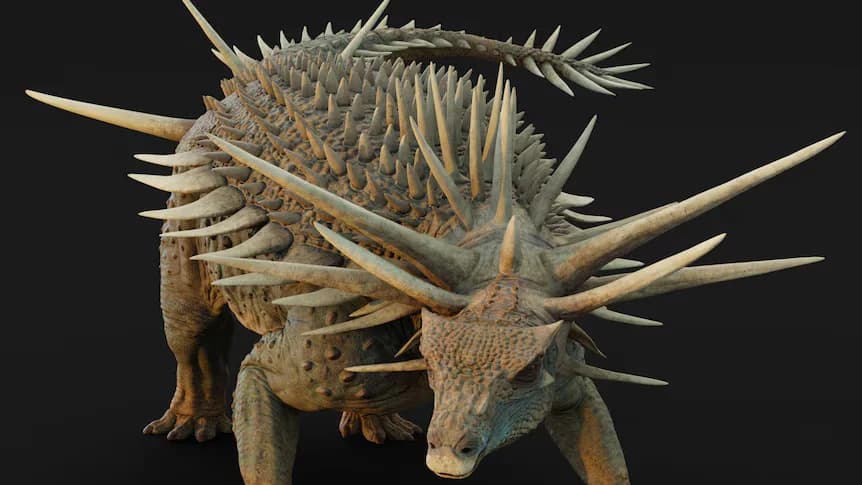
Around 165 million years ago, in what is now Morocco, a heavily armoured dinosaur roamed the Jurassic landscape, sporting some of the most elaborate defences ever seen in the fossil record. The dinosaur, named Spicomellus, stretched about four metres in length, weighed roughly a ton, and was covered in extravagant metre-long spikes. Researchers say its appearance was unlike that of any other animal, past or present. “The armour of Spicomellus is jaw-droppingly weird, unlike that of any other dinosaur; or any other animal alive or dead, that we’ve ever discovered,” said Richard Butler, a vert
Around 165 million years ago, in what is now Morocco, a heavily armoured dinosaur roamed the Jurassic landscape, sporting some of the most elaborate defences ever seen in the fossil record. The dinosaur, named Spicomellus, stretched about four metres in length, weighed roughly a ton, and was covered in extravagant metre-long spikes. Researchers say its appearance was unlike that of any other animal, past or present. “The armour of Spicomellus is jaw-droppingly weird, unlike that of any other dinosaur; or any other animal alive or dead, that we’ve ever discovered,” said Richard Butler, a vertebrate palaeontologist and co-leader of the research team. The species was first identified in 2021 from a single rib fragment. According to ABC News, new partial fossils have been unearthed in Morocco’s Atlas Mountains near Boulemane, and have given palaeontologists a far clearer picture of the creature. Although the skull remains missing, the specimens reveal a striking anatomy. According to the scientists’ description, Spicomellus had a bony collar ringed with plates and four enormous spikes projecting from its neck, including one measuring 87 centimetres. Additional spikes covered its back, with two large protrusions above the hips. “It had spines the length of golf clubs sticking out in a collar around its neck,” Professor Butler explained. Scientists believe the dinosaur’s armour was partly defensive but argue its sheer scale suggests other purposes. “The armour surely had some defensive function, but it’s difficult to imagine how the metre-long spikes around the neck were used for defence. They seem like enormous overkill,” Butler said. Susannah Maidment, who led the study, suggested the structures may have been used in mating rituals or territorial displays. “In living animals, structures that seem to serve no obvious defensive function — like a deer’s antlers or a peacock’s tail — are usually linked to courtship,” Maidment noted. “Spicomellus’ armour is totally impractical and would have been a nuisance in dense vegetation, so we think it is possible the animal evolved such elaborate armour for display, perhaps to do with mating.” The scientists has now identified Spicomellus as the oldest-known member of the ankylosaurs; a group of slow-moving, plant-eating dinosaurs famed for their tank-like armour. The research indicates that Ankylosaurs, walked on four legs and thrived until the mass extinction event 66 million years ago, and are considered among the most successful herbivores of the dinosaur age. They were closely related to stegosaurs, another armoured group, though unlike stegosaurs with their plate-covered backs and spiky tails, ankylosaurs evolved different defensive strategies, including the iconic tail club of Ankylosaurus. Ankylosaurus itself was far larger than Spicomellus, growing up to eight metres long in North America and using its armour and clubbed tail to fend off predators like Tyrannosaurus rex. The Moroccan discovery has challenged assumptions about how ankylosaur armour evolved. Early members of dinosaur groups are typically less ornate than their later descendants. In contrast,scientists say Spicomellus displays some of the most elaborate defensive and display features ever recorded. “The armour of Spicomellus is much more elaborate than that of later ankylosaurs, and no later ankylosaurs have spiky ribs,” Butler said. “What is surprising to us is that the most elaborate ankylosaur armour of all time is present in the oldest member of the group. “Perhaps the simpler armour in later species reflects a shift towards a primarily defensive role, as predation pressure increased in the Cretaceous when predators grew exceptionally large.” For scientists, the bizarre Moroccan dinosaur is more than just a curiosity. Its discovery is reshaping ideas about how some of the most famous dinosaur families evolved, and why some of their strangest features may have existed at all.



Comments
No comments yet. Be the first to share a thought.