
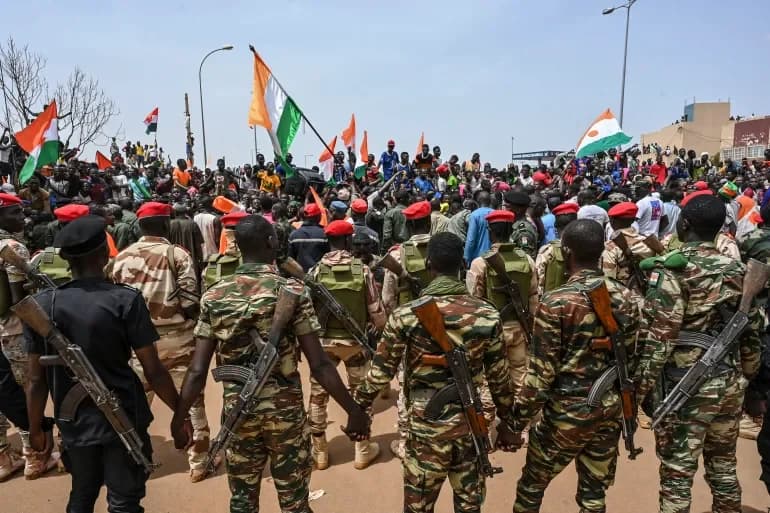
Niger’s military government has contained an attempted mutiny in the capital, Niamey, but the unrest has exposed growing tensions within the country’s armed forces and highlighted Russia’s expanding role in Niger’s security affairs. The mutiny began on Saturday at Base 101, a military installation at Diori Hamani International Airport, before fighting spread to other sensitive locations, including areas near the presidential palace and the state broadcaster. Niger’s army said it eventually regained control of the base after several hours of fighting. State media reported that dozens of soldi
Niger’s military government has contained an attempted mutiny in the capital, Niamey, but the unrest has exposed growing tensions within the country’s armed forces and highlighted Russia’s expanding role in Niger’s security affairs. The mutiny began on Saturday at Base 101, a military installation at Diori Hamani International Airport, before fighting spread to other sensitive locations, including areas near the presidential palace and the state broadcaster. Niger’s army said it eventually regained control of the base after several hours of fighting. State media reported that dozens of soldiers were killed or arrested, although the figures could not be independently verified. The crisis also brought Russian military personnel into a more visible role. Russia’s Africa Corps, a force operating under the Russian Ministry of Defence, supported Nigerien government forces in efforts to suppress the uprising. Russia’s ambassador to Niger, Viktor Voropaev, said the Nigerien authorities had requested Russian assistance to neutralise the mutineers. The Associated Press reported that Africa Corps provided both ground and aerial support as government forces worked to retake the military base. The intervention is significant because it showed Russia supporting Niger’s military government not only against armed groups operating in the country, but also during an internal challenge from members of Niger’s own armed forces. The exact motives and scale of the mutiny remain unclear. However, analysts and security sources have linked the unrest to frustration over worsening insecurity and heavy military losses. Niger has been battling armed groups affiliated with al-Qaeda and ISIL, particularly in the western part of the country. The army has suffered repeated casualties as it confronts these groups. The unrest therefore comes against the same security backdrop that helped bring General Abdourahamane Tiani and other officers to power in a July 2023 coup. They accused the elected government of failing to protect the country and promised to improve security. Three years later, however, armed groups remain active and continue to put pressure on Niger’s military. Russia’s growing involvement reflects a major shift in Niger’s foreign and security partnerships since the coup. The military government pushed French forces out of the country, while the United States later withdrew its forces from Base 101 and other military installations. Niger has instead moved closer to Russia and strengthened cooperation with Mali and Burkina Faso through the Alliance of Sahel States. Africa Corps took over much of the role previously associated with the Wagner Group following the reorganisation of Russia’s African operations after Wagner leader Yevgeny Prigozhin’s death in 2023. The force includes former Wagner personnel but operates under Russian state control. According to the Associated Press, between 200 and 300 Africa Corps personnel are stationed in Niger, including at Base 101. The mutiny also saw support from other foreign partners. Niger’s presidential office said Algeria provided military assistance, while Reuters reported that Algeria sent fighter jets, a transport aircraft and a refuelling tanker. The Alliance of Sahel States backed Niger’s military government politically, while Türkiye expressed solidarity and called for restraint. It remained unclear whether Mali or Burkina Faso provided direct military assistance. For Russia, the events in Niamey demonstrate the practical value of its expanding security relationship with Niger. When the military government faced an armed challenge from within its own forces, Russian personnel were already present and available to provide support. However, the intervention does not mean Russia controls Niger’s armed forces, nor does it demonstrate that Africa Corps can solve the country’s broader security crisis. Armed groups linked to al-Qaeda and ISIL remain active, while Nigerien soldiers continue to face heavy losses. The mutiny has therefore exposed a difficult contradiction for Niger’s military government: it came to power promising greater security and sovereignty, yet the country continues to face persistent armed attacks and now an internal challenge within its own military. For Russia, meanwhile, the episode shows how significantly Niger’s security architecture has changed since the 2023 coup — from one heavily dependent on Western military partners to one in which Russian forces now have a visible supporting role.



Comments
No comments yet. Be the first to share a thought.