

Members of the Tutsi community originally from eastern Democratic Republic of Congo have organised a protest in Canberra, Australia, on 29 May 2026, accusing the Congolese government of failing to protect them from killings and persecution targeting their community in eastern DRC. The demonstration is being organised under the banner of two community bodies, the Banyamulenge Congolese Community of Australia (BCCA) and the Kinyarwanda Speaking Congolese Community (KSCC), and targets the diplomatic quarter of the Australian capital, where protesters plan to deliver their message directly to emba
Members of the Tutsi community originally from eastern Democratic Republic of Congo have organised a protest in Canberra, Australia, on 29 May 2026, accusing the Congolese government of failing to protect them from killings and persecution targeting their community in eastern DRC.
The demonstration is being organised under the banner of two community bodies, the Banyamulenge Congolese Community of Australia (BCCA) and the Kinyarwanda Speaking Congolese Community (KSCC), and targets the diplomatic quarter of the Australian capital, where protesters plan to deliver their message directly to embassies.
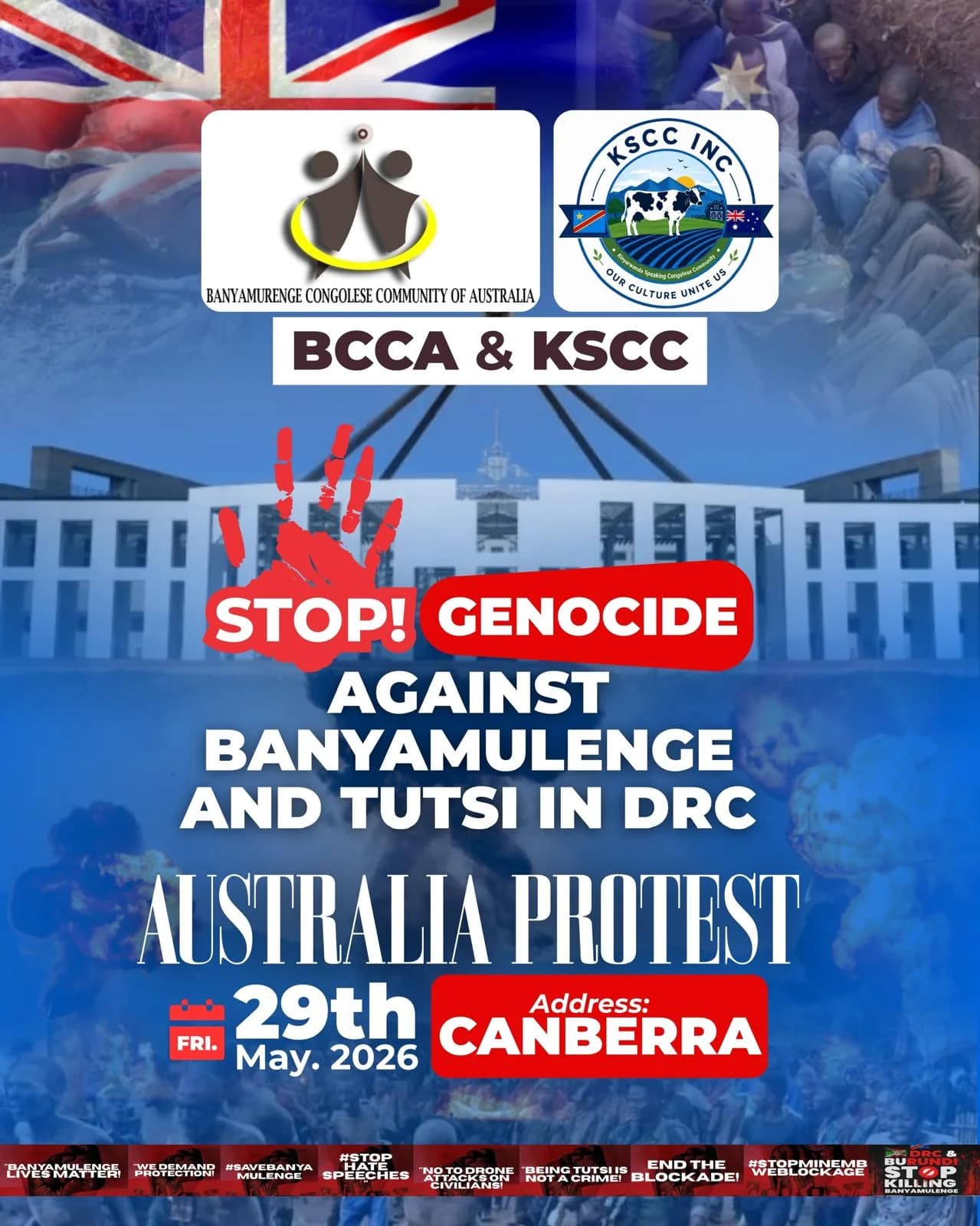
A poster circulated by Congolese diaspora groups BCCA and KSCC announcing a protest planned for 29 May 2026 in Canberra, Australia, calling for an end to violence against Banyamulenge and Tutsi communities in eastern DR Congo.
The Canberra demonstration is part of a broader wave of diaspora mobilisation. Thousands of Congolese protesters gathered in Brussels on May 15, according to the Mahoro Peace Association, a community-based humanitarian organization that represents the Banyamulenge community living in the United States.
Joining previous demonstrations in London, Nairobi, Canada, and Washington, DC, in a coordinated global campaign denouncing what organisers describe as ongoing atrocities against Banyamulenge, Tutsi, and Hema communities in eastern DRC. Australia is next on the protest circuit.
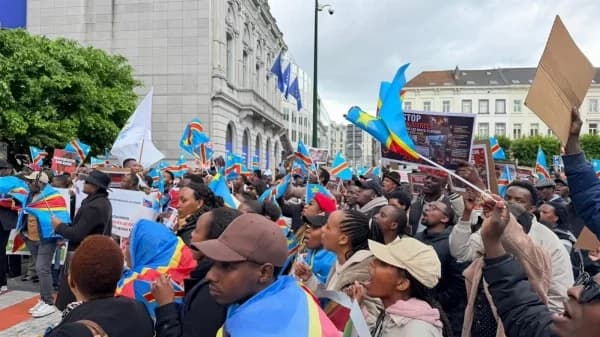
Banyamulenge protest in Brussels, Belgium, May 15, 2026
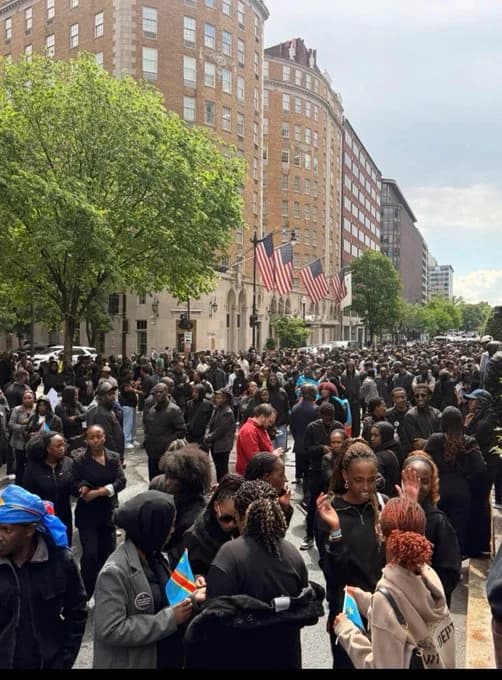
Banyamulenge protest in Washington D.C, USA, April 20, 2026.
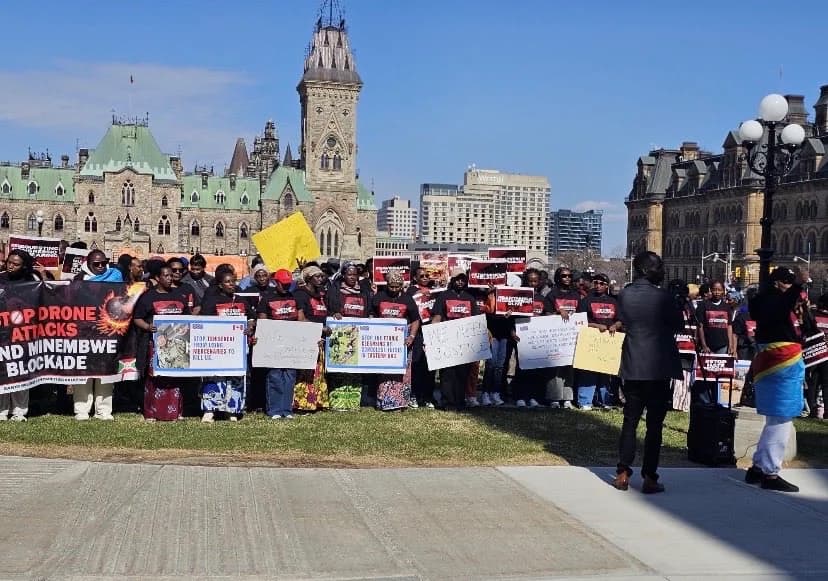
Banyamulenge Protest in Ottawa, Canada, April 21, 2026.
Canberra was chosen deliberately, according to both community leaders, because of Australia's standing as an international decision-maker.
Amini Innocent, a Queensland-based community leader who serves as president of the Kinyarwanda Speaking Congolese Community (KSCC), has been among the most prominent voices calling for the action. Speaking ahead of the demonstration in an interview with Kwetu Pazuri TV, he described the protest as an act of visibility for a community he says is being systematically targeted.
"We want to make ourselves known, that we exist, and we are reaching out to different embassies to make it known that our people are being massacred," Amini said. "The reason is one: this is who we are."
Choosing Canberra
The organisers say the choice of Canberra was strategic. Australia is home to a growing Congolese diaspora, and the capital's concentration of foreign embassies makes it a focal point for diplomatic pressure campaigns.
"What we need to do, we should do it because we see the result," Amini said. "We will deliver our message. We expect a big result because we have prepared well. We shall be in Canberra where most embassies are, and Australia is one of the decision-makers, so we expect something."
The Australian Council for International Development and members of the Congolese diaspora in Australia have previously raised alarm about the conflict in eastern DRC, calling on the Australian government to increase humanitarian assistance to the region.
Grievance rooted in a lifetime of conflict
At the heart of the protest lies a grievance that Amini says spans his entire life. Describing the current security situation in territories under AFC/M23 control in North Kivu, he offered a striking personal assessment.
"Since I was born, now is the first time we have peace in our territories," he said. "The places controlled by M23 are more peaceful than those controlled by the government."
The Congolese government and several human rights organisations have documented abuses by both M23 fighters and government-aligned forces in eastern DRC. The M23 coalition, which Majority includes Congolese Tutsi fighters among its core combatants from North and South Kivu, has controlled significant territory in eastern DRC since capturing Goma, the provincial capital of North Kivu, in January 2025.
The protests draw together two distinct but linked communities. The Banyamulenge, a Tutsi community indigenous to the high plateaus of South Kivu, have long faced displacement and armed attacks centred around Minembwe. In North Kivu's Masisi territory, Kinyarwanda-speaking communities face a parallel crisis, with civilian areas including Mushaki repeatedly struck in the ongoing conflict. Both communities are represented in the Australian diaspora through BCCA and KSCC respectively.
Demands: Kinshasa, mediators, and all armed groups
Beyond the protest itself, Amini laid out a series of demands targeting both the Congolese government and the international community overseeing the stalled peace process.
"The DRC government should stop the hate messages," he said.
His call extended to the mediators brokering negotiations between Kinshasa and the AFC/M23 coalition, referencing a series of accords, including the Washington Accords of June 2025, a framework brokered by the United States, and the Doha Declaration of Principles of July 2025, facilitated by Qatar, that have so far failed to produce a durable ceasefire.
"In all the accords that have happened, we want our message to be that mediators should listen and consider all sides, and stop all militias, including Wazalendo, FDLR and others," Amini said.
The call to disarm all militias signals a broader peace agenda beyond ethnic grievance, though what community leaders describe as state-sanctioned persecution of Kinyarwanda-speaking and Banyamulenge populations remains the community's primary accusation against Kinshasa.
Backdrop of ongoing violence
The protest comes against a backdrop of sustained and escalating conflict across eastern DRC. Civilians in Mushaki, Masisi, and Minembwe continue to face drone attacks, mass violence, displacement, and persecution, according to community organisations and diaspora groups monitoring the situation on the ground.
A drone strike attributed to the Armed Forces of the DRC struck the Mushaki market in Masisi territory on 8 May 2026, killing more than 20 people and wounding over 60, according to local sources and AFC/M23, figures that could not be independently verified at the time of publication.
Earlier, in January 2026, Congolese refugees in camps in Rwanda staged peaceful protests condemning anti-Tutsi rhetoric publicly broadcast by a DRC army spokesperson, who was subsequently suspended.
Congolese diaspora members have also previously demonstrated outside United Nations headquarters in Geneva, demanding international accountability for alleged atrocities in eastern DRC.
Peace negotiations brokered through Qatar have stalled, with scheduled direct talks between the Congolese government and AFC/M23 repeatedly cancelled since late 2025. Kinshasa has escalated drone operations against M23-held areas in the interim, while the humanitarian situation across North and South Kivu continues to deteriorate.
The DRC embassy in Canberra had not responded to a request for comment at the time of publication.



Comments
No comments yet. Be the first to share a thought.