
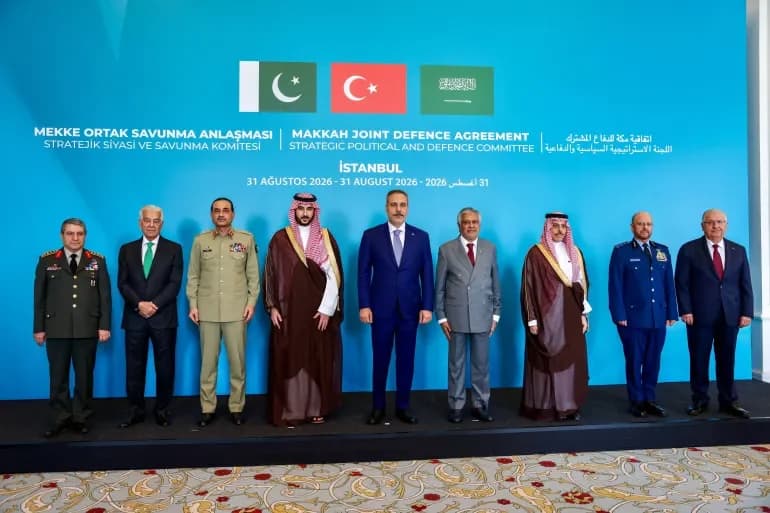
Pakistan, Saudi Arabia and Türkiye have taken the first steps towards putting their new mutual-defence agreement into operation, as the three countries face growing security concerns amid the renewed conflict between the United States and Iran. Senior officials from the three countries met in Istanbul on Monday for the first meeting of the Strategic Political and Defence Committee, established under the defence agreement signed in Mecca on August 7. The three countries have formally named their new security arrangement the Mecca Defence Alliance . Turkish Foreign Minister Hakan Fidan said a
Pakistan, Saudi Arabia and Türkiye have taken the first steps towards putting their new mutual-defence agreement into operation, as the three countries face growing security concerns amid the renewed conflict between the United States and Iran. Senior officials from the three countries met in Istanbul on Monday for the first meeting of the Strategic Political and Defence Committee, established under the defence agreement signed in Mecca on August 7. The three countries have formally named their new security arrangement the Mecca Defence Alliance. Turkish Foreign Minister Hakan Fidan said a permanent secretariat has been established in Riyadh, Saudi Arabia, while its first secretary-general will be appointed from Pakistan. Fidan said the alliance is based on principles including respect for national sovereignty, territorial integrity and non-interference in the internal affairs of other states. He also stressed that the alliance remains open to participation by other countries in the region. The Istanbul meeting focused on how to translate the agreement into practical security cooperation. Under the pact, an attack on any one of the three countries is to be treated as an attack on all three. However, important details about how and when the mutual-defence provision would be activated remain to be worked out. The countries discussed areas including military interoperability, joint military exercises, defence-industrial cooperation, joint production and research, as well as counterterrorism coordination. Pakistan was represented by Deputy Prime Minister and Foreign Minister Ishaq Dar, Chief of Defence Forces Field Marshal Asim Munir and Defence Minister Khawaja Asif. Türkiye's delegation included Foreign Minister Hakan Fidan, Defence Minister Yasar Guler and Chief of General Staff General Selcuk Bayraktaroglu. Saudi Arabia was represented by Foreign Minister Faisal bin Farhan, Defence Minister Khalid bin Salman and Chief of General Staff Fayyad al-Ruwaili. Although the agreement's mutual-defence clause has drawn comparisons with NATO's Article 5, analysts say the new alliance currently lacks many of the structures that make NATO a fully integrated military organisation. The pact does not yet have an integrated command, standing military force or the joint military mechanisms associated with NATO. Analysts say establishing a permanent institutional structure will therefore be critical if the agreement is to become fully operational. The permanent secretariat in Riyadh is expected to play an important role in coordinating the three countries' defence cooperation, although its precise structure and responsibilities still need to be finalised. The meeting took place only hours after the United States and Iran exchanged strikes, ending a period of relative calm in a conflict that has lasted for more than six months. The renewed fighting has increased pressure on countries across the region to strengthen their security arrangements and prepare for possible spillover. Egypt had been expected by some Pakistani officials to participate in broader discussions because of its role, alongside Pakistan, Saudi Arabia and Türkiye, in diplomatic efforts aimed at ending the US war on Iran. However, Monday's meeting ultimately focused on the three countries that signed the mutual-defence agreement. For Pakistan, Saudi Arabia and Türkiye, the challenge now is to transform the Mecca Defence Alliance from a political declaration into a functioning security partnership. The coming months will show whether the pact develops into a deeper military alliance, expands to include other regional countries, or remains primarily a framework for political and defence cooperation.



Comments (1)
Great piece, the background section really helped.