
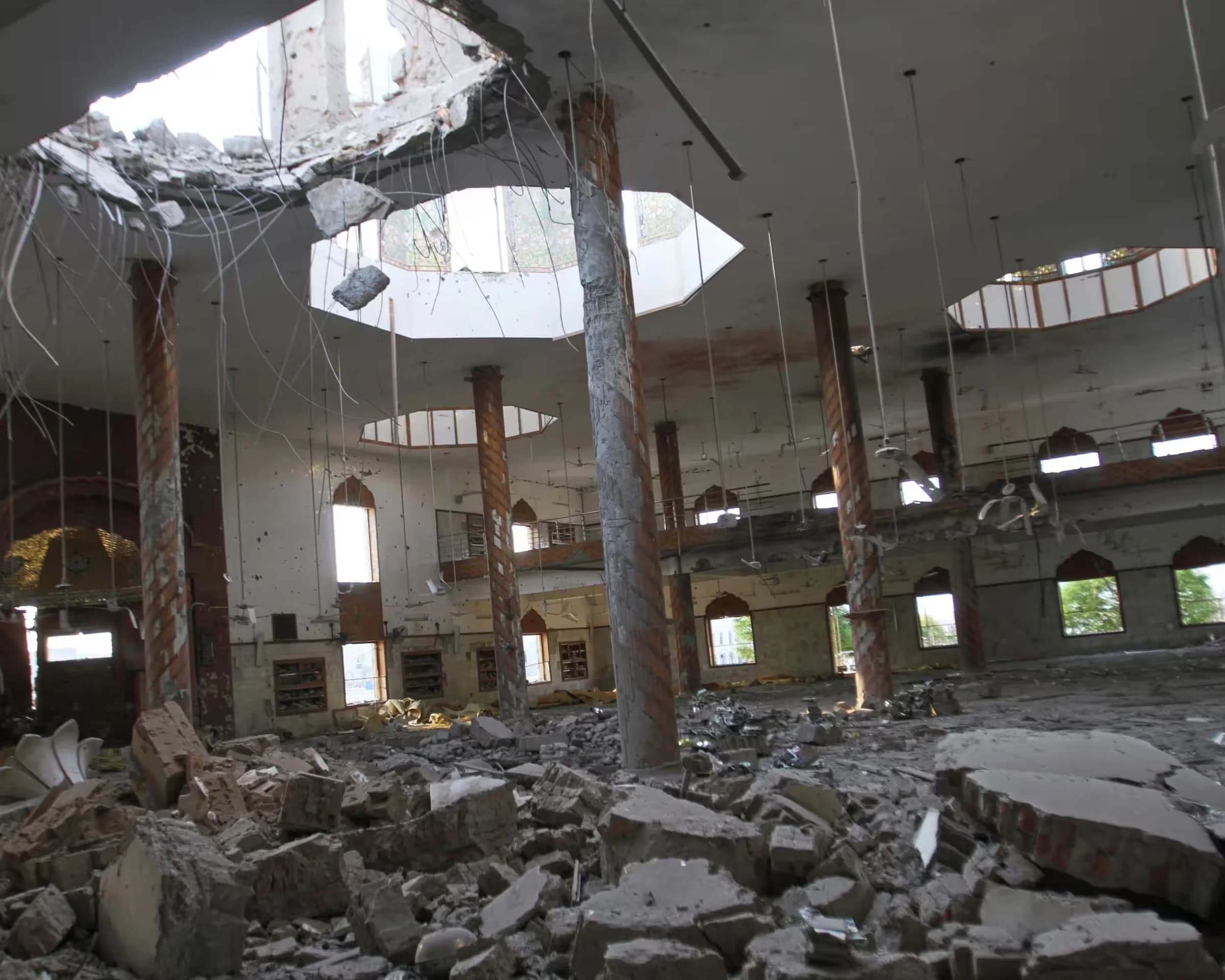
Pakistan has pledged to retaliate after Indian airstrikes killed 31 people overnight, sparking fears of a dangerous escalation between the two nuclear-armed rivals. In a national address late Wednesday, Prime Minister Shehbaz Sharif declared, “We vow to avenge every drop of blood shed by our martyrs.” The remarks followed Indian missile strikes on nine locations across Pakistan-administered Kashmir and Punjab province, which Pakistan condemned as an unprovoked act of aggression. The Pakistani government has since authorized its military to take “corresponding” retaliatory measures. India cla
Pakistan has pledged to retaliate after Indian airstrikes killed 31 people overnight, sparking fears of a dangerous escalation between the two nuclear-armed rivals. In a national address late Wednesday, Prime Minister Shehbaz Sharif declared, “We vow to avenge every drop of blood shed by our martyrs.” The remarks followed Indian missile strikes on nine locations across Pakistan-administered Kashmir and Punjab province, which Pakistan condemned as an unprovoked act of aggression. The Pakistani government has since authorized its military to take “corresponding” retaliatory measures. India claimed the attacks were in direct response to a deadly assault last month in Indian-administered Kashmir, where militants killed 25 Hindu pilgrims and their guide. India blamed Pakistan for harboring Islamist militants behind the attack, a charge Islamabad denies. In an interview with The Guardian, Pakistan’s Deputy Prime Minister and Foreign Minister Ishaq Dar warned that Pakistan would go to “any extent” to defend its sovereignty. “We reserve the right to authorize the armed forces to take appropriate, measured, and responsible action,” Dar said, emphasizing that decisions would be coordinated with Army Chief Gen Asim Munir and the ruling coalition. While refusing to provide a timeline, Dar stressed that Pakistan had shown “patience and maximum restraint” despite India's provocations. “The cost of war is immense, but when sovereignty and national dignity are at stake, we are prepared to pay the price,” he said. Dar also criticized the international community for its lack of engagement, noting that Pakistan’s call for an independent investigation into the Kashmir attack had gone unanswered. He contrasted the current response with past U.S. administrations that actively worked to prevent India-Pakistan conflicts. “This time, global silence is worrying,” he said. “The fallout from any war won’t be confined to our borders—it will ripple globally.” India’s strikes killed at least 31 people, including children, and injured dozens more. Indian officials claimed they had successfully targeted terrorist training camps linked to Lashkar-e-Taiba and Jaish-e-Mohammed, two groups with a history of attacks in India. “We hit only those responsible for killing our innocents,” said Defence Minister Rajnath Singh. Home Affairs Minister Amit Shah affirmed India’s resolve to respond firmly to any threat. India described the missile strikes as “proportionate and responsible.” Pakistan, however, condemned them as unjustified and said the areas targeted had no terrorist infrastructure. “There were no terrorist outfits operating in those regions,” Dar reiterated. Significantly, Indian missiles also hit Punjab—Pakistan’s most strategic province—for the first time since the 1971 war, killing at least 16 people. In response, Pakistan’s National Security Council gave the military a green light to act at a “time, place, and manner of its choosing.” In Parliament, Bilawal Bhutto Zardari, a key coalition leader, emphasized that Pakistan’s response was forthcoming. “Pakistan has the right to respond however it deems appropriate,” he said. Kashmir remains the epicenter of this enduring conflict. Claimed in full by both countries but divided along the heavily militarized Line of Control, it has been the trigger for three wars between India and Pakistan since 1947. Pakistan claimed that around 80 Indian jets participated in the recent strikes. Though it said only five were shot down, debris from three aircraft was found in Indian-administered Kashmir and Punjab. India has not confirmed any losses. In Wuyan village, Indian-administered Kashmir, a witness described a fiery crash of an aircraft in the early hours of the morning. “It exploded near a school, and blasts continued for about an hour,” said 25-year-old Adnan Ahmad. Heavy artillery exchanges continued along the Line of Control throughout the day. At least 12 civilians were reported killed on the Indian side and five on the Pakistani side. In Poonch, a heavily shelled border district, 42 people were treated for injuries. “We’ve lived under this fear for generations,” said Safeer Abdullah, a resident. “Every moment feels like it could be our last.” Many have fled, while others remain trapped in their homes amid intense shelling that damaged homes, farms, and even religious sites. Global leaders, including those from the U.S., UK, China, Iran, and the UAE, have called for de-escalation. UK Prime Minister Keir Starmer said efforts were underway to urge dialogue and protect civilians. Former U.S. President Donald Trump also weighed in, urging both nations to halt hostilities. “We want to see it stop,” he said. “We have good relations with both countries.”



Comments
No comments yet. Be the first to share a thought.