
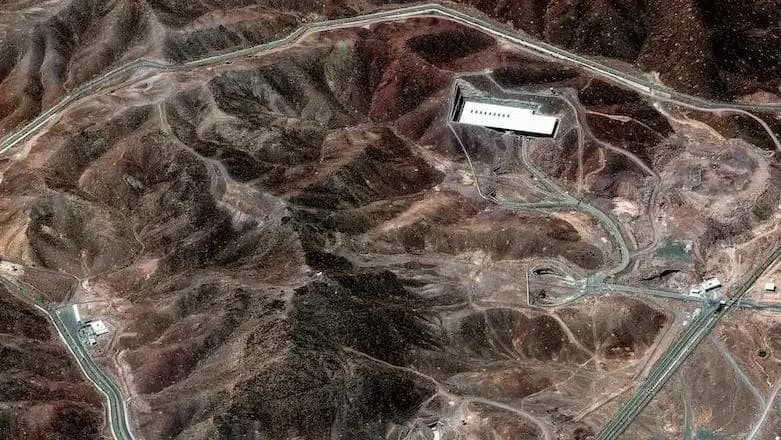
President Donald Trump announced Saturday evening that U.S. military forces had conducted airstrikes on three Iranian nuclear facilities, concluding a weeklong deliberation over whether to join Israel’s campaign against Tehran. “We have completed our very successful attack on the three nuclear sites in Iran, including Fordow, Natanz, and Esfahan. All planes are now outside of Iranian airspace,” Trump wrote on Truth Social on Saturday, June 21. Trump added that “a full payload of BOMBS was dropped on the primary site, Fordow.” He ended his message with a call for peace. This marks the first
President Donald Trump announced Saturday evening that U.S. military forces had conducted airstrikes on three Iranian nuclear facilities, concluding a weeklong deliberation over whether to join Israel’s campaign against Tehran. “We have completed our very successful attack on the three nuclear sites in Iran, including Fordow, Natanz, and Esfahan. All planes are now outside of Iranian airspace,” Trump wrote on Truth Social on Saturday, June 21. Trump added that “a full payload of BOMBS was dropped on the primary site, Fordow.” He ended his message with a call for peace. This marks the first time since the 1979 Iranian Revolution that a U.S. president has ordered direct airstrikes on major Iranian infrastructure. Reports indicate that American B-2 stealth bombers were used in the operation. These aircraft are uniquely capable of carrying the Massive Ordnance Penetrator (MOP), which defense experts consider the only bomb capable of reaching Iran’s deeply buried Fordow nuclear facility. Each B-2 can carry two of these 30,000-pound "bunker buster" bombs. The extent of the damage inflicted on Iran’s nuclear enrichment facilities remains unclear, and there is no confirmed information yet regarding casualties or injuries. Hassan Abedini, deputy political director of Iran’s state broadcaster, stated that the sites had been evacuated "a while ago." Appearing on state-run television, he claimed Iran "didn't suffer a major blow because the materials had already been removed." Iranian officials had previously warned the United States against intervening, stating it would face "irreparable damage" and risk an "all-out war" in the region. In retaliation, Iran has threatened to target American military bases throughout the Middle East. The U.S. maintains military installations in at least 19 areas across the region, including Bahrain, Egypt, Iraq, Jordan, Kuwait, Qatar, Saudi Arabia, and the United Arab Emirates. One of the most likely targets for an Iranian response is the U.S. Navy’s Fifth Fleet headquarters in Mina Salman, Bahrain. The broader conflict between Israel and Iran has now entered its second week, with missiles, drones, and fighter jets exchanged by both sides despite the two nations not sharing a land border. The latest escalation began on June 13, when Israeli warplanes struck Tehran, Iran’s capital. The airstrike reportedly killed several top Iranian military officials, including the Chief of Staff of the Armed Forces, the Commander of the Revolutionary Guard, and the head of Emergency Command. Several nuclear scientists were also reportedly among the casualties. Israel claimed that over 200 fighter jets participated in the operation, which targeted what it described as the core of Iran’s nuclear program. In response, Iran launched missile strikes on Israeli cities, including Tel Aviv and Jerusalem, resulting in at least 30 deaths and significant damage to military facilities.



Comments
No comments yet. Be the first to share a thought.