
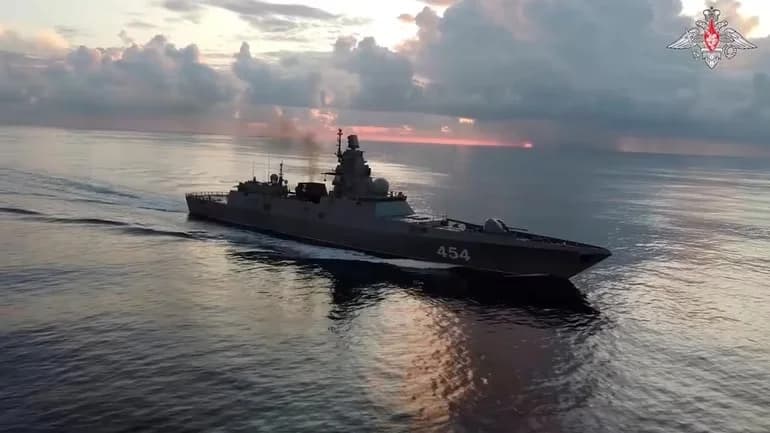
In a demonstration of naval prowess, a Russian frigate and a nuclear-powered submarine engaged in strategic missile drills amidst their journey through the vast Atlantic Ocean. The Russian Ministry of Defence confirmed the maneuvers undertaken by the formidable submarine Kazan and the warship Admiral Gorshkov. These exercises involved the precise launching of missiles aimed at simulated enemy targets, showcasing Russia's strategic capabilities and maritime dominance. According to an official statement released on Tuesday, the drills unfolded over a distance exceeding 600 kilometers (370 mi
In a demonstration of naval prowess, a Russian frigate and a nuclear-powered submarine engaged in strategic missile drills amidst their journey through the vast Atlantic Ocean. The Russian Ministry of Defence confirmed the maneuvers undertaken by the formidable submarine Kazan and the warship Admiral Gorshkov. These exercises involved the precise launching of missiles aimed at simulated enemy targets, showcasing Russia's strategic capabilities and maritime dominance. According to an official statement released on Tuesday, the drills unfolded over a distance exceeding 600 kilometers (370 miles), affirming the extended reach and precision of the Russian naval arsenal. The participation of the Admiral Gorshkov, a state-of-the-art frigate equipped with advanced weaponry systems, underscores Russia's commitment to maintaining a formidable presence in international waters. In addition to the missile exercises, the Russian Ministry of Defence disclosed that the Admiral Gorshkov also engaged in rigorous training to defend against potential aerial threats. This comprehensive approach to combat readiness emphasizes the importance Russia places on safeguarding its naval assets and territorial interests. The timing of these maneuvers, coupled with the destination of the vessels, adds a layer of geopolitical significance to the spectacle. As the Kazan and the Admiral Gorshkov make their way towards Cuba, a historically significant ally of Russia, the message conveyed is one of strategic cooperation and solidarity. The presence of Russian naval forces in the vicinity of Cuba not only serves as a display of military strength but also signals Russia's continued engagement in the geopolitically sensitive region of the Caribbean. The deployment of the Kazan submarine, powered by a nuclear reactor, underscores Russia's commitment to maintaining a formidable presence on both surface waters and beneath the ocean's depths. With its advanced propulsion and stealth capabilities, the Kazan represents a formidable asset in Russia's maritime arsenal, capable of executing strategic missions with precision and stealth. While the nature of these exercises may raise eyebrows among some international observers, it is essential to recognize the broader context within which they occur. Military drills such as these are not uncommon among major naval powers and serve as a means of maintaining readiness and deterrence. In an era marked by geopolitical tensions and shifting power dynamics, demonstrations of military strength serve as a reminder of the importance of maintaining a balance of power on the global stage. However, it is crucial for such displays of military might to be conducted responsibly and transparently, in accordance with international norms and regulations. As Russia continues to assert its presence in strategic regions across the globe, it must do so in a manner that promotes stability and constructive dialogue among nations. In conclusion, the missile drills conducted by the Russian naval frigate and submarine serve as a potent reminder of Russia's military capabilities and strategic objectives. As these vessels navigate the Atlantic waters en route to Cuba, they underscore Russia's commitment to safeguarding its interests and maintaining a robust presence on the international stage. In an era characterized by geopolitical uncertainty, the importance of responsible and transparent military conduct cannot be overstated, as nations strive to navigate the complexities of a rapidly evolving global landscape.



Comments
No comments yet. Be the first to share a thought.