
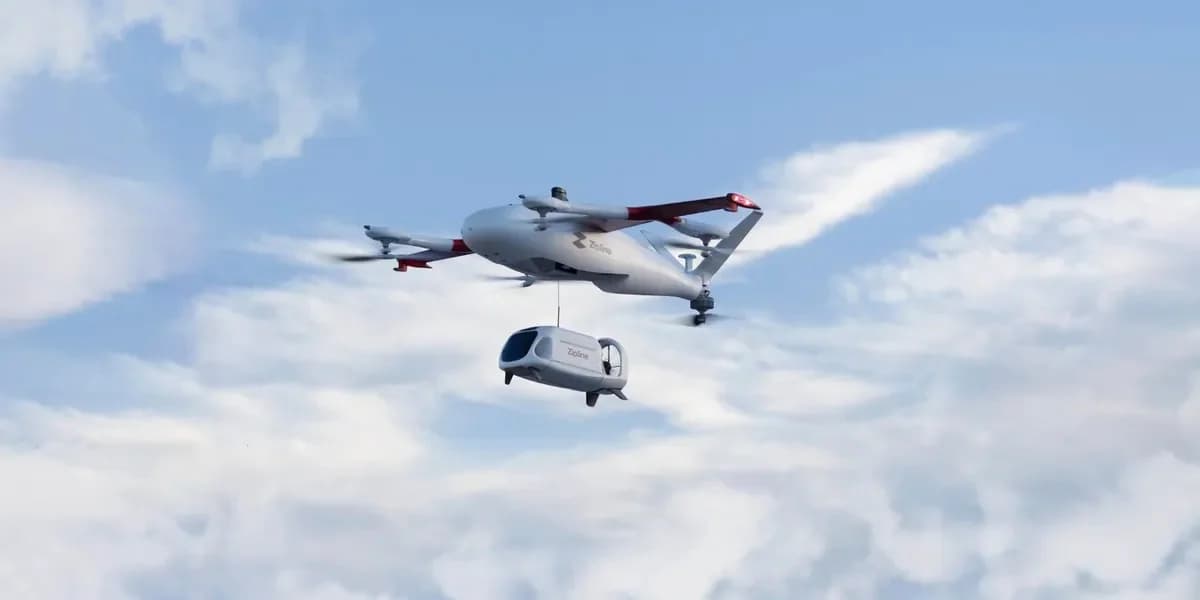
Rwanda has become the first country in the world with full nationwide autonomous drone delivery, expanding Zipline’s service to urban centers and new districts, transforming healthcare access for millions and setting a global benchmark in innovation. The historic expansion builds on Rwanda’s 2016 launch of Zipline’s medical delivery service, which initially enabled rapid deliveries of blood, vaccines, and essential medicines to remote rural health posts. The February 5, 2026 agreement marks the first milestone under Zipline’s $150 million pay-for-performance award from the U.S. Department of S
Rwanda has become the first country in the world with full nationwide autonomous drone delivery, expanding Zipline’s service to urban centers and new districts, transforming healthcare access for millions and setting a global benchmark in innovation.
The historic expansion builds on Rwanda’s 2016 launch of Zipline’s medical delivery service, which initially enabled rapid deliveries of blood, vaccines, and essential medicines to remote rural health posts. The February 5, 2026 agreement marks the first milestone under Zipline’s $150 million pay-for-performance award from the U.S. Department of State, reinforcing Rwanda’s global leadership in artificial intelligence, robotics, and technology-driven healthcare.
Reflecting on the 2016 launch, a Zipline spokesperson said, “We’ve centered our drones on reaching communities that roads simply couldn’t, bringing vaccines, blood, and medicines in minutes, not hours, racing along at 100 km/h.”

Rwanda Becomes World’s First Country with Nationwide Drone Delivery photo
At the signing ceremony, Minister of ICT and Innovation Paula Ingabire emphasized the impact of the decade-long partnership:
“Rwanda and Zipline have been working together for years to harness technology for the good of our people. We have witnessed the extraordinary impact of drone delivery, saving time, saving money, and saving lives. With this partnership, we will now expand to urban delivery, bringing these benefits to even more communities.”
The expansion introduces Zipline’s urban Platform 2 (P2) system in Kigali, the first of its kind in Africa, enabling ultra-fast, quiet, and highly precise deliveries in dense urban areas, where roughly 40 percent of the country’s healthcare demand is concentrated.
Caitlin Burton, CEO of Zipline Africa, praised Rwanda’s leadership:
“In 2016, Rwanda made a decision that changed health access forever. They tested it, measured it, and scaled it. Today, Rwanda is doing it again. This is a global first, not because the technology exists, but because the leadership exists.”

Caitlin Burton (CEO, Zipline Africa) at signing ceremony
A third long-range hub in Karongi District, complementing existing hubs in Muhanga and Kayonza, will serve approximately 200 health posts, 60 major facilities, and more than 2.9 million people. Nationwide, Zipline’s network will now cover over 11 million residents and support around 350 local jobs.
The expansion also includes Rwanda’s first AI and robotics testing facility, supporting aircraft performance research, safety systems testing, and next-generation logistics software, while helping develop local talent and improve drone performance across diverse climates.
Since 2016, Zipline drones have improved access to essential healthcare, helping reduce maternal deaths by 51 percent and integrating all operational data into Rwanda’s national health information system for stronger outbreak detection and emergency response.
Global tech outlets describe Rwanda’s expansion as a world first in autonomous logistics. TechInafrica called it a “historic expansion” positioning Rwanda at the forefront of AI-driven logistics research, while Aerospace Global News highlighted the expanded network and urban service as a model for countries seeking faster, cost-effective, and life-saving delivery systems.
Rwanda’s milestone demonstrates how autonomous delivery can function at national scale under a government-led system, offering a blueprint for the continent and the world in health innovation and logistics.
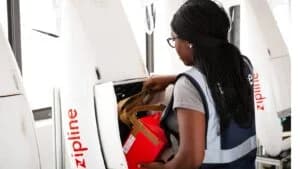
FILE: A woman packs a box of vaccines to be delivered by a Zipline drone, in Ghana, April 22, 2019. Isaac Griberg/Gavi and the UPS Foundation



Comments
No comments yet. Be the first to share a thought.