
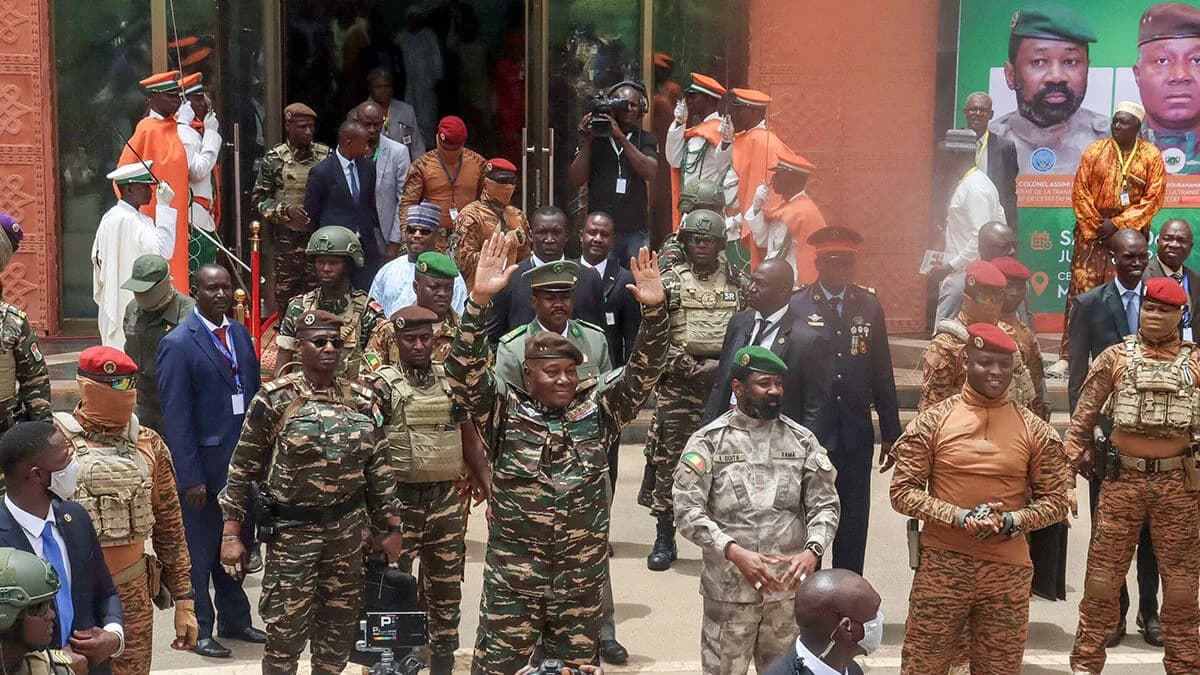
Leaders of the Alliance of Sahel States (AES) are meeting in Bamako as Mali, Niger and Burkina Faso take further steps toward regional autonomy and a decisive shift away from the West African bloc, ECOWAS. The high-level talks mark the second summit of the AES and bring together Mali’s President Assimi Goïta, Niger’s President Abdourahamane Tchiani and Burkina Faso’s President Ibrahim Traoré. The meeting aims to strengthen cooperation among the three military-led states in key areas including defence and security, development, communication and counterterrorism. Presidents Goïta and Tchiani
Leaders of the Alliance of Sahel States (AES) are meeting in Bamako as Mali, Niger and Burkina Faso take further steps toward regional autonomy and a decisive shift away from the West African bloc, ECOWAS. The high-level talks mark the second summit of the AES and bring together Mali’s President Assimi Goïta, Niger’s President Abdourahamane Tchiani and Burkina Faso’s President Ibrahim Traoré. The meeting aims to strengthen cooperation among the three military-led states in key areas including defence and security, development, communication and counterterrorism. Presidents Goïta and Tchiani met on Monday at Bamako’s international airport before proceeding to the presidential palace, while President Traoré joined the summit on Tuesday morning following an unexpected delay. The gathering underscores the bloc’s determination to consolidate a common political and security vision for the Sahel. According to Africanews, the Bamako summit comes at a critical moment for the alliance, as the three countries accelerate efforts to reduce reliance on ECOWAS and redefine regional cooperation on their own terms. Mali, Niger and Burkina Faso formed the Alliance of Sahel States in 2023 following strained relations with ECOWAS and several Western partners after a series of military coups. In 2024, the three countries formally withdrew from the regional bloc, accusing it of political interference and failing to address persistent insecurity in the Sahel. Security remains central to the alliance’s agenda. Ahead of the summit, the three states announced the creation of a joint military force aimed at combating terrorism and armed groups operating across their borders, as violence continues to destabilise large parts of the region. During the summit, the leaders also launched an AES television broadcaster, intended to counter disinformation and promote the alliance’s policies and strategic vision. After Assimi Goïta was appointed president of the alliance at last year’s summit, a new AES leader is expected to be named in Bamako, reflecting the bloc’s rotating leadership system. Although ECOWAS has indicated willingness to allow Mali, Niger and Burkina Faso to retain certain trade privileges, the three countries have continued to assert their independence, including by introducing their own travel documents. Despite their withdrawal from ECOWAS, the three nations remain members of the West African Economic and Monetary Union (UEMOA), which ensures continued trade and free movement of goods among its eight member states, highlighting the complex balance between political autonomy and economic integration.



Comments
No comments yet. Be the first to share a thought.