
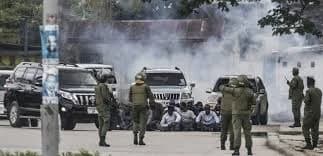
Police in Tanzania’s largest city fired live rounds and tear gas on Thursday to disperse demonstrators who returned to the streets a day after a general election marred by allegations of repression, disqualifications, and violence. The protests erupted in several neighborhoods of Dar es Salaam, including Mbagala, Gongo la Mboto, and Kiluvya, after residents accused the government of manipulating the October 29 vote and excluding President Samia Suluhu Hassan’s main challengers from the race. A Reuters witness reported seeing officers firing gunshots into the air as crowds regrouped after polic
Police in Tanzania’s largest city fired live rounds and tear gas on Thursday to disperse demonstrators who returned to the streets a day after a general election marred by allegations of repression, disqualifications, and violence.
The protests erupted in several neighborhoods of Dar es Salaam, including Mbagala, Gongo la Mboto, and Kiluvya, after residents accused the government of manipulating the October 29 vote and excluding President Samia Suluhu Hassan’s main challengers from the race. A Reuters witness reported seeing officers firing gunshots into the air as crowds regrouped after police crackdowns.
The unrest followed a tense election day, during which demonstrators across multiple cities took to the streets to denounce what the opposition described as a “coronation” of President Hassan rather than a free contest.
The main opposition party, Chama cha Demokrasia na Maendeleo (CHADEMA), was disqualified in April after refusing to sign an electoral code of conduct. Its leader, Tundu Lissu, was later charged with treason. Another major opposition figure, ACT-Wazalendo’s candidate, was also barred from participating, leaving only minor parties to challenge Hassan — a move that international observers and human-rights groups said undermined the legitimacy of the vote.
On election day, security forces deployed heavily around Dar es Salaam and other major towns, with curfews imposed overnight and internet access disrupted nationwide. Rights watchdogs reported arbitrary arrests of opposition members and journalists.
According to Al Jazeera and The Guardian, several major roads, including the one leading to Julius Nyerere International Airport, were closed, and civil servants were ordered to work from home on Thursday. State television later instructed students to remain home “until further notice.”
In an Instagram post, government spokesperson Gerson Msigwa said the decision for workers and students to stay home was “a precautionary measure to maintain public safety.”
President Hassan, who took office in 2021 following the death of her predecessor John Magufuli, initially won praise for easing restrictions on opposition parties and the media. However, rights groups say her administration has recently tightened control, citing unexplained abductions and harassment of critics.
Although Hassan announced last year that she had ordered an investigation into reports of abductions, no official findings have been released.
Despite internet restrictions, protesters coordinated using the Zello app, which functions like a walkie-talkie, to plan further demonstrations including possible marches on government buildings.
A Reuters correspondent heard discussions among activists urging renewed protests until what they called “the stolen election” is annulled.
Western embassies in Dar es Salaam expressed concern about the heavy-handed police response. The U.S. Embassy warned its citizens to avoid protest-affected areas and confirmed that access to several districts remained restricted.
Analysts from Chatham House noted that the 2025 vote has further eroded Tanzania’s reputation as a stable democracy in East Africa. “The exclusion of major opposition figures not only undermines political pluralism but also threatens economic confidence,” the think-tank said in an October 29 briefing.
Tanzania’s ruling party, Chama Cha Mapinduzi (CCM), has governed since independence in 1961. But the latest unrest underscores growing public frustration — especially among the youth over unemployment, censorship, and political exclusion.
As of Thursday evening, sporadic clashes continued in several suburbs of Dar es Salaam. Police have not released casualty figures, but witnesses reported injuries among protesters and officers alike.
With Hassan poised to secure another term, questions linger over whether her administration will choose reconciliation or further repression. For now, Tanzania stands at a crossroads — torn between its promise of reform and the shadow of its authoritarian past.
Comments
No comments yet. Be the first to share a thought.