
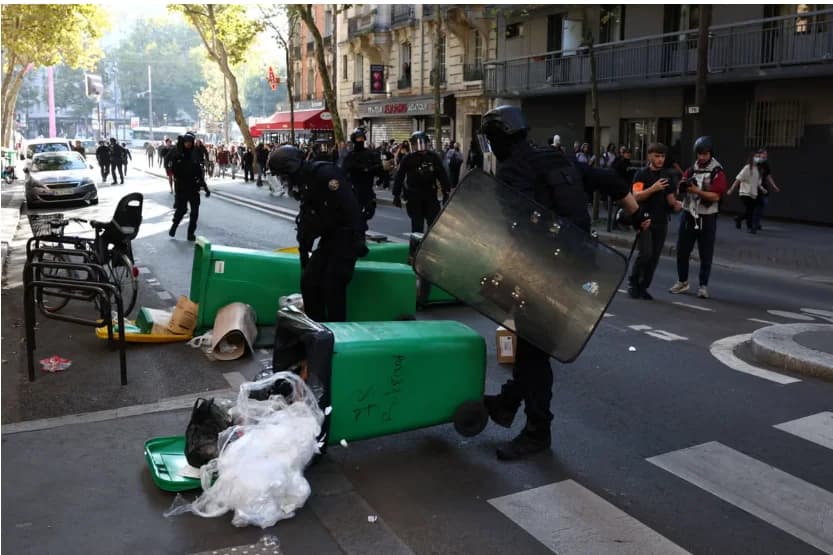
France was hit by a wave of strikes on Thursday as teachers, transport workers, hospital staff, pharmacists and other public sector employees staged a rare united protest against budget cuts, stagnant wages, pension reforms and declining public services. According to The Guardian , Trade unions said about 800,000 people were expected to join 250 marches across the country, marking one of the largest strike days in recent years. The demonstrations caused major disruption to schools, rail and air transport. Authorities deployed up to 80,000 police officers nationwide to manage the unrest. By e
France was hit by a wave of strikes on Thursday as teachers, transport workers, hospital staff, pharmacists and other public sector employees staged a rare united protest against budget cuts, stagnant wages, pension reforms and declining public services. According to
The
Guardian
, Trade unions said about 800,000 people were expected to join 250 marches across the country, marking one of the largest strike days in recent years. The demonstrations caused major disruption to schools, rail and air transport. Authorities deployed up to 80,000 police officers nationwide to manage the unrest. By early morning, bus depots in Paris and northern France were blockaded, while high schools were shut down in eastern Paris, Amiens in the Somme, and Le Havre in Normandy. Train services were interrupted across the country. Union leaders described the movement as the most significant mobilisation since 2023, when mass protests erupted against President Emmanuel Macron’s controversial decision to raise the retirement age to 64 without a parliamentary vote.
Unions Demand a Shift in Policy
Perrine Mohr of the moderate CFDT trade union in northern Hauts-de-France said the strikes were a direct challenge to the government’s economic priorities. “Since Macron came to power in 2017, we have had a government that is pro-business, with tax relief and unconditional assistance to businesses. What we’re asking is that the future government is more pro-workers and pro-citizens,” she told local public radio
Ici
. The unrest comes as France enters another period of political turmoil following Macron’s decision last week to appoint Sébastien Lecornu as his third prime minister in a year. Lecornu replaced François Bayrou, who was ousted after losing a confidence vote in parliament over a €44 billion budget squeeze that included sweeping austerity measures.
Lecornu’s Rocky Start
Lecornu, 39, previously served as defence minister under Bayrou and his predecessor, Michel Barnier, both of whom were also forced out by parliamentary opposition. He enters office with low approval ratings and has promised a “profound break” from past politics, but opposition parties remain unconvinced. Although Lecornu has pledged to drop Bayrou’s unpopular proposal to abolish two public holidays, unions fear that other austerity measures — including a freeze on welfare spending — may remain. He now faces the urgent task of drafting a budget acceptable to parliament while forming another minority government. Failure to do so could trigger a no-confidence vote and remove him from office. The stakes are high as France’s parliament remains fragmented following the snap elections of June 2024, which left the chamber divided between the left, the far right and Macron’s centrist bloc, with no absolute majority. Lecornu began consultations with opposition parties on Wednesday as he sought support for his upcoming budget. His political background lies on the traditional right before joining Macron’s centrist alliance, and analysts expect him to maintain cooperation with Les Républicains and continue Macron’s pro-business economic agenda. However, observers believe Lecornu must secure at least a tacit non-aggression pact with the Socialist Party to avoid immediate collapse. Socialist leader Olivier Faure said his party had demanded “an end to harsh budget cuts,” along with “fair contributions from the wealthiest” and measures to ease the cost of living. After talks with Lecornu, Faure signaled scepticism. “We’ll see what he says in the coming days,” he told reporters, warning that if the new prime minister refused to shift course, the Socialists could back a future no-confidence vote. Meanwhile, far-right leader Marine Le Pen of the National Rally said after her own meeting with Lecornu: “If he continues the same politics, he’ll fall.”
Mounting Economic Pressure
France’s public finances remain under intense scrutiny. The country’s budget deficit is nearly double the EU’s 3% limit, and national debt has reached 114% of GDP. Last week, ratings agency Fitch downgraded France’s credit rating, citing concerns over political instability. Against this backdrop, Lecornu has only weeks to produce a viable budget text that can secure enough parliamentary support to survive.



Comments
No comments yet. Be the first to share a thought.