
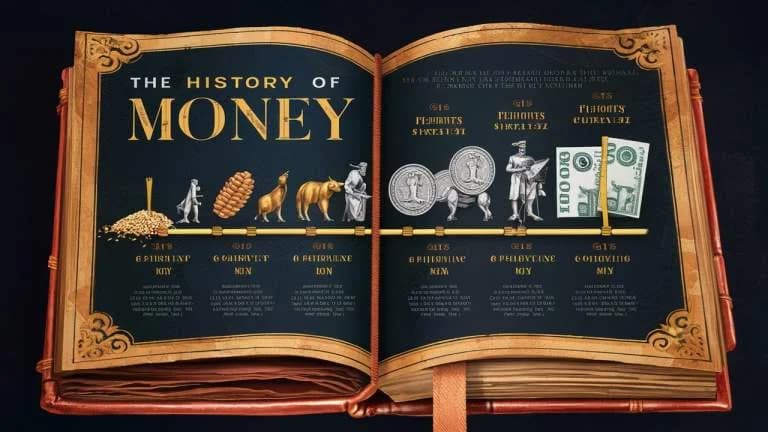
Money, an essential element of modern civilization, is so ingrained in our daily lives that we often take it for granted. From ancient barter systems to the complex financial instruments of today, the evolution of money tells a fascinating story of human ingenuity, trust, and societal development. This article explores the historical progression of money, the philosophy behind its creation, and its profound impact on the world. The Birth of Money: From Barter to Coinage In the earliest human societies, bartering was the primary method of trade. People exchanged goods and services directly, b
Money, an essential element of modern civilization, is so ingrained in our daily lives that we often take it for granted. From ancient barter systems to the complex financial instruments of today, the evolution of money tells a fascinating story of human ingenuity, trust, and societal development. This article explores the historical progression of money, the philosophy behind its creation, and its profound impact on the world. The Birth of Money: From Barter to Coinage In the earliest human societies, bartering was the primary method of trade. People exchanged goods and services directly, but this system had significant limitations. The "double coincidence of wants" problem required that both parties in a transaction needed what the other had to offer. This inefficiency led to the search for a more versatile medium of exchange. Around 600 BCE, the first standardized coins appeared in Lydia (modern-day Turkey). These early coins were made from electrum, a natural alloy of gold and silver, and stamped with official seals to guarantee their value. The introduction of coinage revolutionized trade by providing a uniform and reliable medium of exchange, facilitating commerce, and laying the groundwork for economic expansion. The Philosophy of Money: Trust and Value The philosophical underpinnings of money are rooted in the concepts of trust and value. Money, in essence, is a social contract—a mutual agreement within a community to accept a particular object or symbol as a representation of value. This collective trust is what gives money its power. Philosophers like Aristotle and Adam Smith have long debated the nature of money. Aristotle viewed money as a measure of value and a means to facilitate exchange, while Smith saw it as a symbol of labor and production. In the modern era, the notion of money has expanded to encompass not only physical currency but also digital forms, underscoring its role as an abstract representation of value. The Rise of Paper Money and Banking The next major leap in the evolution of money came with the advent of paper currency. In 7th century China, during the Tang Dynasty, merchants and traders began using promissory notes as a more convenient alternative to heavy metal coins. By the 11th century, the Song Dynasty had formalized this practice, issuing the world's first government-backed paper money. The concept of banking emerged alongside paper currency. Medieval European banks, starting in Italy, issued receipts for deposits, which gradually became accepted as money. The establishment of central banks, beginning with the Bank of England in 1694, further solidified the role of paper money and banking systems in modern economies. The Digital Revolution: From Plastic to Cryptocurrencies The 20th and 21st centuries have witnessed an unprecedented transformation in the nature of money. The introduction of credit and debit cards in the mid-20th century paved the way for electronic transactions, reducing the reliance on physical cash. The rise of the internet and digital technology further accelerated this trend, leading to the emergence of online banking and mobile payment systems. One of the most revolutionary developments in recent years has been the advent of cryptocurrencies. Bitcoin, created in 2009 by an anonymous entity known as Satoshi Nakamoto, introduced the concept of decentralized digital currency. Unlike traditional money, cryptocurrencies are not controlled by any central authority, relying instead on blockchain technology to ensure transparency and security. This innovation has sparked debates about the future of money, challenging traditional financial systems and raising questions about regulation and stability. The Impact of Money on Society Money's influence extends far beyond economics; it shapes societies, cultures, and politics. It enables trade and commerce, fosters innovation and entrepreneurship, and provides a means for individuals to achieve their goals and aspirations. However, money also has a darker side. The pursuit of wealth can lead to social inequality, corruption, and environmental degradation. Philosophers and economists continue to grapple with the ethical implications of money. Karl Marx critiqued the capitalist system, arguing that it leads to exploitation and alienation. In contrast, proponents of free-market economics, like Friedrich Hayek, argue that money is a tool for individual freedom and economic efficiency. The journey of money from ancient barter systems to digital currencies is a testament to human ingenuity and the continuous quest for efficiency and trust in economic transactions. Its evolution reflects broader societal changes, technological advancements, and philosophical debates. As we move further into the digital age, the nature of money will undoubtedly continue to evolve, raising new questions and challenges for future generations. In understanding the history and philosophy of money, we gain insight into one of the most powerful forces shaping our world. It is not just a medium of exchange, but a reflection of human civilization's complexity, aspirations, and contradictions. References and Resources 1. Books and Articles - Ferguson, Niall. The Ascent of Money: A Financial History of the World*. Penguin Books, 2008. - Weatherford, Jack. The History of Money. Crown Publishers, 1997. - Smith, Adam. The Wealth of Nations. W. Strahan and T. Cadell, 1776. - Graeber, David. *Debt: The First 5,000 Years. Melville House, 2011. 2. Philosophical Perspectives - Aristotle. Nicomachean Ethics. Translated by W. D. Ross, Oxford University Press, 1925. - Marx, Karl. *Das Kapital. Progress Publishers, 1887. - Hayek, Friedrich. The Road to Serfdom. University of Chicago Press, 1944. 3. Historical Records and Documents - Kraay, Colin M. *Archaic and Classical Greek Coins*. University of California Press, 1976. - von Reden, Sitta. Money in Classical Antiquity. Cambridge University Press, 2010. - Goetzmann, William N., and K. Geert Rouwenhorst, editors. *The Origins of Value: The Financial Innovations that Created Modern Capital Markets. Oxford University Press, 2005. 4. Modern Developments - Nakamoto, Satoshi. "Bitcoin: A Peer-to-Peer Electronic Cash System." Bitcoin.org, 2008. - Swartz, Lana. New Money: How Payment Became Social Media. Yale University Press, 2020. - Narayanan, Arvind, et al. *Bitcoin and Cryptocurrency Technologies. Princeton University Press, 2016. 5. Digital Resources - Investopedia. "History of Money." [Investopedia](https://www.investopedia.com/articles/07/roots_of_money.asp) - The British Museum. "A History of the World in 100 Objects: Coin of Croesus." [The British Museum](https://www.britishmuseum.org/collection/object/C_1958-1201-490) - Federal Reserve Education. "The History of Money." [Federal Reserve Education](https://www.federalreserveeducation.org/about-the-fed/history-of-money) 6. Documentaries and Multimedia - PBS. The Ascent of Money. Directed by Adrian Pennink, presented by Niall Ferguson, 2008. - BBC. The History of Money. BBC Radio 4, produced by Dominic Byrne, 2016. 7. Academic Journals - Journal of Economic History - Economic History Review - History of Political Economy



Comments
No comments yet. Be the first to share a thought.