
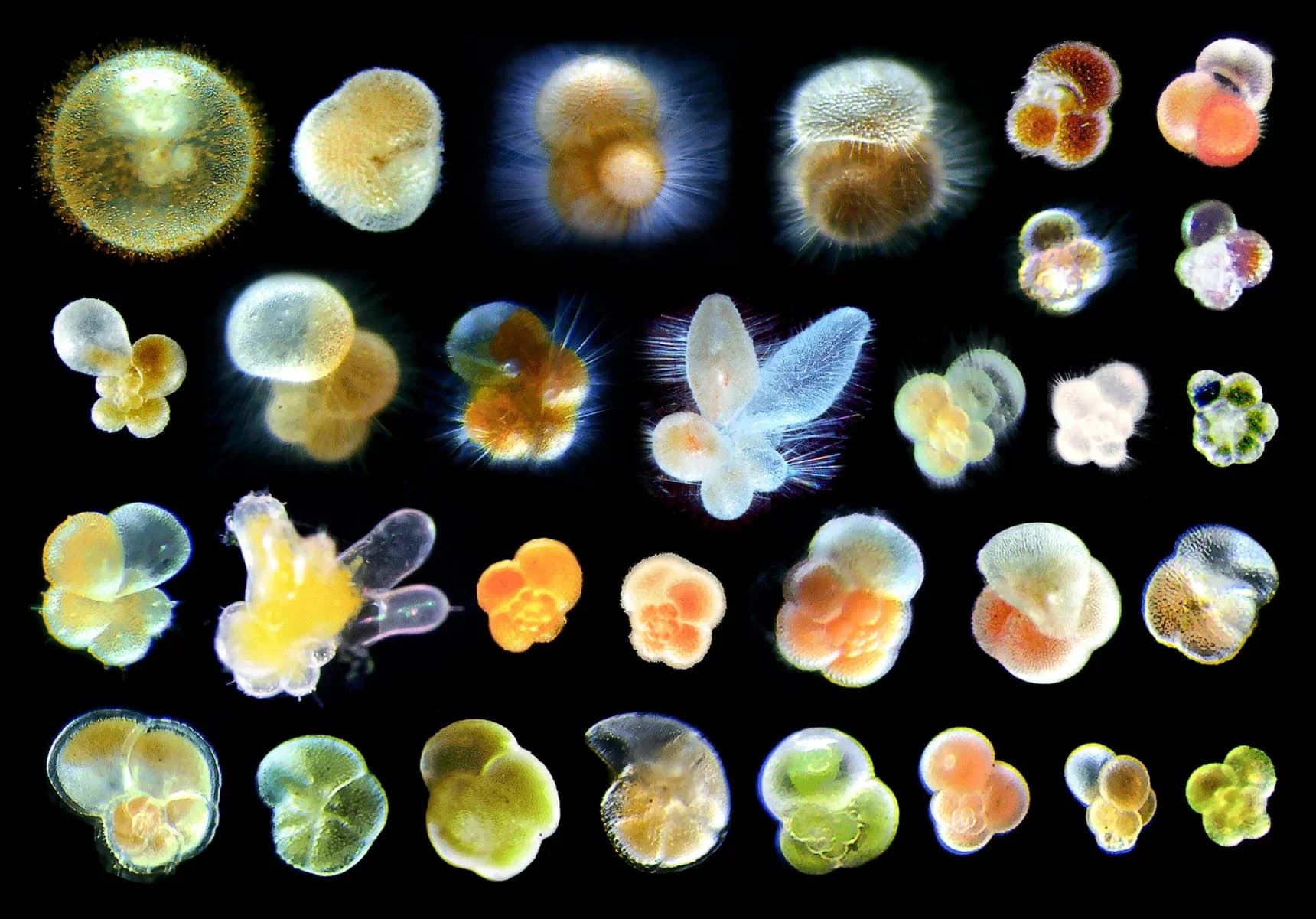
Scientists are investigating a strange pattern preserved in fossil shells: tiny marine organisms known as foraminifera sometimes suddenly change the direction in which their shells coil, with similar changes appearing across widely separated oceans. Foraminifera are single-celled organisms found throughout the world’s oceans. Many species build hard, spiral-shaped shells that become part of the seafloor after the organisms die. Because these shells can accumulate for millions of years, they provide scientists with an important record of Earth’s past climate, oceans and biological changes. Wh
Scientists are investigating a strange pattern preserved in fossil shells: tiny marine organisms known as foraminifera sometimes suddenly change the direction in which their shells coil, with similar changes appearing across widely separated oceans. Foraminifera are single-celled organisms found throughout the world’s oceans. Many species build hard, spiral-shaped shells that become part of the seafloor after the organisms die. Because these shells can accumulate for millions of years, they provide scientists with an important record of Earth’s past climate, oceans and biological changes. What makes the phenomenon particularly unusual is the strong preference for one direction in some species. In certain populations, as many as 97% of individuals coil their shells in the same direction either clockwise or counterclockwise. Yet, at particular points in the fossil record, that dominant direction suddenly changes. For decades, scientists suspected that temperature might explain the shifts. Early research found links between shell direction and colder or warmer periods. But studies from different oceans, combined with advances in genetics, gradually challenged the idea that temperature alone was responsible. A recent synthesis of research covering several species over the past 56 million years offers another possibility. Researchers suggest that changes in shell-coiling direction may not be an adaptation themselves, but rather a visible marker of a much larger evolutionary event. One possibility is that a genetically distinct or newly adapted population emerged within a species and gained an advantage over its competitors. Ocean currents could then have helped that population spread across enormous distances, eventually becoming dominant in different ocean basins. Its characteristic shell-coiling direction would remain visible in the fossil record. One species, Pulleniatina obliquiloculata, provides particularly striking evidence. Although it has predominantly coiled to the right for about 860,000 years, earlier fossil records show rapid global shifts in its coiling direction occurring only thousands of years apart. Scientists stress that the explanation remains a hypothesis. They still do not fully understand why some foraminifera strongly favor one direction while others coil both ways. Nevertheless, these tiny shells could provide a rare window into evolution on a global scale showing how a biological change that begins in a small population may eventually spread across entire ocean systems and leave a lasting mark in Earth’s fossil record.



Comments
No comments yet. Be the first to share a thought.