
President Donald Trump said Wednesday he will ask Congress for “long-term” authority over Washington DC’s police department, suggesting the move could serve as a model for other Democratic-led cities, reports The Guardian. The remarks come days after he invoked a rarely used clause in the federal district’s governance law to temporarily take control of the city’s police force, a power that expires after 30 days unless extended by Congress. “We’re going to need a crime bill that we’re going to be putting in, and it’s going to pertain initially to DC,” Trump said during a visit to the Kennedy C
President Donald Trump said Wednesday he will ask Congress for “long-term” authority over Washington DC’s police department, suggesting the move could serve as a model for other Democratic-led cities, reports The Guardian. The remarks come days after he invoked a rarely used clause in the federal district’s governance law to temporarily take control of the city’s police force, a power that expires after 30 days unless extended by Congress. “We’re going to need a crime bill that we’re going to be putting in, and it’s going to pertain initially to DC,” Trump said during a visit to the Kennedy Center. “We’re going to use it as a very positive example, and we’re going to be asking for extensions on that, long-term extensions, because you can’t have 30 days.” The president said he planned to introduce legislation “very quickly,” but noted Congress is not due to return from recess until September 2. He also hinted at bypassing lawmakers altogether: “If it’s a national emergency, we can do it without Congress.” Trump’s comments follow a major Tuesday night operation in which national guard troops appeared on the National Mall and officers from the FBI, Drug Enforcement Administration, Department of Homeland Security, and other agencies patrolled neighborhoods across the capital. A White House official credited the deployment with 43 arrests, twice the previous night’s total; though Metropolitan Police data showed the city averages 56 arrests per day in 2024. In total, 76 arrests were made citywide on Tuesday, including for DUI, unlawful entry, resisting arrest, and an outstanding assault warrant. Officials also seized seven illegal firearms. More than 1,450 officers participated, about half from DC’s police department, alongside just 30 of the roughly 800 national guard troops expected for the mission. The White House said a “significantly higher” national guard presence is planned, along with 24-hour federal patrols.
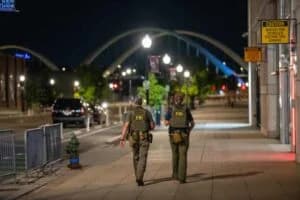
FBI agents patrol the Navy Yard area in Washington DC on 12 August 2025.
Photograph: Andrew Leyden/Getty Images via The Guardian
The administration argues the measures are needed to combat what Trump calls an “out of control” crime crisis. He ordered the deployment after a staffer from the “department of government efficiency” was attacked in an upscale entertainment district. While crime in DC dropped last year to its lowest level in three decades, the city still records higher rates of certain violent crimes than similarly sized cities. Trump linked his push to broader reforms, signaling plans to alter DC’s laws, particularly its cash bail policy, approved in 1992; and to encourage other cities to adopt them. He singled out New York, Chicago, and Los Angeles. “We’re going to go for statutes in DC and then ultimately for the rest of the country, where that’s not going to be allowed,” he said, adding that statehood for DC was “ridiculous” and “an attempt by Democrats to get two more senators.” Democratic leaders have denounced the move as an authoritarian power grab. DC Attorney General Brian Schwalb said the city is “considering all of our options” to protect residents’ rights and safety. Mayor Muriel Bowser, who has largely maintained a cordial relationship with Trump since his return to office, shifted tone Tuesday, urging voters to “protect our city, protect our autonomy, protect our home rule … and make sure we elect a Democratic House so that we have a backstop to this authoritarian push.” Critics also say the intervention is intended to divert attention from Trump’s refusal to release files related to disgraced financier Jeffrey Epstein, once a friend of the president. Trump dismissed the criticism, accusing Democrats of inaction: “They’re afraid to do anything because they don’t want to be criticized. But fighting crime is a good thing.” The White House confirmed that 19 teams of officers from various federal agencies are now in the city “to promote public safety and arrest violent offenders,” while national guard units will “protect federal assets” and deter crime with a visible presence. In the Washington Post, newly appointed US attorney for DC Jeanine Pirro, formerly a Fox News host; wrote that she would press the city council to toughen criminal sentencing, especially for juveniles. “Young criminals have been emboldened to think they can get away with committing crime in this city, and, very often, they do,” Pirro said. “But together with our local and federal partners, our message to them today is: we will identify you, prosecute you and convict you.” This is the second time Trump has sent troops into a US city since taking office in January. In June, he deployed US Marines and federalized national guard forces to Los Angeles to quell protests over his immigration crackdown. Washington DC’s roughly 700,000 residents have no voting representation in Congress, and federal lawmaker, along with the president; have the authority to override or alter city laws.



Comments
No comments yet. Be the first to share a thought.