
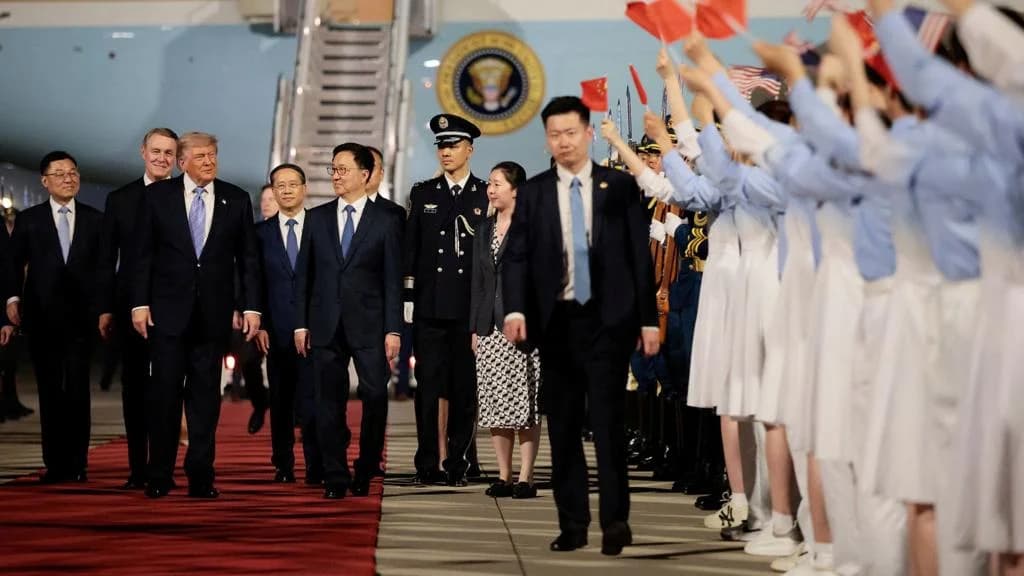
President Donald Trump arrived in Beijing on Wednesday for a high-stakes summit with Chinese President Xi Jinping , opening two days of talks expected to focus on trade, technology, Taiwan and rising tensions in the Middle East. Trump was greeted with a lavish state welcome alongside a delegation that included top American business leaders such as Jensen Huang , Elon Musk and Tim Cook , signaling the central role of technology and commerce in the visit. The summit marks the first visit by a sitting U.S. president to China since 2017 and comes at a delicate moment for both countries, with the t
President Donald Trump arrived in Beijing on Wednesday for a high-stakes summit with Chinese President Xi Jinping, opening two days of talks expected to focus on trade, technology, Taiwan and rising tensions in the Middle East.
Trump was greeted with a lavish state welcome alongside a delegation that included top American business leaders such as Jensen Huang, Elon Musk and Tim Cook, signaling the central role of technology and commerce in the visit.
The summit marks the first visit by a sitting U.S. president to China since 2017 and comes at a delicate moment for both countries, with the trade truce reached during the 2025 Busan Summit under pressure and geopolitical tensions rising over Iran and Taiwan.
While Trump said trade would remain the primary focus of discussions, observers say Iran is likely to dominate much of the strategic conversation behind closed doors. Washington has spent weeks unsuccessfully trying to persuade Beijing to use its influence with Tehran to reduce tensions around the Strait of Hormuz and return to negotiations.
China is Iran’s largest oil customer, purchasing more than 80 percent of Iran’s shipped crude exports, giving Beijing considerable leverage over Tehran at a time when fears of wider regional instability continue to grow.
Taiwan is also expected to emerge as a major flashpoint during the talks. Trump said earlier this week that he intended to raise the issue of U.S. arms sales to Taiwan with Xi, a move analysts say conflicts with longstanding U.S. commitments, including the Reagan-era Six Assurances, which have historically governed American arms policy toward the island.
The presence of leading U.S. technology executives has further underscored the importance of artificial intelligence and semiconductors in the negotiations. Huang’s presence highlights the growing importance of AI diplomacy as Washington and Beijing compete over strategic technologies. Nvidia has faced mounting U.S. restrictions on exports of advanced AI chips to China amid the broader technology rivalry between the two countries.
Analysts expect both sides to seek symbolic economic wins that could demonstrate stability in the relationship. Possible announcements include major Chinese purchases of American aircraft, soybeans and agricultural products. U.S. Senator Steve Daines, who recently visited Beijing, described the expected outcomes as “Boeing, beef and beans.”
The economic stakes extend well beyond bilateral trade. The summit is also being closely watched across Africa due to its potential implications for critical mineral and rare earth supply chains. China dominates global rare earth processing and has previously used its control over strategic minerals as leverage during trade disputes with the United States.
Several African countries, including Democratic Republic of the Congo, South Africa, Tanzania and Madagascar, are increasingly important players in the global supply of critical minerals used in electric vehicles, defense systems and semiconductor manufacturing.
Analysts say any easing of tensions between Washington and Beijing over rare earth exports could affect Western investment strategies in Africa’s mineral sector, while continued rivalry may increase competition for influence and access across the continent.
Experts believe the summit is more likely to produce modest steps toward greater stability rather than a major breakthrough, with both governments seeking to prevent further deterioration in relations between the world’s two largest economies.



Comments
No comments yet. Be the first to share a thought.