
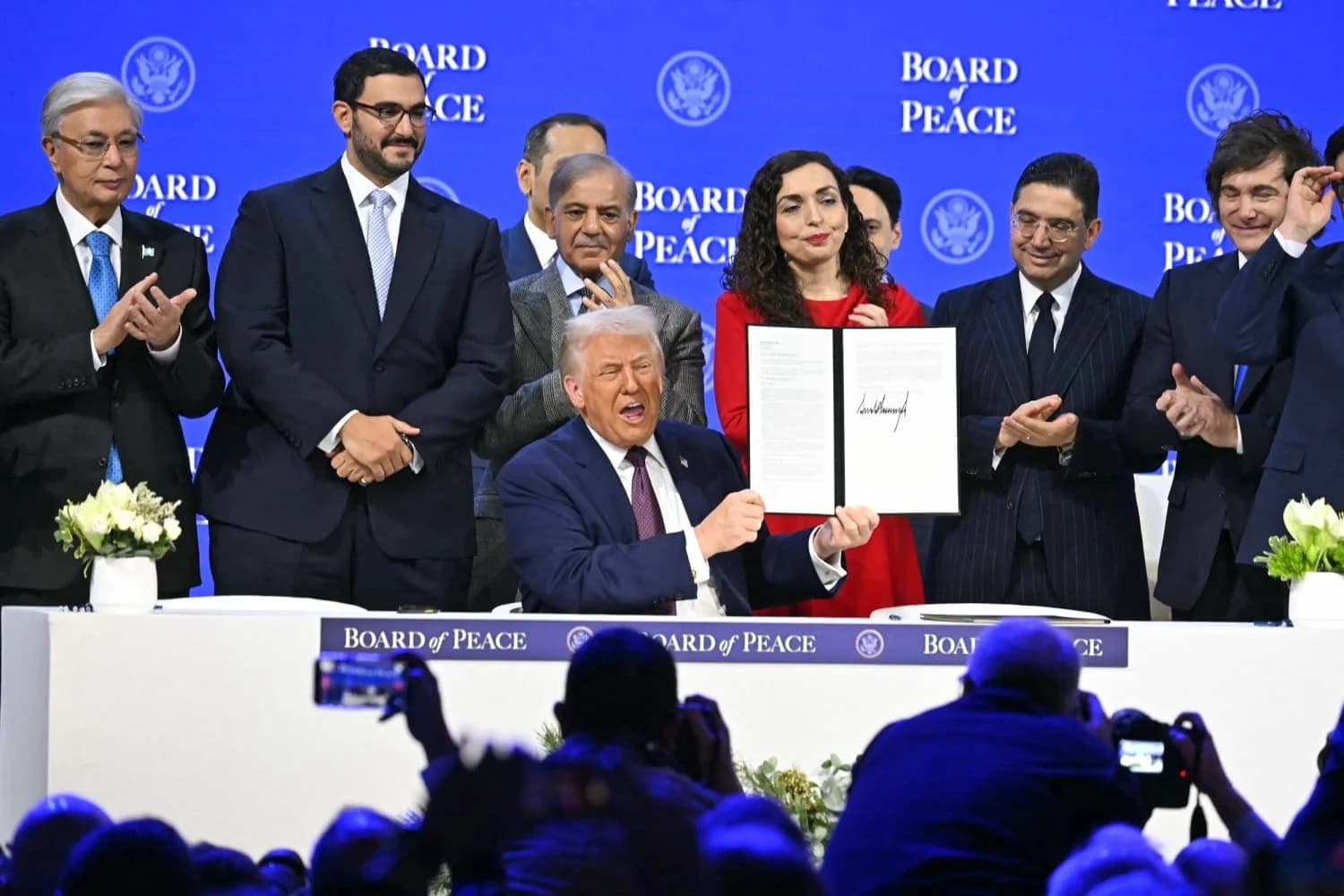
U.S. President Donald Trump’s newly launched Board of Peace has triggered widespread international debate, with criticism focusing on both its structure and the controversial leaders linked to it. The invite-only body was formally unveiled at the World Economic Forum in Davos, after Trump first proposed it in September as part of a U.S.-brokered effort to secure a ceasefire between Israel and Hamas and later oversee the reconstruction of Gaza following a destructive two-year war. Trump has since expanded its scope, presenting it as a global mechanism for resolving conflicts and rebuilding war-
U.S. President Donald Trump’s newly launched Board of Peace has triggered widespread international debate, with criticism focusing on both its structure and the controversial leaders linked to it. The invite-only body was formally unveiled at the World Economic Forum in Davos, after Trump first proposed it in September as part of a U.S.-brokered effort to secure a ceasefire between Israel and Hamas and later oversee the reconstruction of Gaza following a destructive two-year war. Trump has since expanded its scope, presenting it as a global mechanism for resolving conflicts and rebuilding war-torn regions. Much of the controversy surrounds the figures associated with the board. Leaders who have joined or expressed interest include Russia’s Vladimir Putin, Hungary’s Viktor Orbán, Saudi Arabia’s Mohammed bin Salman, Turkey’s Recep Tayyip Erdoğan, Belarusian President Alexander Lukashenko, and Israeli Prime Minister Benjamin Netanyahu. Many of these leaders have been strongly criticized by international human rights organizations. Putin faces an International Criminal Court arrest warrant over alleged war crimes linked to Russia’s war in Ukraine, including the forced transfer of Ukrainian children. Lukashenko has been accused by UN experts of crimes against humanity for widespread repression and torture, while Mohammed bin Salman has been linked by U.S. intelligence to the killing of journalist Jamal Khashoggi. Orbán and Erdoğan have been accused of undermining democratic institutions, and Netanyahu also faces an ICC arrest warrant over the Gaza conflict. Trump has defended the board’s composition, acknowledging it includes “controversial people” but arguing that strong leaders can deliver results. He has said the Board of Peace will work alongside the United Nations, though he has also suggested it could replace the UN, which he has repeatedly criticized as ineffective. Under the board’s charter, Trump will remain chairman indefinitely. Membership is limited to three years unless a country pays $1 billion for permanent status. Several countries, including France, Norway, and Sweden, have declined to join, citing concerns about undermining multilateral institutions. As the initiative takes shape, the Board of Peace remains one of the most divisive foreign policy projects of Trump’s presidency.
Comments
No comments yet. Be the first to share a thought.