
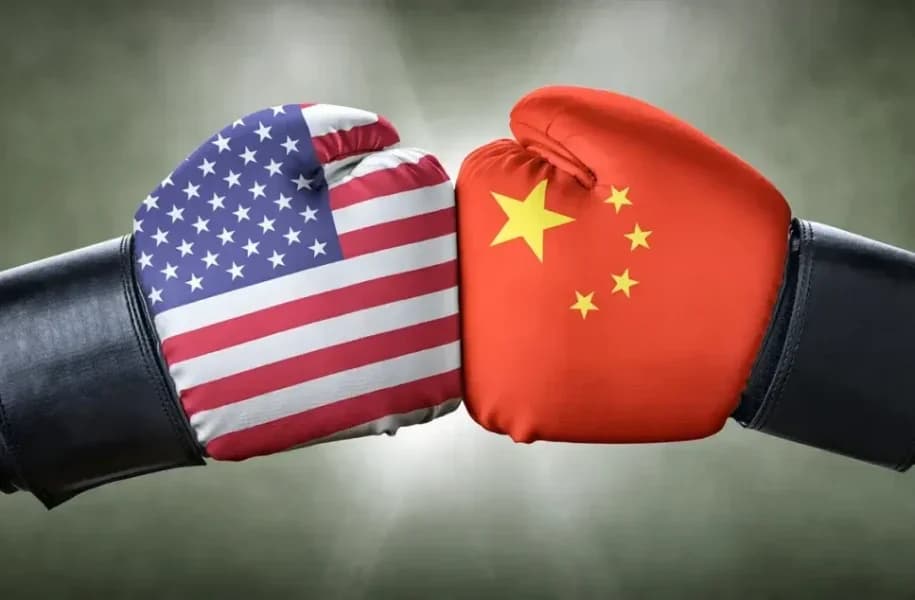
The United States and China have reached a significant agreement to pause their intensifying trade war for 90 days, announcing a reciprocal reduction of tariffs by 115%, in a move aimed at easing global economic tensions. The breakthrough came after high-level negotiations held in Geneva over the weekend. U.S. Treasury Secretary Scott Bessent described the talks as conducted with “great respect” and confirmed that both sides had agreed on the need to de-escalate. “The consensus from both delegations this weekend was neither side wants a decoupling,” Bessent told reporters following the talks
The United States and China have reached a significant agreement to pause their intensifying trade war for 90 days, announcing a reciprocal reduction of tariffs by 115%, in a move aimed at easing global economic tensions. The breakthrough came after high-level negotiations held in Geneva over the weekend. U.S. Treasury Secretary Scott Bessent described the talks as conducted with “great respect” and confirmed that both sides had agreed on the need to de-escalate. “The consensus from both delegations this weekend was neither side wants a decoupling,” Bessent told reporters following the talks. Under the terms of the agreement, the steep duties previously imposed by both nations will be temporarily reduced. The U.S. had imposed tariffs reaching 125% on Chinese imports, a policy that had been met with equivalent countermeasures from Beijing. As part of the new deal, tariffs on Chinese goods entering the U.S. will now be lowered to 30%, while China’s tariffs on American products will drop to 10%. However, the U.S. will maintain an earlier 20% tariff on certain Chinese goods, originally imposed by President Donald Trump over concerns regarding China’s alleged role in fueling the fentanyl crisis in the United States. In addition to tariffs, China had implemented a series of non-tariff retaliatory actions, including restrictions on the export of rare earth minerals critical to U.S. technology and manufacturing sectors. U.S. Trade Representative Jamieson Greer criticized China’s countermeasures as disproportionate, claiming they amounted to a near-total embargo on trade between the world’s two largest economies. A spokesperson for China’s Ministry of Commerce welcomed the outcome, calling it a mutually beneficial development. “This move meets the expectations of producers and consumers in both countries, as well as the interests of both nations and the common interest of the world,” the spokesperson said. They urged the U.S. to take further steps toward reversing unilateral tariff hikes and strengthening cooperation. The positive developments had an immediate impact on global markets. China’s yuan surged to a six-month high amid optimism, with analysts estimating up to 16 million jobs in China were at risk due to the trade conflict. In the U.S., the tariffs had been driving inflation and causing shortages of key consumer goods. Bessent also acknowledged progress on another critical issue: fentanyl. “For the first time, the Chinese side understood the magnitude of what is happening in the U.S.,” he said, adding that Chinese officials showed a willingness to engage on curbing the production and export of synthetic opioids. A joint statement released by both governments on Monday emphasized continued collaboration and dialogue, pledging to move forward “in a spirit of mutual openness, continuous communication, cooperation, and mutual respect.” The financial world responded favorably. William Xin, chairman of Spring Mountain Pu Jiang Investment Management, called the agreement “a result that far exceeds market expectations.” He told Reuters: “Previously, the hope was just that the two sides could sit down to talk. Now there’s more certainty. Both China stocks and the yuan will be in an upswing for a while.” Chinese commentators hailed the agreement as a diplomatic win. Hu Xijin, former editor of the nationalist tabloid Global Times, called it a “great victory for China in upholding the principles of equality and mutual respect.” On social media, he contrasted the U.S.-China outcome with the recent UK-U.S. trade deal, which maintained a 10% U.S. tariff on British imports without reciprocal British measures. Wang Wen, director of the Chongyang Institute for Financial Studies at Renmin University, described the agreement as “an unexpected achievement in Sino-U.S. tariff negotiations.” Nonetheless, he cautioned that it did not resolve the underlying structural tensions between the two countries. “There will still be friction and serious differences between China and the United States in the future,” Wang said. Stock markets across Europe rallied on the news. Germany’s DAX rose by 1.5%, with gains led by major manufacturers like Mercedes-Benz, Daimler Trucks, and BMW. France’s CAC index saw a 1.2% increase.



Comments
No comments yet. Be the first to share a thought.