

The Ugandan High Court has sentenced Christopher Okello Onyum to death for the murder of four toddlers at a Kampala daycare center, concluding one of the most disturbing criminal trials in the country’s recent history and shifting the case from questions of evidence to the weight of judgment and consequence. Delivering the ruling in a mobile court session near the scene of the April 2 attack in Ggaba, Justice Alice Komuhangi Khaukha said the nature of the crime met the threshold for the “rarest of the rare,” a standard used to justify capital punishment in exceptional cases. The victims (Ryan
The Ugandan High Court has sentenced Christopher Okello Onyum to death for the murder of four toddlers at a Kampala daycare center, concluding one of the most disturbing criminal trials in the country’s recent history and shifting the case from questions of evidence to the weight of judgment and consequence.
Delivering the ruling in a mobile court session near the scene of the April 2 attack in Ggaba, Justice Alice Komuhangi Khaukha said the nature of the crime met the threshold for the “rarest of the rare,” a standard used to justify capital punishment in exceptional cases.
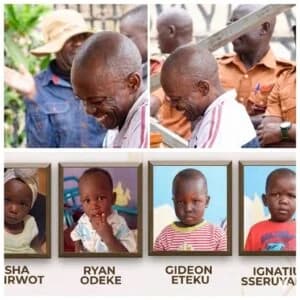
The victims (Ryan Odeke, Keisha Agenorwoth Otim, Gideon Eteku, and Ignatius Sseruyange) were all under the age of three. ALSO READ : Ggaba daycare killings trial
A calculated attack in minutes
In her judgment, Justice Komuhangi outlined what the court determined to be a deliberate and premeditated act.
Evidence presented during trial showed that Okello had visited the daycare a day earlier posing as a parent. On the morning of the attack, he returned, completed registration procedures, and remained on the premises briefly before carrying out the killings.
The court found that the sequence of actions, including prior reconnaissance, financial transactions at the facility, and the speed of execution, pointed to planning rather than impulse. The attack itself, the court heard, unfolded in a matter of minutes.
Investigators also linked Okello to multiple weapons recovered after his arrest, reinforcing the prosecution’s argument that the incident was not isolated or spontaneous.
Digital traces and alleged influences
A significant aspect of the prosecution’s case, highlighted in the ruling, involved Okello’s digital footprint. The court referenced evidence that he had accessed violent online material, including content associated with the Islamic State of Iraq and Syria (ISIS).
Justice Komuhangi stated that while such material alone does not constitute a crime, in this case it contributed to a broader pattern suggesting preparation and psychological conditioning toward violence.
The court stopped short of establishing any formal link to extremist networks but held that the content reinforced the conclusion of intentional and methodical conduct.
Insanity defence rejected
Okello’s defence argued that he was suffering from severe psychological distress, claiming he was under surveillance and coercion by unknown individuals at the time of the killings.
The court rejected this argument.
In its ruling, the judge cited inconsistencies in the defence narrative and pointed to evidence indicating that Okello was mentally sound in the period leading up to the attack. A psychiatric assessment conducted in late 2025 reportedly found no chronic mental illness, and testimony from individuals who had interacted with him described his behaviour as stable.
“The accused was aware of his actions and their consequences,” Justice Komuhangi ruled, concluding that the legal threshold for an insanity defence had not been met.
Silence in the dock
In one of the most striking moments of the proceedings, Okello declined to speak when given the opportunity before sentencing. Standing in the dock, he offered no apology or statement to the families of the victims.
The courtroom, filled with relatives and community members, reacted emotionally as the sentence was read, with some attendees reportedly collapsing under the weight of the moment.
A rare but lawful sentence
While the death penalty remains part of Ugandan law, its application has become increasingly limited following the landmark Susan Kigula case, which removed its mandatory nature and granted judges discretion in capital cases.
Legal analysts say the Ggaba ruling reflects how courts now reserve the death sentence for cases deemed exceptionally grave, particularly where victims are vulnerable and evidence points to clear premeditation.
However, the sentence does not automatically translate into execution.
Uganda has not carried out executions in decades, and under the Kigula precedent, death sentences may be commuted to life imprisonment if not implemented within a specified period after all appeals are exhausted.
Fast-tracked justice under scrutiny
The trial itself was conducted under unusual circumstances following a directive by Yoweri Museveni to expedite proceedings and hold them within the affected community.
While the approach was intended to deliver swift justice, it also drew criticism from legal observers who questioned whether the setting and speed risked undermining procedural safeguards.
Despite those concerns, the court maintained that due process was followed and that the verdict was based strictly on the evidence presented.
What comes next
Okello has the right to appeal both the conviction and the sentence, a process that could extend the legal battle for months or years.
If the conviction is upheld, the case will move into a different phase, one less about establishing guilt and more about how justice is ultimately carried out in a system where the death penalty exists in law but is rarely enforced in practice.
For the families of the victims and the Ggaba community, the ruling marks a decisive legal conclusion. But as the appeals process begins, the broader questions raised by the case, about justice, punishment, and prevention, are likely to remain.
The Ggaba daycare killings, once defined by contested evidence and courtroom tension, now stand as a judgment delivered, and a sentence whose final outcome may still depend on time, law, and the path ahead.



Comments
No comments yet. Be the first to share a thought.