
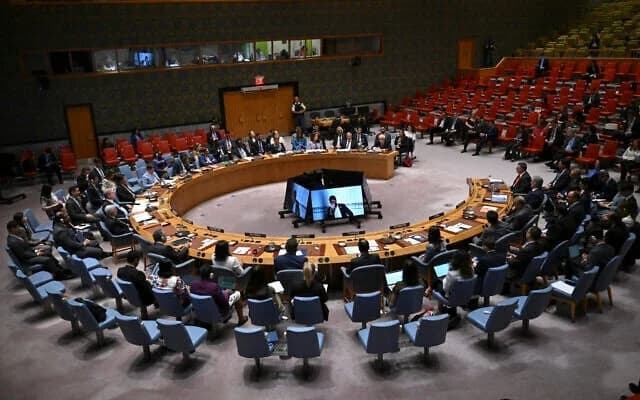
The United States announced Friday it will not allow Palestinian Authority (PA) President Mahmoud Abbas to travel to New York next month for the annual United Nations General Assembly (UNGA), where several US allies are expected to formally recognize Palestine as a state. A State Department official told The Times of Israel that the visa ban, which applies to 80 senior PA officials, extends to Abbas himself. The restriction follows a policy first unveiled last month and now implemented for the first time. Abbas had planned to attend the high-level UNGA meetings at UN headquarters in Manhatta
The United States announced Friday it will not allow Palestinian Authority (PA) President Mahmoud Abbas to travel to New York next month for the annual United Nations General Assembly (UNGA), where several US allies are expected to formally recognize Palestine as a state. A State Department official told
The Times of Israel
that the visa ban, which applies to 80 senior PA officials, extends to Abbas himself. The restriction follows a policy first unveiled last month and now implemented for the first time. Abbas had planned to attend the high-level UNGA meetings at UN headquarters in Manhattan and participate in a summit hosted by France and Saudi Arabia, where Britain, France, Australia, and Canada are preparing to announce recognition of Palestinian statehood. Abbas’s office expressed “astonishment” at the US decision, calling it a violation of the UN “headquarters agreement,” which generally obliges Washington to admit foreign diplomats invited to UN sessions. “The decision stands in clear contradiction to international law and the UN Headquarters Agreement, particularly since the State of Palestine is an observer member of the United Nations,” his office said, urging the US to reverse course.
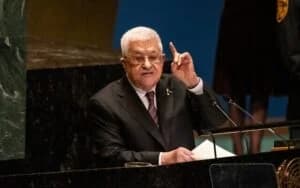
Palestinian Autthority president Abbas Mahmoud speaking at UNGA in September 2024, New York. Photograph: Stephanie Keith / Getty Images
The UN confirmed it will raise the issue with Washington. UN spokesperson Stephane Dujarric noted that, under the 1947 agreement, the US must permit access for member state representatives, invited officials, and UN personnel to headquarters in New York. Explaining the move, the State Department said: “It is in our national security interests to hold the Palestine Liberation Organization and the Palestinian Authority accountable for not complying with their commitments, and for undermining the prospects for peace.” The restrictions will not apply to the PA’s permanent mission to the UN, whose diplomats are already based in New York. Those officials will receive visa waivers to attend the UNGA. US officials added that before the PA and PLO can be considered “partners for peace,” they must “repudiate terrorism including the October 7 massacre, and end incitement to terrorism in education, as required by US law.” Abbas, under heavy Israeli and international pressure, condemned the Hamas-led October 7, 2023, attack for the first time in June. The visa decision is seen as Washington’s first direct punitive measure in response to France, the UK, Canada, and Australia advancing recognition of Palestine. The Trump administration appears focused on penalizing Ramallah rather than directly confronting Western allies. Secretary of State Marco Rubio argued that France’s decision to recognize a Palestinian state emboldened Hamas in hostage negotiations, though sources involved in the talks told
The Times of Israel
Hamas had already raised its demands hours before French President Emmanuel Macron’s announcement. Israel’s Ambassador to the UN, Danny Danon, said France was spearheading the recognition drive rather than the PA. The State Department also accused the PA of attempting to “bypass negotiations” through legal campaigns at the International Criminal Court and International Court of Justice, which it claimed contributed to Hamas’s refusal to release hostages and the collapse of ceasefire talks in Gaza. Israel’s Foreign Minister Gideon Sa’ar praised the US decision, thanking Rubio for holding the PA and PLO “accountable for rewarding terrorism, incitement and efforts to use legal warfare against Israel.” Sa’ar, who met Rubio in Washington earlier this week, said the move showed the Trump administration was “standing by Israel once again” with a “bold step.” White House deputy chief of staff Stephen Miller reinforced the administration’s stance, saying: “We’ve been very clear when it comes to our visa system that we are going to take all necessary steps to prevent it from being used by individuals who may support or espouse terrorism or terrorist activity.” The visa denial is the least severe of four measures available under a 2002 law requiring the president to certify whether Palestinian entities are upholding commitments to peace and combating terrorism. A harsher step; designating the PA as a foreign terrorist organization, would trigger sweeping sanctions but has not been pursued. The PA faces growing international pressure to reform, as Arab and Western governments push for it to eventually govern Gaza in place of Hamas. Israeli Prime Minister Benjamin Netanyahu has ruled out such a role but has offered no alternative, under pressure from far-right coalition partners advocating settlements in the territory.



Comments
No comments yet. Be the first to share a thought.