
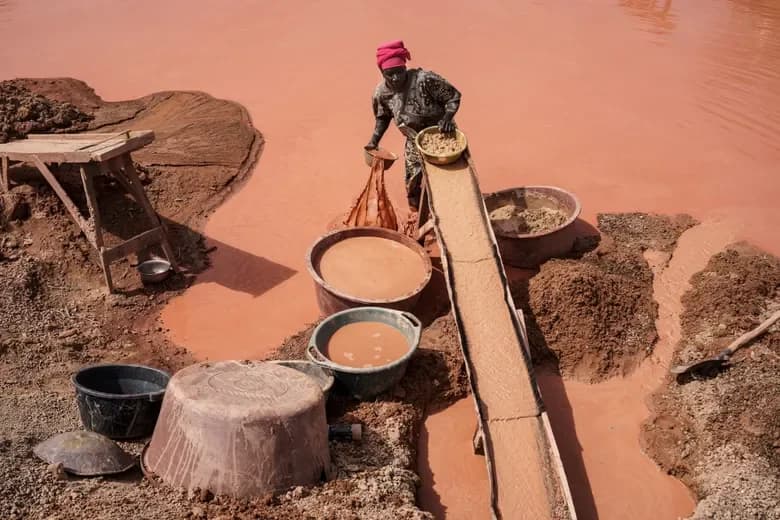
In Senegal’s remote Kedougou Region, near the borders of Guinea and Mali, the search for gold is an everyday activity — but it comes at a dangerous cost. Sadio Camara, like many other women in the region, relies on mercury to extract gold from rock. It’s the fastest method, she says, as she empties a small packet of the silvery substance into a bucket of sediment in front of her home. With no gloves or mask, Camara mixes the contents by hand while her children look on. “I know it’s dangerous,” she admits, noting that gold traders wear masks when heating the mercury again. “But I only process
In Senegal’s remote Kedougou Region, near the borders of Guinea and Mali, the search for gold is an everyday activity — but it comes at a dangerous cost. Sadio Camara, like many other women in the region, relies on mercury to extract gold from rock. It’s the fastest method, she says, as she empties a small packet of the silvery substance into a bucket of sediment in front of her home. With no gloves or mask, Camara mixes the contents by hand while her children look on. “I know it’s dangerous,” she admits, noting that gold traders wear masks when heating the mercury again. “But I only process small amounts, so I think I’m safe.” Unfortunately, even limited exposure to mercury can lead to severe health consequences. Across West Africa, mercury, a highly toxic neurotoxin — remains the most common tool in informal and often illegal gold mining operations. In Kedougou, women like Camara use mercury routinely without proper protection. Prolonged exposure can result in irreversible brain damage, tremors, hearing and vision loss, and developmental issues. Mercury is also an environmental hazard. Once released into the environment, it travels quickly through the air, contaminates rivers after heavy rainfall, and accumulates in the food chain by poisoning fish and aquatic life. “We do this out of ignorance and because we have no other means,” Camara says, her young son playing at her feet. “If the government knows what’s best for us, they should come and show us.” The process of extracting gold is simple but harmful. In her small kitchen hut, Camara heats mercury-laced sediment over an open flame using a spoon. The mercury evaporates into toxic fumes, leaving behind a small gold nugget. Her children stand nearby, exposed to the fumes without any protection. Camara explains that men usually handle the burning, but women regularly mix the mercury amalgam with bare hands. “If mercury hurt immediately like a knife, people wouldn’t touch it. But its damage comes years later,” says Doudou Dramé, president of a local safety advocacy group for gold miners. Women are particularly vulnerable, says Modou Goumbala, who works with La Lumiere, an NGO focused on community development in southeastern Senegal. He highlights how women’s daily activities: laundry, dishwashing, and childcare; increase their contact with contaminated water sources. For pregnant and nursing women, the risks are even more serious, as mercury can cross the placenta and pass into breast milk, threatening the development of infants. While mercury-free gold extraction methods do exist, such as gravity separation using shaking tables, access remains extremely limited. In 2020, the Senegalese government pledged to build 400 mercury-free gold processing units. As of now, only one has been completed, sitting idle and rusting under a roof in Bantaco, 15 miles from Camara’s village. Few miners use it due to the long and impractical journey required to transport ore there and back. “One machine per village would be more effective,” says Goumbala. Jen Marraccino, senior development director at Pure Earth, a global NGO combating mercury and lead poisoning, believes that widespread adoption of mercury-free technologies could transform the sector. “As this work expands in a region, costs for safer technologies like shaking tables decrease. With stronger supply chains, solutions become sustainable,” she explains. Repeated attempts by the Associated Press to speak with Senegal’s director of artisanal and small-scale mining were unsuccessful. The official later stated that the department had been suspended but did not offer any further explanation.



Comments
No comments yet. Be the first to share a thought.