
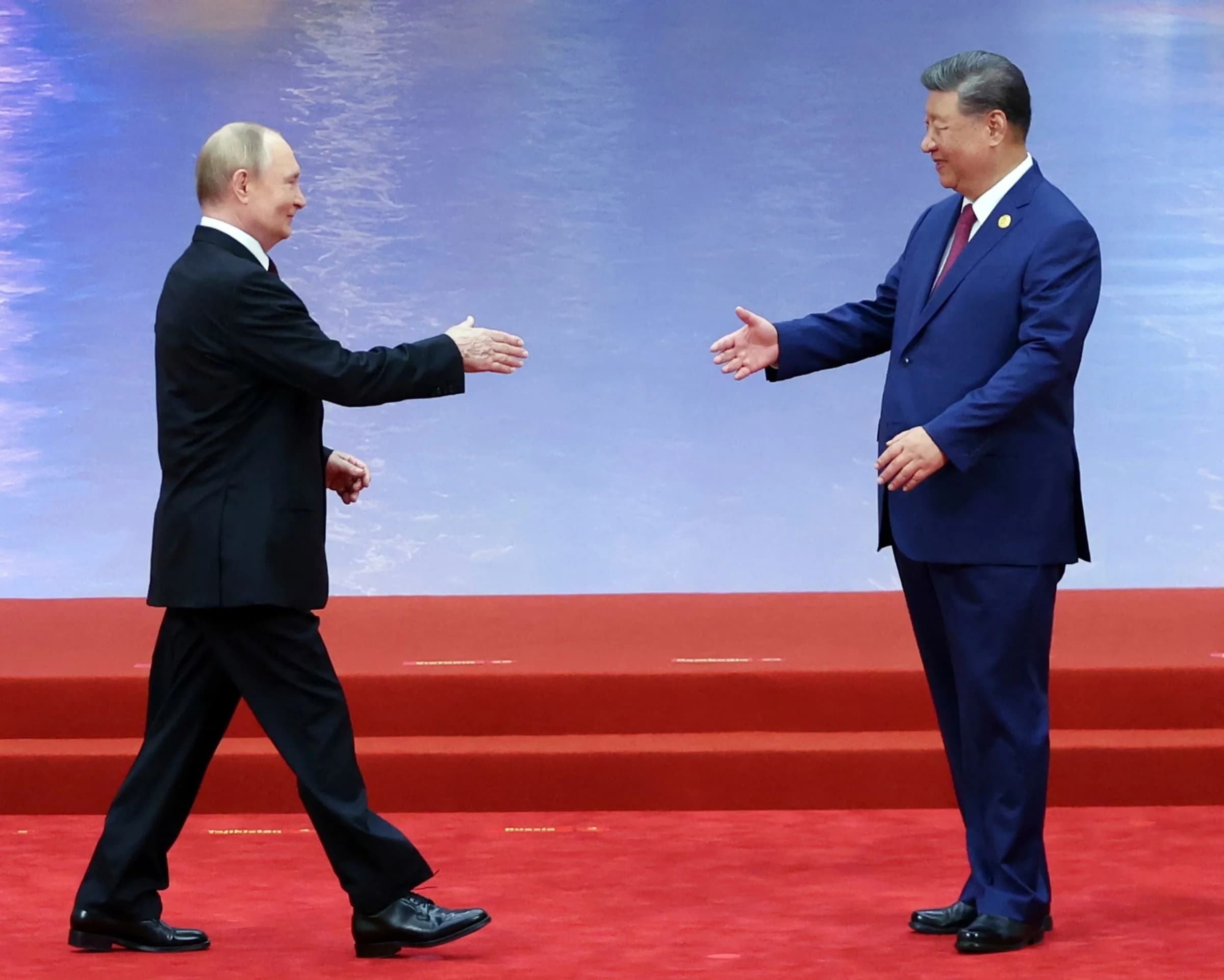
Chinese President Xi Jinping and Russian President Vladimir Putin held talks on Sunday on the sidelines of a major summit in Tianjin, underscoring their “limitless” partnership as Beijing pushes for alternatives to US-led alliances. According to The Guardian , the meeting took place during the Shanghai Cooperation Organisation (SCO) summit, a 10-member Eurasian bloc that China has positioned as a counterweight to Western influence. This year’s gathering is the largest since the SCO was founded in 2001, drawing leaders from more than two dozen nations, including 16 observer or “dialogue partne
Chinese President Xi Jinping and Russian President Vladimir Putin held talks on Sunday on the sidelines of a major summit in Tianjin, underscoring their “limitless” partnership as Beijing pushes for alternatives to US-led alliances. According to The Guardian, the meeting took place during the Shanghai Cooperation Organisation (SCO) summit, a 10-member Eurasian bloc that China has positioned as a counterweight to Western influence. This year’s gathering is the largest since the SCO was founded in 2001, drawing leaders from more than two dozen nations, including 16 observer or “dialogue partner” states. According to a Kremlin official, Xi and Putin discussed the Russian leader’s recent meeting with Donald Trump, though no further details were given. Footage released by Russian state media showed the two leaders warmly greeting one another before sitting down for a lengthy conversation with the help of interpreters. Xi welcomed several heads of state in person, including Indian Prime Minister Narendra Modi and Turkish President Recep Tayyip Erdoğan, before hosting a formal reception. In his opening remarks, Xi described the last century as marked by “instability, uncertainty and unpredictable factors,” adding that the SCO had become “an important force in promoting the building of a new type of international relations and a community with a shared future for mankind,” reports The Guardian. Putin arrived in Tianjin with senior political and business figures and is expected to stay on for a military parade in Beijing on Wednesday marking the 80th anniversary of the end of World War II. North Korean leader Kim Jong-un is also expected to attend the parade, which China commemorates as the “war of resistance against Japanese aggression.” Speaking to China’s Xinhua news agency ahead of the summit, Putin said the meeting would “consolidate solidarity” among Eurasian nations and “help shape a fairer multipolar world order.” Trump’s tariff regime and recent foreign policy moves have helped fuel the summit’s anti-Western momentum. Modi’s talks with Xi came just days after Washington imposed 50% tariffs on Indian goods in retaliation for New Delhi’s purchase of Russian oil. It was Modi’s first visit to China in seven years. “We are committed to progressing our relations based on mutual respect, trust and sensitivities,” Modi said. Xi responded that China-India ties could be “stable and far-reaching” if the two nations viewed one another as partners rather than rivals, according to Chinese state media. During separate bilateral meetings, Xi urged Erdoğan to deepen cooperation with China on counter-terrorism. He also held talks with leaders from the Maldives, Azerbaijan, Kyrgyzstan, and Belarusian President Alexander Lukashenko, one of Putin’s closest allies. The meetings took place at the Tianjin Guest House, an intimate compound surrounded by greenery, with large parts of the city locked down under heavy police presence. Analysts said the Xi-Putin encounter highlighted the endurance of their partnership despite ongoing conflicts. Lim Chuan-Tiong of the University of Tokyo said their cooperation reflects a shared determination to oppose Washington. “As long as the mutual opponent [the US] has not been defeated, China and Russia’s off-limits cooperation will remain,” Lim said. “Their cooperation also serves to highlight a global order that exists beyond the United States.” The partnership has been reinforced by Moscow’s 2022 invasion of Ukraine and Beijing’s ongoing threats against Taiwan, which have deepened both governments’ isolation from the West. Russian analysts cited by The Guardian, said the war in Ukraine has become central to the relationship, with Moscow seeking clarity on how Beijing would respond if pressed by Washington to push for an end to the fighting. “The longer the war [in Ukraine] drags on, the more Russia will need China’s assistance, whether economically or other forms,” Lim said. “China also recognises that it is unlikely for Sino-US relations to return to their pre-2018 state and thus has no choice but to accept a close alignment with Russia.” Beijing insists it remains neutral on the Ukraine conflict but has provided Moscow with a crucial economic lifeline. Kyiv has accused China of supplying direct aid to Russia’s war effort, while the two nations have increased joint military drills.



Comments
No comments yet. Be the first to share a thought.