
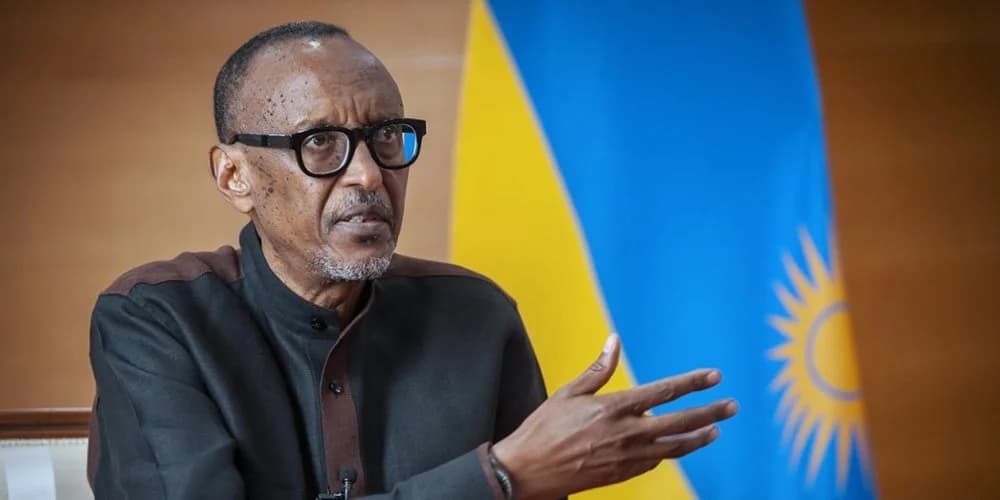
President Paul Kagame has stated that aid to developing countries is often used as a tool for control and dependency. In an interview with American journalist Mario Nawfal, President Kagame discussed various topics, including Rwanda’s recovery journey after the 1994 Genocide against the Tutsi, the crisis in the Democratic Republic of Congo, and international politics, particularly foreign aid to developing nations. During the interview, President Kagame noted that while aid can be used to build a country's capacity for self-sufficiency, it also fosters dependency. “Aid creates dependency. W
President Paul Kagame has stated that aid to developing countries is often used as a tool for control and dependency. In an interview with American journalist Mario Nawfal, President Kagame discussed various topics, including Rwanda’s recovery journey after the 1994 Genocide against the Tutsi, the crisis in the Democratic Republic of Congo, and international politics, particularly foreign aid to developing nations. During the interview, President Kagame noted that while aid can be used to build a country's capacity for self-sufficiency, it also fosters dependency. “Aid creates dependency. Whoever gives you aid controls your life,” he said. He further explained "In fact, that is why they want you to stay with aid, so they continue controlling your life. They use it as a tool to direct you where they want you to go. They keep threatening that if you don’t do this, we will switch it off. It is weaponized.” President Kagame emphasized that, depending on how it is managed, aid can become a liability for a country. He pointed out that Rwanda has faced criticism for its long-term vision of reducing dependence on aid. “We need it, we can show where we need it but we also work out how to get out of it ... But that has attracted a lot of problems for us. We have been branded as arrogant or insensitive or dictatorial -- all kind of names.” He clarified that Rwanda's position on aid is not about rejecting it outright but about avoiding the long-term consequences of dependency. “It's not that we don't want aid for the sake of not wanting it; we are saying aid creates dependency. By the way, it's not only dependency -- dependency is on the good side, or even the better side -- whoever gives you aid controls your life.” Rwanda has achieved self-reliance by implementing strategic policies focused on economic growth, good governance, and sustainable development. The country prioritizes domestic resource mobilization through effective taxation policies, the promotion of local industries, and investments in infrastructure projects that enhance productivity. Vision 2050, along with initiatives like the National Strategy for Transformation (NST1 and NST2), aims to strengthen key sectors such as agriculture, manufacturing, and technology to drive economic independence. Additionally, Rwanda fosters entrepreneurship and innovation, supporting small and medium enterprises (SMEs) to boost economic self-sufficiency. Through initiatives like Made in Rwanda, the country reduces its reliance on imports while increasing exports, further enhancing economic resilience. Rwanda also minimizes dependence on foreign aid by promoting homegrown solutions tailored to local challenges. Policies such as Umuganda (community service), Girinka (one-cow-per-family program), and the Agaciro Development Fund emphasize self-sufficiency and collective responsibility. The government prioritizes education and skills development to ensure the workforce meets the demands of a growing economy. Strategic partnerships with investors and regional trade agreements enable Rwanda to attract investment while maintaining financial independence. As a result, Rwanda’s economy has consistently grown at an annual rate of over 8%. The country’s per capita income has increased from $111 in 1994 to $1,040 in 2023, reflecting its commitment to self-sufficiency and sustainable development.



Comments
No comments yet. Be the first to share a thought.