
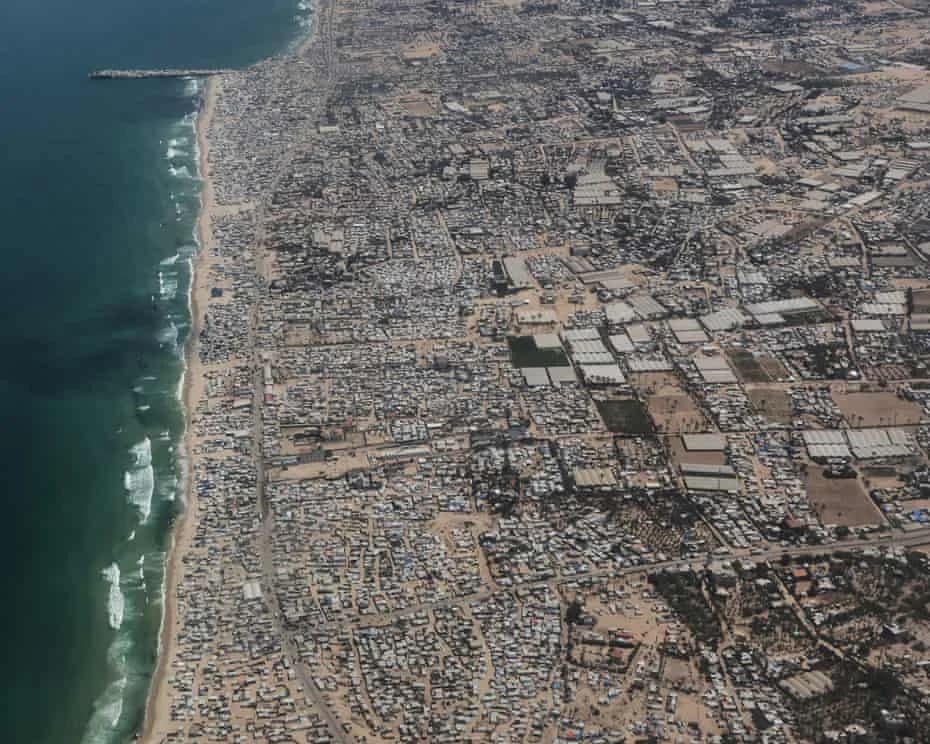
Belgium and Germany have both taken significant steps in response to Israel’s newly announced plan to surround and occupy Gaza City as part of an expanded military operation across the entire Gaza Strip, reports The Guardian . The move, confirmed by Prime Minister Benjamin Netanyahu’s office on Thursday night, has sparked international criticism amid warnings that it could worsen the humanitarian crisis and derail prospects for peace. Belgian Foreign Minister Maxime Prévot announced on Friday that he had summoned the Israeli ambassador to Brussels to express “total disapproval” of the decisi
Belgium and Germany have both taken significant steps in response to Israel’s newly announced plan to surround and occupy Gaza City as part of an expanded military operation across the entire Gaza Strip, reports
The Guardian
. The move, confirmed by Prime Minister Benjamin Netanyahu’s office on Thursday night, has sparked international criticism amid warnings that it could worsen the humanitarian crisis and derail prospects for peace. Belgian Foreign Minister Maxime Prévot announced on Friday that he had summoned the Israeli ambassador to Brussels to express “total disapproval” of the decision. Writing on X (formerly Twitter), Prévot condemned Israel’s stated intention to take military control of all Gaza, as well as the “continued colonisation” of occupied territories, including the controversial E1 settlement project east of Jerusalem and recent West Bank annexation proposals backed by the Knesset. “These actions, with a potential to wipe Palestine completely off the map, are unacceptable and contrary to international law, United Nations resolutions and the decisions of the International Court of Justice,” Prévot said. “They also pose a major risk to the Israeli hostages still being held.”
Recommended Article
Prévot urged Israel to reverse course, warning that such a plan would “permanently compromise” the possibility of a ceasefire and a viable two-state solution, both of which Belgium has been advocating for “for months.” He also called for full, free access for humanitarian aid into Gaza, stressing that while destroying Hamas is a legitimate aim, it cannot be done through “disproportionate operations” that add to the mounting Palestinian civilian death toll. In a full statement, Prévot said:
Following the Israeli government’s official confirmation of its intention to subsequently surround and occupy the city of Gaza, and take military control of the entire Gaza Strip, I have decided to summon the Israeli ambassador.
The aim is clearly to express our total disapproval of this decision, but also of the continued colonisation, in particular the resumption of the E1 project east of Jerusalem, and the desire to annex the West Bank as was recently promoted by the Knesset.
All of these actions, with a potential to wipe Palestine completely off the map, are unacceptable and contrary to international law, United Nations resolutions and the decisions of the International Court of Justice. They also pose a major risk to the Israeli hostages still being held.
We must therefore vigorously advocate for a reversal of these plans, which would permanently compromise any prospect of a ceasefire and a peaceful and lasting two-state solution, which Belgium has been insisting on for months, not to mention full free access by land for humanitarian aid.
While it is legitimate to want to destroy the terrorist group Hamas, this cannot be achieved through disproportionate operations that will further lengthen the already very long list of Palestinian civilian victims.
Meanwhile, in Berlin, German Chancellor Friedrich Merz announced a halt to all military exports that could be used in Gaza, citing deep concern over the escalation. Speaking on Friday, Merz acknowledged Israel’s right to disarm Hamas and secure the release of hostages but said that the intensified military campaign “makes it increasingly difficult to see how these goals can be achieved.”
"Under these circumstances, the German government will not approve any exports of military equipment that could be used in the Gaza Strip until further notice,” Merz said, according to Reuters.
He reiterated that Germany’s top priorities remain the release of hostages and negotiations for a ceasefire. Germany’s parliament previously reported that between 7 October 2023 and 13 May 2025, Berlin had approved €485 million ($564 million) worth of military export licences to Israel, according to
Reuters
report. The freeze marks one of the most significant shifts in German policy towards its ally since the outbreak of the war. The Israeli plan, as approved by the security cabinet, has been criticised by multiple governments, human rights organisations, and Israeli opposition leaders, who argue that the move risks drawing Israel into a prolonged occupation, further destabilising the region, and worsening the already catastrophic humanitarian situation in Gaza.

Comments
No comments yet. Be the first to share a thought.