
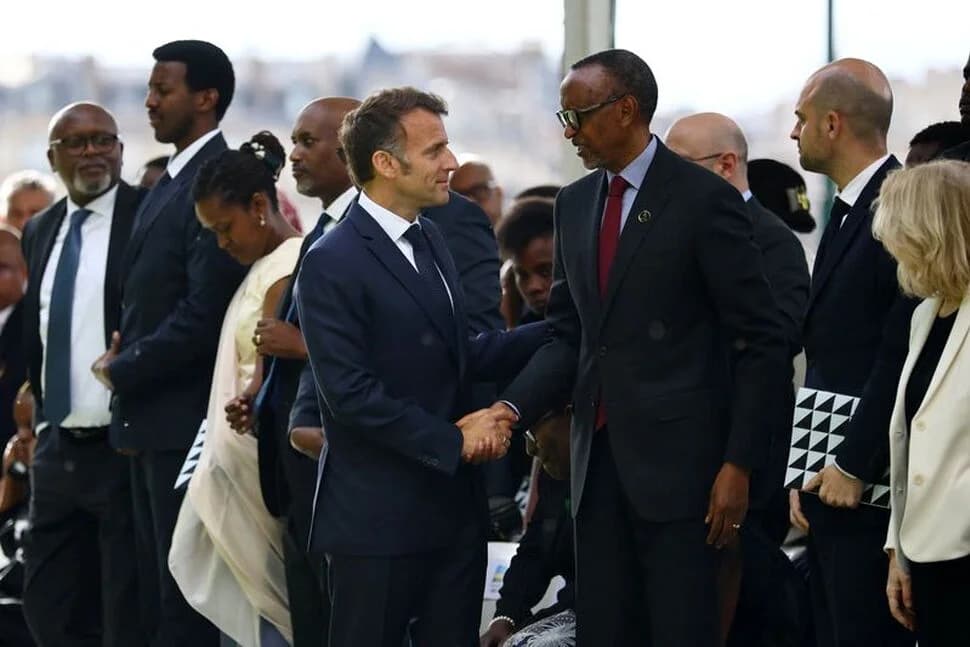
For decades, the relationship between Rwanda and France was defined by one of the most painful questions in modern African history: what did France know, and what did it do? The unveiling of "L'Archive" in Paris on Tuesday, a permanent memorial to the more than one million victims of the 1994 Genocide against the Tutsi, is the latest answer to that question. But the road that led Presidents Paul Kagame and Emmanuel Macron to the banks of the Seine was long, fractured, and at times seemingly impossible to repair. Before the genocide: France as ally To understand the rupture, you have to go b
For decades, the relationship between Rwanda and France was defined by one of the most painful questions in modern African history: what did France know, and what did it do? The unveiling of "L'Archive" in Paris on Tuesday, a permanent memorial to the more than one million victims of the 1994 Genocide against the Tutsi, is the latest answer to that question. But the road that led Presidents Paul Kagame and Emmanuel Macron to the banks of the Seine was long, fractured, and at times seemingly impossible to repair. Before the genocide: France as ally To understand the rupture, you have to go back further than 1994. During the years leading up to the genocide, France actively supported the Hutu-led government of President Juvénal Habyarimana against the Rwandan Patriotic Front, a rebel group composed largely of Tutsi exiles that launched an invasion from Uganda in 1990. France provided arms and military training to Habyarimana's forces and militias, which were among the primary instruments of the genocide that followed. When Habyarimana's plane was shot down on April 6, 1994, triggering the start of the genocide, France's deep ties to the former regime immediately made it a subject of suspicion, a suspicion that would poison relations between Paris and Kigali for three decades. The rupture: 1994 and its aftermath In June 1994, near the end of the approximately 100-day genocide, France launched Opération Turquoise, a United Nations–mandated intervention that established a humanitarian zone in southwestern Rwanda. While French authorities described the mission as an effort to protect civilians, critics argued that the zone also enabled some perpetrators of the genocide to flee into neighbouring Zaire as the RPF advanced. After the RPF took power and ended the genocide, relations between the new Rwandan government and France deteriorated steadily. Rwanda closed French schools and cultural institutions and, in a pointed symbolic move, switched the language of instruction in Rwandan schools from French to English and sought to join the British-led Commonwealth, becoming one of only two members that were not former British colonies. The lowest point came in 2006. Rwanda severed diplomatic ties with France after a French judge issued international arrest warrants for nine senior Rwandan officials suspected of involvement in the downing of President Habyarimana's plane. Kigali saw the move as an attempt to deflect attention from France's own role in the genocide. Diplomatic relations were only restored in November 2009, during a broader thaw between 2008 and 2011 that included a visit by President Sarkozy to Kigali in 2010 and a return visit by Kagame to Paris in 2011. But the core historical question, what France knew and what it failed to do, remained unanswered and unacknowledged in any official capacity. The turning point: the Duclert Commission That began to change when Emmanuel Macron came to power. In 2019, he commissioned a team of historians to do what no French government had done before: open the archives. The 15-member Duclert Commission was given unprecedented access to all French archives relating to Rwanda, covering political, diplomatic and military domains. Its 991-page report examined French responsibility over the Rwandan genocide between 1990 and 1994. The commission released its findings on March 26, 2021. While it stopped short of concluding that France was legally complicit in the genocide, it found that France bore "overwhelming responsibilities," describing its actions as "a political, institutional, intellectual, moral and cognitive failure." The report revealed that President François Mitterrand and his closest advisers knew that genocide against the Tutsi was being planned by their allies in Rwanda, and did nothing to stop it. Rwanda welcomed the findings as "an important step toward a common understanding of France's role in the Genocide against the Tutsi." Macron in Kigali: words from the source Two months after the report was published, Macron flew to Kigali, the first French president to visit Rwanda in eleven years. Standing at the Kigali Genocide Memorial, he acknowledged what no French head of state had said before: that France had failed Rwanda, had been blinded by a colonialist mindset, and that this failure had contributed to the conditions in which the genocide took place. He did not issue a formal apology. But his words, that France bore "serious and overwhelming responsibilities," were received as a meaningful act of institutional honesty. The two presidents shook hands. A new chapter, however fragile, had begun. The memorial: setting truth in stone Tuesday's inauguration took that chapter further. Designed by Berlin-based Portuguese artist Grada Kilomba, L'Archive consists of two large black brass steles mounted on a platform of volcanic lava stone, installed on the Esplanade Habib-Bourguiba along the Seine, steps from the Eiffel Tower, at the heart of the French capital. At the ceremony, Kagame did not dwell on grievances. Instead, he praised France for doing what most countries in a similar position have never done. "France was not alone in falling short, far from it," he said. "Many other countries did so as well, but none has gone as far as France in setting the record straight and accepting its part in the tragedy." Macron, for his part, reaffirmed that France would not retreat from what it had said. "I do not intend to retract any of those words. I have forgotten none of them," he said, referring to his 2021 Kigali address. He also issued a direct warning to genocide suspects still living in France: "No crime against humanity can benefit from statutes of limitation or impunity." Marcel Kabanda, president of Ibuka France, the survivors' organisation that campaigned for decades for such a memorial, described its creation as a milestone. He noted that the structure has been entered into the French National Heritage Register, meaning the state is now legally obligated to protect it in perpetuity. Where things stand Kagame acknowledged on Tuesday that not every historical dispute between the two countries has been settled. "At some points, we still have not found consensus," he said. But he called the process irreversible. Thirty-two years after the genocide, L'Archive stands not as a conclusion, but as the most concrete marker yet of how far two countries can travel from rupture toward reckoning, when political will is sustained long enough.



Comments
No comments yet. Be the first to share a thought.