
Presidents Paul Kagame and Emmanuel Macron unveiled a permanent memorial to the victims of the 1994 Genocide against the Tutsi in the heart of Paris on Tuesday, June 2, in a ceremony that brought together government officials, genocide survivors, and members of the Rwandan community. The monument, named "L'Archive," stands on the Esplanade Habib-Bourguiba along the banks of the Seine River. Designed by Berlin-based Portuguese artist Grada Kilomba, it consists of two large black brass steles mounted on a platform of volcanic lava stone. The structure's inscriptions appear in French, English,
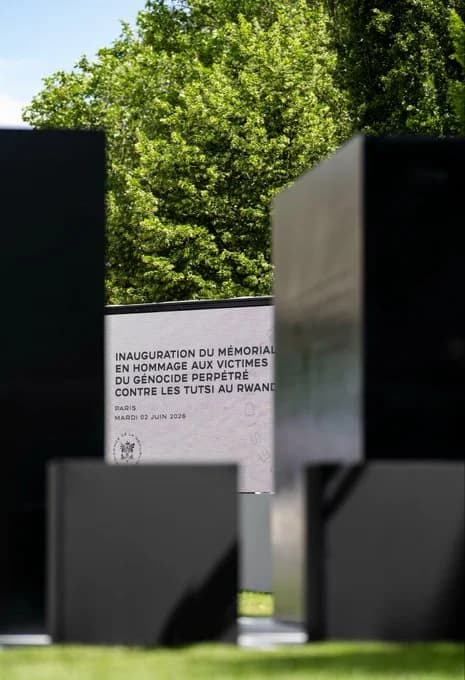
Presidents Paul Kagame and Emmanuel Macron unveiled a permanent memorial to the victims of the 1994 Genocide against the Tutsi in the heart of Paris on Tuesday, June 2, in a ceremony that brought together government officials, genocide survivors, and members of the Rwandan community. The monument, named "L'Archive," stands on the Esplanade Habib-Bourguiba along the banks of the Seine River. Designed by Berlin-based Portuguese artist Grada Kilomba, it consists of two large black brass steles mounted on a platform of volcanic lava stone. The structure's inscriptions appear in French, English, Kinyarwanda, and Swahili, and the names of four Rwandan genocide memorial sites, Nyamata, Murambi, Gisozi, and Bisesero, are engraved on it. A QR code will also be added to provide visitors with additional information about the Genocide against the Tutsi and the significance of the memorial. The information will be available in text, audio and visual formats. In his address, President Kagame said truth holds more value than a verbal apology, describing the permanent structure as a victory for historical accuracy. "The memorial sets the truth in stone and protects it from the helplessness of time," he said. While acknowledging that the international community broadly failed Rwanda during the 100 days of the 1994 Genocide against Tutsi, Kagame singled out France for going further than any other country in confronting its historical role. "France was not alone in falling short, far from it," he said. "Many other countries did so as well, but none has gone as far as France in setting the record straight and accepting its part in the tragedy." The Rwandan president also acknowledged that not all historical disagreements between the two countries have been resolved, but said the process was now irreversible. "I believe that our common work has initiated a journey towards the truth, which is irreversible," he said. Macron, for his part, issued a direct warning to individuals accused of participating in the genocide who are currently living in France. "To those who believed they had found on our soil a refuge in time or shelter in oblivion, French justice has found the means to respond," he said. "No crime against humanity can benefit from statutes of limitation or impunity." Macron also reaffirmed the position he took during his landmark 2021 visit to Kigali, where he acknowledged France's "responsibilities" in the genocide. "I do not intend to retract any of those words. I have forgotten none of them," he said. The ceremony included remarks from Paris Mayor Emmanuel Grégoire and genocide survivor Jeanne Uwimbabazi, while Franco-Rwandan musician and writer Gaël Faye read a poem by Franco-Rwandan author and genocide survivor Beata Umubyeyi Mairesse. The two presidents later attended an official dinner at the Élysée Palace. Marcel Kabanda, president of Ibuka France, described the memorial as an important milestone in preserving the memory of victims and educating future generations about the consequences of hatred and division. He also noted that the memorial has been entered into the French National Heritage Register, granting it state protection and ensuring its preservation for future generations. The inauguration comes as Rwanda continues to mark Kwibuka 32, the 32nd commemoration of the 1994 Genocide against the Tutsi, and follows several high-level engagements between the two countries in recent months, including bilateral talks on trade and regional security in the Great Lakes.



Comments
No comments yet. Be the first to share a thought.