
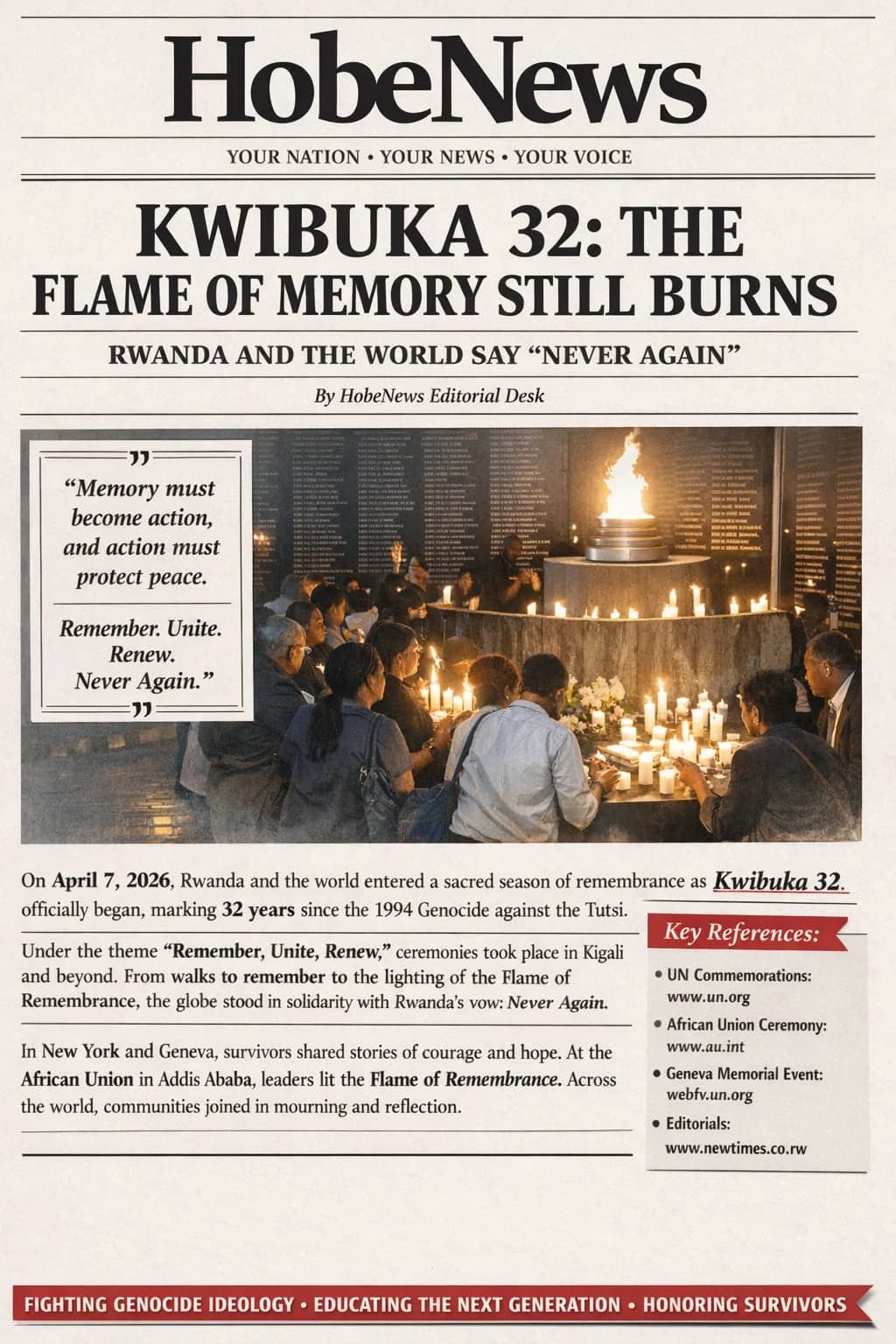
On April 7, 2026, Rwanda and the international community entered a solemn season of remembrance as Kwibuka 32 officially began, marking 32 years since the 1994 Genocide against the Tutsi in Rwanda. Under this year’s theme, “Remember, Unite, Renew,” the commemoration carries the weight of grief, the dignity of resilience, and the hope of a future safeguarded from hatred. Across Rwanda and around the world, candles were lit, tears were shared, and voices rose in unison with one enduring message: Never Again. Kwibuka is not merely an anniversary it is a living wound, a national reflection, and a
On April 7, 2026, Rwanda and the international community entered a solemn season of remembrance as Kwibuka 32 officially began, marking 32 years since the 1994 Genocide against the Tutsi in Rwanda. Under this year’s theme, “Remember, Unite, Renew,” the commemoration carries the weight of grief, the dignity of resilience, and the hope of a future safeguarded from hatred. Across Rwanda and around the world, candles were lit, tears were shared, and voices rose in unison with one enduring message: Never Again.
Kwibuka is not merely an anniversary it is a living wound, a national reflection, and a global moral responsibility. Over 100 days, Rwanda honors more than one million innocent lives lost in one of history’s darkest atrocities. Families remember loved ones who never returned, children inherit stories of names they never met, and survivors confront memories that time cannot erase. Yet within this profound pain lies one of the most remarkable narratives of human resilience: Rwanda’s journey from devastation to unity, justice, and renewal, as consistently emphasized by the United Nations in its annual commemorations.
This year’s observances began with solemn Walks to Remember, where thousands marched in silence carrying candles and flowers symbols of remembrance and shared humanity. At the headquarters of the African Union in Addis Ababa, leaders, diplomats, and members of the Rwandan diaspora gathered to light the Flame of Remembrance. This symbolic act represents lives lost, truth preserved, and a renewed commitment to vigilance. The African Union reiterated that remembrance must go beyond mourning, calling for collective action against hate speech, division, and genocide ideology wherever it appears.
At the global level, commemorations organized by the United Nations in Geneva placed survivors’ voices at the center. Through powerful testimonies, survivors and diplomats reflected on loss, courage, healing, and rebuilding. Their stories underscore a critical truth: remembrance is not about remaining in grief, but about transforming memory into action, compassion, and prevention. Coverage by United Nations Web TV highlighted these reflections, amplifying the message to a global audience.
The message of Kwibuka 32 resonated far beyond Rwanda’s borders. From diplomatic gatherings across Africa to solidarity events in Europe and other regions, the world stood united in remembrance. These global commemorations reaffirm that the 1994 Genocide against the Tutsi is not solely Rwanda’s history—it is a shared human lesson about the dangers of silence, the consequences of dehumanization, and the necessity of defending truth.
For younger generations, Kwibuka 32 carries a profound responsibility. Many were born long after 1994, yet they inherit the duty to preserve memory with dignity and courage. This year’s commemoration strongly emphasizes education, vigilance, and the rejection of hate in all its forms. Editorial perspectives from The New Times Rwanda stress that remembrance must be matched with decisive action against genocide ideology, ensuring that “Never Again” is not merely a slogan but a sustained commitment.
Rwanda’s story remains a powerful testament to the strength of reconciliation and national renewal. From the ashes of tragedy, the country has built unity; from grief, it has forged purpose. Kwibuka 32 is therefore not only a reflection on the past but a forward-looking call grounded in wisdom, vigilance, and humanity.
As the Flame of Remembrance continues to burn throughout these 100 days, it calls upon every conscience to act: memory must inspire responsibility, and responsibility must protect peace. Rwanda remembers. Africa remembers. The world remembers.
And through that remembrance, the promise endures:
Remember. Unite. Renew. Never Again.



Comments
No comments yet. Be the first to share a thought.